
Gantry vs. Goliath Cranes: Double Girder Comparison Guide
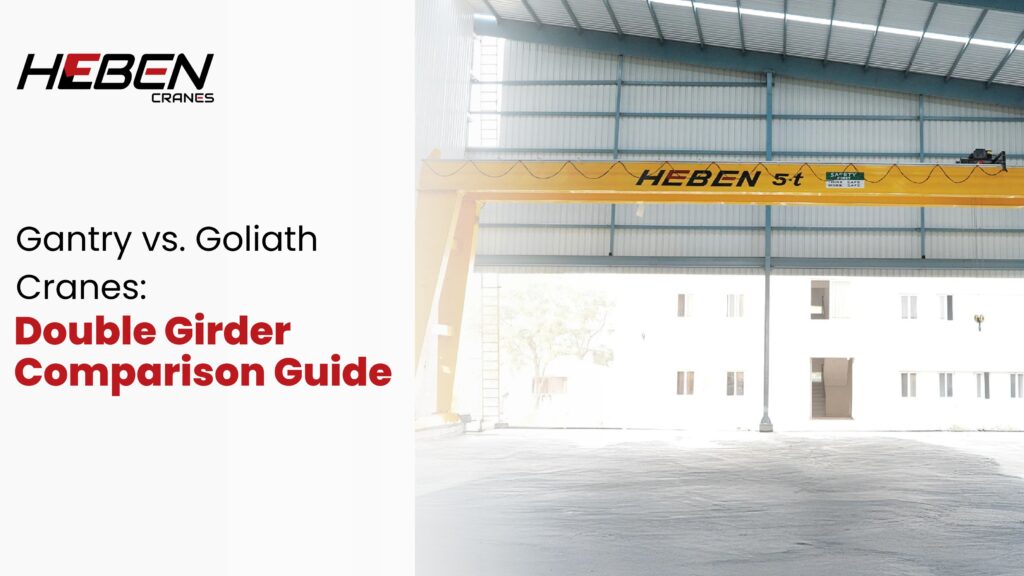
Industry terminology creates confusion that costs projects time and money. Buyers request “gantry cranes” when they need goliath capacity, or specify “goliath” for applications where standard gantry designs suffice. The terms overlap significantly—goliath cranes are essentially heavy-duty rail-mounted gantry cranes designed for extreme loads and outdoor industrial yards. This definitional blur leads to mismatched specifications, over-engineered solutions, or inadequate capacity. Understanding the structural differences, capacity ranges, double girder advantages, and application boundaries clarifies which configuration serves specific material handling needs. This guide examines terminology, design distinctions, capacity and span capabilities, mobility differences, typical applications, and decision criteria determining when each crane type delivers optimal value. Terminology and Basic Definitions Gantry cranes use bridge structures supported by legs riding on ground-level rails or wheels rather than elevated runway beams. The design ranges from portable units handling 1-5 tons to fixed rail-mounted systems managing 100+ tons. Single or double girder configurations support different capacity and span requirements. Goliath cranes represent heavy-duty gantry variants specifically designed for extreme loads, long spans, and intensive outdoor industrial service. The term typically applies to rail-mounted double girder systems exceeding 50-100 ton capacities serving shipyards, steel mills, and container terminals. Here’s the uncomfortable reality: no universal standard separates gantry from goliath terminology. Some manufacturers use “goliath” for any double girder rail-mounted gantry regardless of capacity. Others reserve it for systems exceeding 200-300 tons. Regional and industry practices vary significantly. Double Girder Configuration Advantages Single girder gantry cranes handle lighter loads economically through simplified construction. The hoist hangs beneath one main beam, limiting capacity to roughly 20-30 tons and spans under 65 feet. Cost advantages and faster installation suit workshops and light manufacturing. Double girder designs use two parallel beams supporting the trolley and hoist riding atop the bridge. This structure enables 50-1000+ ton capacities, spans exceeding 150 feet, and superior stability under heavy loads. Maximum hook height results from hoist positioning above girders rather than hanging beneath. Duty classification capabilities differ significantly. Single girder suits Class A3-A5 light to moderate service. Double girder construction accommodates Class A6-A8 heavy to severe duty cycles common in steel production, shipbuilding, and container handling. Double Girder Benefits Load capacity scaling from 50 to 1000+ tons for extreme applications Span lengths exceeding 150 feet without excessive deflection Hook height optimization from top-running hoist configurations Structural rigidity supporting intensive multi-shift operations Capacity and Span Differences Standard gantry cranes typically range 1-100 tons covering workshop material handling, construction site applications, and moderate industrial service. Portable models stay under 10 tons for mobility and manual positioning. Fixed rail-mounted gantries reach 50-100 tons before transitioning to goliath classifications. Goliath cranes start where standard gantries end—50-100 tons minimum extending to 1000+ tons for specialized shipbuilding and offshore construction applications. The heavy construction, reinforced leg structures, and robust rail systems support extreme loads and intensive duty cycles. Span capabilities distinguish applications clearly. Gantry cranes economically cover 20-80 foot spans for typical workshop and yard widths. Goliath designs routinely span 100-200+ feet across shipbuilding docks, steel storage yards, and container terminals requiring maximum coverage. Mobility and Installation Options Portable gantry cranes use rubber wheels or adjustable legs enabling manual repositioning without permanent rail installation. Capacities stay under 5-10 tons due to stability limitations. The flexibility suits construction sites, maintenance shops, and facilities needing occasional lifting in varied locations. Rail-mounted systems provide higher capacity through fixed installation and robust foundation support. Standard gantries use lighter rail systems adequate for moderate loads. Goliath installations require heavy-duty rails, reinforced foundations, and careful alignment supporting extreme loads and preventing track damage. Semi-gantry configurations combine one elevated runway beam with one ground rail, using building structure to support one side. This hybrid approach suits facilities with adequate wall or column structure on one side and open area requiring coverage on the other. Capacity and span limitations fall between portable and full gantry/goliath systems. Application Distinctions Gantry cranes serve workshops, fabrication shops, light manufacturing, and construction sites handling moderate loads in controlled environments. Indoor installations dominate. Outdoor use typically involves temporary construction applications rather than permanent industrial yards. Goliath cranes define heavy outdoor industrial operations: shipyards assembling vessel sections, steel mills moving coils and structural components, container terminals stacking cargo, precast concrete yards handling large elements, and heavy equipment manufacturing. The robust construction withstands weather exposure, temperature extremes, and intensive continuous service. The contrarian insight buyers miss: calling a 75-ton outdoor rail-mounted crane “goliath” versus “heavy-duty gantry” changes nothing functionally but often adds 15-25% cost through perceived premium positioning. Focus specifications on actual requirements—capacity, span, duty class, environmental protection—rather than accepting terminology-driven pricing. Selection Criteria and Decision Guide Capacity requirements under 50 tons generally suit standard gantry designations. Loads exceeding 100 tons definitively require goliath-class construction. The 50-100 ton middle zone depends on span, duty cycle, and environmental factors. Span needs under 80 feet fit standard gantry economics. Spans exceeding 120 feet favor goliath structural designs minimizing deflection and ensuring stability. Moderate spans of 80-120 feet require evaluation based on load, duty class, and total cost factors. Duty classification determines structural requirements independent of terminology. Class A6-A8 intensive operations demand double girder goliath construction regardless of capacity. Lighter duty cycles may function adequately with standard gantry designs even at higher capacities. Environmental exposure drives weatherproofing requirements. Permanent outdoor installations need corrosion protection, sealed electrical systems, and wind-resistant designs typical of goliath specifications. Indoor or sheltered operations function with lighter protection levels. Frequently Asked Questions Is goliath crane terminology standardized across manufacturers? No universal standard defines the gantry-to-goliath transition point. Some manufacturers apply “goliath” to any rail-mounted double girder gantry over 50 tons. Others reserve it for 200+ ton specialized systems. Focus procurement specifications on technical requirements (capacity, span, duty class) rather than terminology to ensure accurate proposals and pricing comparability. When does double girder become necessary versus single girder? Double girder becomes practical above 20-30 ton capacities, spans exceeding 65 feet, or duty classifications above A5 moderate service. The structural advantages—higher capacity, longer spans, maximum hook height, heavy-duty construction—justify premium costs through superior performance
Single Girder Crane Components: Key Parts & Accessories

Most buyers spec a single girder crane by capacity and span. They assume all 10-tonne cranes are identical. Two years later, the hoist motor burns out, the trolley wheels develop flat spots, and the wire rope shows premature strand breaks. The crane was built to price, not to duty cycle. This guide explains the component-level decisions that separate a reliable single girder crane from one that stops production. You’ll learn which parts fail first, why standard configurations create hidden costs, and how to specify components that match your actual operating conditions. Structural Framework: The Foundation of Load Distribution The main girder carries the load across the bay. Single girder cranes use I-beams or welded box sections. I-beams suit light-duty applications under 5 tonnes. Box girders handle heavier loads and longer spans because they distribute stress more evenly. End carriages mount at each end of the girder. They house the wheel assemblies, bearings, and long-travel drive motors. Poor end carriage design creates wheel load concentration. This leads to uneven wear on runway rails and premature bearing failure. Runway beams support the crane. Rail alignment must stay within ±5 mm over the full span. Misalignment causes the crane to skew during travel. Skewing increases wheel wear by 40-60% compared to properly aligned systems. Hoist Unit: Where Most Failures Begin The hoist lifts the load. It includes a motor, gearbox, drum or chain wheel, rope or chain, and hook block. Here’s what buyers miss: the hoist is the highest-failure component in any overhead crane system. Wire rope hoists suit lifting heights above 12 meters and capacities above 5 tonnes. Chain hoists work for lighter loads and shorter lifts. Chain hoists have lower failure rates because they don’t suffer from slack rope issues that cause wire rope to jump sheaves. Duty Class Mismatch: The Silent Killer A 5-tonne hoist rated M3 (light duty) looks identical to a 5-tonne hoist rated M5 (medium duty). The M3 hoist is designed for 500 lift cycles per year. The M5 hoist handles 5,000 cycles. If your operation runs two shifts with 20 lifts per shift, you’re doing 10,000 cycles annually. An M3 hoist will fail within 18 months. The motor overheats, the brake linings wear through, and the gearbox bearings collapse under sustained load. Trolley System: Cross-Travel Precision The trolley carries the hoist along the girder. It uses wheels that roll on the bottom flange of the I-beam or inside the box girder. Trolley wheels need hardened treads. Soft wheels develop flat spots after 6-12 months of daily use. Cross-travel drives move the trolley. Direct-on-line starters give on/off control. VFD-driven systems provide smooth acceleration and deceleration. VFDs reduce mechanical shock by 70%, extending rope life and reducing load swing. Trolley alignment matters. If the wheels aren’t parallel, the trolley will crab sideways. This creates binding, motor overload, and uneven wheel wear. Long-Travel Drive: Bridging the Bay Long-travel motors move the entire crane along the runway. Most single girder cranes use a single-motor drive on one end carriage. This creates a torque imbalance that must be managed through wheel diameter matching and careful rail alignment. Wheel assemblies include the wheel, bearing block, and axle. Bearing failure is the second most common mechanical problem after hoist issues. Sealed bearings last 3-5 times longer than open bearings in dusty or outdoor environments. End stops and buffers prevent over-travel. Spring buffers absorb impact. Hydraulic buffers provide smoother deceleration at high speeds. Missing or damaged buffers allow the crane to hit the end wall at full speed. This bends the girder and cracks welds. Electrical System: The Overlooked Weakness Power delivery uses DSL busbar systems or cable reels. Busbars suit cranes that travel frequently. Cable reels work for short-span or infrequent-travel applications. Control panels house contactors, inverters, and protection devices. Here’s what audits reveal: loose terminals are the leading cause of intermittent electrical failures. Vibration loosens connections over time. Increased resistance generates heat. Heat accelerates insulation breakdown. Cable aging is invisible until it fails. Cables exposed to heat, oil, or repeated bending lose insulation performance. The outer jacket looks fine. Inside, the copper strands are corroding. A short circuit happens mid-lift with a load suspended. Control Types and Operator Interface Pendant push-button stations hang from the crane. They work for applications where the operator follows the load. Radio remote controls allow operators to position themselves for better visibility and safety. VFD-based controls reduce energy consumption by 30-40% compared to contactor systems. They also eliminate motor inrush current, reducing peak demand charges and extending motor life. Safety Devices: Protection That Actually Protects Limit switches stop motion at defined points. Hoist up-limit prevents two-blocking (hook hitting the trolley). Hoist down-limit prevents rope from unspooling off the drum. Travel limits prevent collision with end stops or adjacent cranes. Brakes hold the load when power cuts off. Single girder cranes need three independent brake systems: hoist brake, cross-travel brake, and long-travel brake. Cheap suppliers skip the travel brakes to save cost. The crane drifts when stopped on an incline or in wind. Overload protection prevents lifting beyond rated capacity. Load cells provide accurate measurement. Torque limiters on the hoist motor offer simpler, less precise protection. Either system must shut down the hoist before structural damage occurs. Maintenance Reality: Preventive vs Reactive Factories with structured maintenance programs experience 60% fewer unplanned shutdowns than those using reactive repair strategies. The gap comes from component-specific inspection intervals. Wire rope needs visual inspection every 100 operating hours. Brake adjustment happens every 500 cycles. Bearing lubrication occurs every 1,000 hours. Skipping these tasks doesn’t show immediate consequences. It compounds over 12-18 months until multiple systems fail simultaneously. Critical spares to stock: brake linings, contactors, rope guides, bearings, and wheels. Lead time for these parts ranges from 2-8 weeks if ordered on failure. Stocking them costs less than one day of crane downtime. How Heben Cranes Selects Components Heben designs single girder cranes by matching hoist duty class, trolley drive, and structural profile to your shift schedule, lift frequency, and load spectrum.
Top Running vs. Underhung Cranes: Key Differences Guide
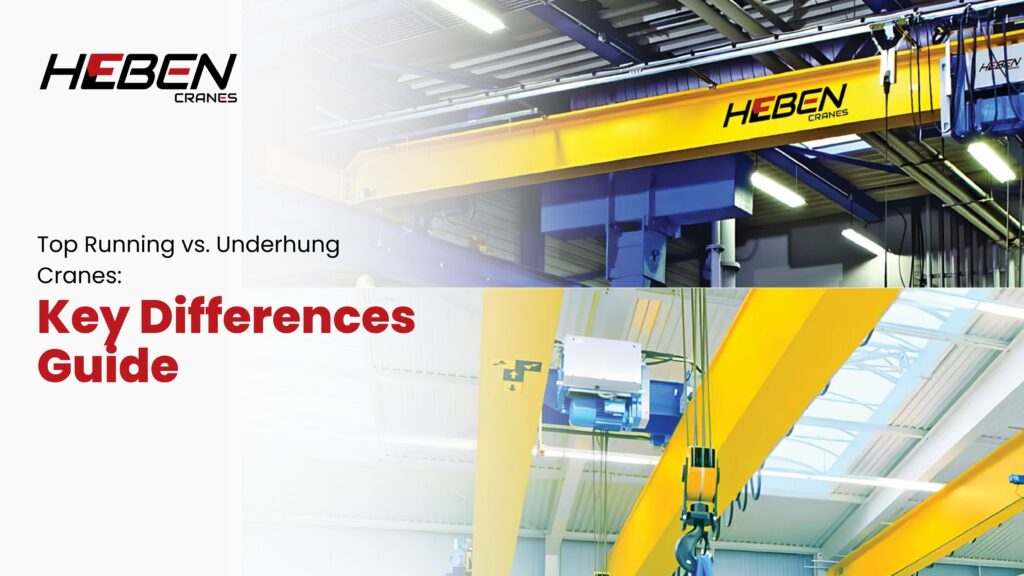
Introduction Your facility needs an overhead crane, and the choice between top running and underhung configurations determines capacity limits, building modifications, and long-term operational costs. Most buyers select based on initial price or available headroom without understanding how structural design affects load capability and maintenance access. Top running cranes ride on top of runway beams and handle heavy loads across long spans. Underhung cranes suspend from the bottom flange of beams and suit lighter loads in compact spaces. This guide covers structural differences, capacity ranges, installation requirements, operational factors, and a selection framework to match crane type to your actual facility constraints and load patterns. How Top Running Cranes Work Top running cranes position the bridge structure on top of runway beams mounted to building columns. The end trucks contain wheels that travel along the top surface of these beams. This configuration places the entire crane weight and load above the runway support system. Single girder top running cranes handle loads up to 20 tons with one main beam. Double girder configurations support 20-500+ tons using two parallel beams with the hoist trolley riding on top. The design provides maximum hook height between the hoist and floor level. Typical spans reach 10-45 meters, with specialized applications extending beyond 45 meters. The elevated position delivers superior lifting height but demands robust building structure to support concentrated loads at column points. How Underhung Cranes Work Underhung cranes suspend the bridge from the bottom flange of runway beams. The crane hangs below the support structure rather than riding on top. Wheels or rollers travel along the beam’s lower surface, with the hoist suspended further below. This configuration typically limits capacity to 3-10 tons for standard industrial applications. Some heavy-duty underhung systems reach 20 tons, but beyond this threshold top running designs prove more practical. The suspended structure reduces building load concentration at column points.Spans generally range from 3-15 meters, though applications occasionally extend to 25 meters. The hanging design consumes more vertical space between beam and floor, reducing available hook height compared to top running alternatives. Structural Differences That Matter Top running systems require runway beams engineered for crane wheel loads concentrated at specific points. Building columns must withstand vertical and horizontal forces from acceleration, braking, and load swinging. The infrastructure cost increases with capacity and span. Underhung systems distribute loads differently across existing building beams. Many installations use standard roof structure without major reinforcement. The hanging configuration often integrates into facilities where top running installation would require prohibitive structural modifications. Headroom represents the critical trade-off. Top running cranes maximize lifting height by positioning the hoist near ceiling level. Underhung cranes consume vertical space, reducing the distance between hook and floor. A facility with 6 meters of clear height might achieve 5.5 meters of hook height with top running but only 4.5 meters with underhung configuration. Capacity and Span Capabilities Top running cranes dominate heavy-duty applications from 20 tons upward. The structural design handles concentrated loads and dynamic forces from multi-ton lifts. Double girder configurations serve steel mills, heavy manufacturing, and power plants where 50-200 ton capacities are routine. Underhung cranes suit workshops, assembly operations, and material handling under 10 tons. The lighter capacity range matches applications where precision positioning matters more than raw lifting power. Many facilities run multiple underhung cranes on shared runway beams for flexible coverage. Here’s the pattern most facilities miss: they choose underhung systems to avoid building modifications, then discover the capacity and span limits force operational compromises that cost more than proper runway installation would have. Load planning should drive crane selection, not installation convenience alone. Installation and Building Requirements Top running installation demands engineered runway beams mounted to building columns at precise elevations. Alignment tolerances of 3-5mm across the entire span prevent premature wheel wear and tracking problems. Column reinforcement often adds 15-25% to total project cost. Underhung systems typically mount to existing roof beams or purpose-built support structures. Installation happens faster with less structural intervention. Some facilities add underhung cranes without production downtime by working above active floor operations. Cost factors extend beyond initial installation. Top running systems cost 30-50% more upfront but deliver greater capacity and operational flexibility. Underhung cranes save installation expense but limit future load increases and span extensions. Maintenance and Operational Factors Top running cranes provide easier access to end trucks, wheels, and drive components. Maintenance crews reach critical wear points from catwalks or maintenance platforms at runway level. Component replacement happens faster with better access. Underhung systems offer superior tracking stability. The suspended design resists lateral forces and maintains alignment through building movement or thermal expansion. Facilities with marginal runway installation often experience better performance from underhung configurations. Downtime patterns differ between types. Top running cranes need more frequent wheel and drive maintenance due to concentrated loads. Underhung systems require trolley and suspension point inspection but typically run longer between major service intervals in light-duty applications. Applications and Use Cases Top running cranes serve heavy manufacturing, steel fabrication, automotive assembly, and aerospace facilities. These environments need maximum capacity, long spans, and the ability to position heavy loads precisely. The infrastructure investment pays off through operational capability. Underhung cranes fit machine shops, warehouses, electronics assembly, and general manufacturing under 10 tons. The compact design works in buildings with limited headroom or inadequate structure for top running installation. Multiple underhung units provide flexible material flow patterns. Some facilities use both types strategically. Heavy top running cranes handle primary production loads while lighter underhung units serve assembly stations and secondary work areas. The hybrid approach optimizes infrastructure investment against operational needs. How to Choose the Right Configuration Step 1: Define Load Requirements Document maximum load, typical load range, and lift frequency. Calculate whether your application falls within underhung capacity limits or demands top running capability. Include safety margins and future growth projections. Step 2: Measure Building Constraints Assess column spacing, available headroom, and existing structure capacity. Determine if your building supports top running loads or requires underhung approach. Consider ceiling height and
Single Girder Gantry Crane: Specs, Types, and Use Cases

Introduction Many facilities need lifting capacity where buildings offer no overhead support. Construction sites, outdoor yards, warehouses without adequate roof structure—these spaces demand material handling equipment that brings its own support system. Single girder gantry cranes solve this through independent leg structures that operate without building attachment. They handle 0.5 to 32 tons across spans up to 35 meters, cost 30-40% less than double girder alternatives, and install in days rather than weeks. This guide examines specifications, structural variants, mobility options, application patterns, and selection criteria that determine whether single girder gantry design fits your operational requirements. Basic Specifications and Technical Parameters Capacity ranges from 0.5 to 32 tons for standard single girder gantry configurations. Most industrial applications cluster between 3 and 16 tons. Span capabilities reach 5 to 35 meters. The girder structure determines maximum practical span—beyond 25 meters, deflection concerns typically favor double girder construction. Lifting height varies from 3 to 30 meters depending on leg length and hoist specifications. Most installations use 6-12 meter heights suited to outdoor storage and light manufacturing. Operating speeds include: Lifting: 0.5-8 meters per minute Cross-travel (trolley): 2-20 meters per minute Long-travel (gantry movement): 3-30 meters per minute Duty classes: A3 to A5 for light to moderate use Structural Design and Components The single girder beam supports an electric wire rope hoist or chain hoist that travels along the bottom flange. This positioning keeps overall height low compared to top-running trolley designs. Leg structures come in three primary configurations: A-frame legs: Equal height supports on both sides, suited to level ground and symmetrical load L-type legs: One side flush with the girder edge, maximizing usable width beneath the crane C-type legs: Inverted design placing legs outside the wheel base, allowing vehicles or equipment to pass through Cantilever extensions add working area beyond the legs. Standard cantilevers extend 0.5-2 meters, though this reduces effective capacity due to leverage. Types of Single Girder Gantry Cranes Full Gantry Design Both ends supported by independent legs traveling on ground-level rails. This configuration provides complete mobility within the rail system without requiring building structure. Semi-Gantry Design One side runs on building runway while the opposite side travels on ground legs. Semi-gantry suits facilities with partial overhead support or constrained width. Portable and Mobile Variants Smaller capacity units (0.5-5 tons) mount on wheels or casters for repositioning without fixed rails. These serve maintenance shops, fabrication areas, and temporary work zones. Structural Options Box girder construction provides torsional rigidity and weather resistance. Truss girder reduces weight for lighter loads but requires more maintenance in outdoor environments. Mobility and Configuration Rail-mounted systems use fixed track for precise positioning and heavy-duty cycles. Rails embed in concrete or mount to grade beams supporting 15-20 year service life. Rubber-tired gantries offer repositioning flexibility. Pneumatic or solid rubber wheels suit uneven surfaces and temporary installations though load capacity drops 20-30% compared to rail systems. Control methods determine operator effectiveness: Pendant controls: wired connection for close operator proximity Radio remote: wireless operation from optimal viewing positions Cabin controls: enclosed operator station for weather protection Applications and Industry Use Cases Construction sites use gantry cranes for steel erection, concrete panel placement, and equipment positioning where tower cranes prove impractical. Outdoor storage yards—lumber, steel stock, precast concrete—benefit from weather-resistant designs that handle materials across large areas without building investment. Shipyards deploy gantries for hull fabrication, outfitting work, and launching operations. Capacity requirements often exceed 20 tons with specialized rigging attachments. Railway maintenance facilities service rolling stock and track components. Long span gantries cover multiple rail lines simultaneously. Manufacturing applications include steel fabrication shops, heavy equipment assembly, and foundry operations requiring flexible coverage without overhead restrictions. Advantages and Limitations Cost advantages reach 35-45% below equivalent overhead bridge crane systems when building structure cannot support runway installation. Installation happens rapidly. Ground rail preparation and crane assembly complete in 3-7 days versus 3-6 weeks for building-mounted alternatives. Mobility allows repositioning. Rail-based systems relocate to new areas within days. Portable units move between job sites or facility areas without infrastructure investment. Capacity limits appear around 32 tons. Beyond this, structural requirements favor double girder design for stability and deflection control. Wind loading becomes critical in outdoor installations. Cranes require anchoring systems, rail clamps, or tie-downs when wind speeds exceed operating limits. Selection and Customization Factors Load characteristics determine capacity specification. Account for rigging equipment weight, dynamic loading during movement, and occasional oversize items requiring 125-150% of typical capacity. Span selection balances coverage area against structural cost. Each additional meter of span adds 3-5% to crane cost while reducing maximum safe working load slightly. Environmental factors influence design details: Outdoor exposure: weatherproof electrical components, corrosion-resistant coatings Temperature extremes: lubricant selection, material specifications Dust or chemical exposure: sealed controls, protective enclosures Ground conditions affect rail installation. Soft soil requires deeper foundations. Uneven terrain favors adjustable leg heights. FAQs Q: What ground preparation does rail-mounted gantry require? A: Rails need level concrete foundation or embedded steel beams capable of supporting crane weight plus maximum load. Typical foundation depth runs 300-600mm depending on soil conditions. Q: Can single girder gantry cranes operate in high winds? A: Operating limits typically range 20-28 km/h wind speed. Non-operating storm anchoring resists winds up to 150 km/h. Installations in exposed areas need wind monitoring systems. Q: How does capacity change with span and cantilever? A: Each meter of span beyond 15 meters reduces capacity by approximately 5%. Cantilever extensions reduce capacity by 10-15% per meter of overhang due to leverage effects. Q: What maintenance intervals apply to outdoor gantry cranes? A: Weekly visual inspection of rails, wheels, and structural connections. Monthly lubrication of travel mechanisms and wire ropes. Annual comprehensive inspection by qualified technicians. Q: Can I add a second hoist to existing single girder gantry? A: Rarely practical. The single beam lacks capacity for dual hoists. Applications requiring multiple lifting points need double girder design from initial specification. Conclusion Single girder gantry cranes provide mobile lifting capacity from 0.5 to 32 tons where building structure cannot support
Top Jib Cranes Supplier in Chennai
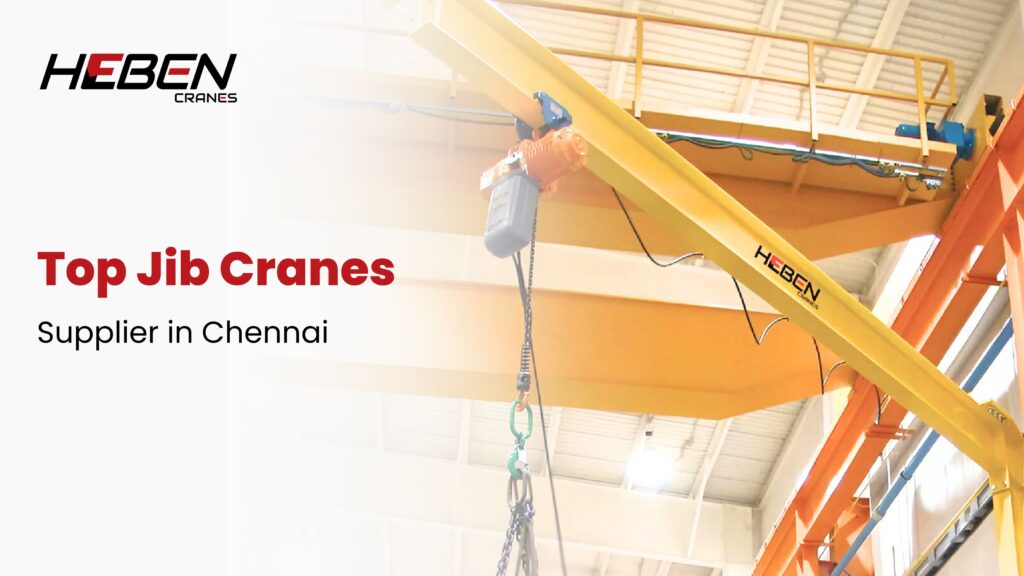
Chennai workshops run main overhead cranes at full capacity. The EOT crane moves large assemblies across the bay. But smaller jobs wait. A machinist needs to load a 500 kg fixture onto a CNC bed. The welder needs a tool from storage. The assembly team needs a component from the staging area. They wait for the main crane. Or they lift manually. Both options cost time, create bottlenecks, and increase injury risk. A jib crane solves this by giving each workstation its own lifting capacity, independent of the main system. This guide explains how to select a Chennai supplier who understands the technical, structural, and operational requirements of jib crane installations. What Jib Cranes Do in Industrial Workstations A jib crane consists of a vertical mast, a horizontal boom, and a hoist that travels along the boom. The boom rotates around the mast. This creates a circular lifting zone at each workstation. Pillar-mounted jib cranes stand on the floor with a foundation. They rotate 360 degrees. Wall-mounted jib cranes bolt to existing columns or structural walls. They rotate 180 to 200 degrees. Both types eliminate the need to wait for the main crane. Studies show workstation cranes increase productivity by 27-28% compared to manual handling or traditional I-beam systems. The time savings come from faster load positioning, reduced travel distance, and continuous availability. Why Chennai Factories Install Jib Cranes Chennai’s automotive component shops, machine tool units, and fabrication workshops operate in bays where the main EOT crane serves multiple stations. A single crane cannot handle simultaneous lifting at five or six workstations. Jib cranes decentralize the lifting. Each machining center gets its own crane. Each welding bay gets its own crane. Each packing station gets its own crane. The main overhead crane handles large transfers between zones. The jib cranes handle repetitive, localized tasks. This separation increases throughput. It also reduces operator fatigue and musculoskeletal injuries from manual lifting. Chennai’s labor laws and safety audits now penalize repetitive manual handling of loads above 20 kg. Jib cranes eliminate compliance risk. The Hidden Problem with Cheap Jib Crane Suppliers Most buyers focus on boom length and capacity. They ignore the mast design, foundation calculations, and rotation mechanism quality. A 2-tonne jib crane looks identical whether it’s built to 1,000 lift cycles or 10,000 lift cycles. Undersized bearings fail within six months. Poorly welded mast joints crack under repeated slewing. Electric hoists without overload protection burn out when operators exceed rated capacity. These failures stop production at the exact workstation the crane was meant to serve. Chennai suppliers who import catalogue jib cranes cannot modify boom length, rotation angle, or hoist specifications. If your column spacing is 4.8 meters and the catalogue offers 4 meters or 5 meters, you either waste reach or create interference. Custom engineering matters. Pillar-Mounted vs Wall-Mounted: The Choice Most Get Wrong Buyers assume wall-mounted cranes save money because they skip the foundation. This is true only if your building columns can handle the loads. A 2-tonne jib crane with a 4-meter boom generates significant bending moment at the wall bracket. Chennai’s older industrial sheds use 200 mm x 200 mm columns. They cannot support a 2-tonne wall jib without reinforcement. You’ll spend on column strengthening what you saved on the foundation. Pillar-mounted jib cranes are structurally independent. They require a small concrete pad but can be placed anywhere in the bay. They offer 360-degree rotation, which covers four workstations in a square layout. Wall-mounted cranes offer 180 degrees, covering only two stations. Choose wall-mounted for light loads (under 500 kg), short booms (under 3 meters), and wall-adjacent workstations. Choose pillar-mounted for heavier loads, longer reach, and multi-station coverage. Technical Specifications That Separate Quality Suppliers Capacity ranges in Chennai installations run from 125 kg to 5,000 kg. Most machine shops need 500 kg to 2,000 kg. Foundries and heavy fabrication need 3,000 kg to 5,000 kg. Boom length determines the work radius. Standard lengths are 3, 4, 5, and 6 meters. Custom lengths matter when existing columns, machines, or storage racks define the workspace geometry. Rotation and Slewing Mechanism Manual slewing works for infrequent lifts (under 20 per shift). Motorized slewing is essential for high-frequency operations (over 50 lifts per shift). Ball bearing slewing rings reduce friction and extend service life. Plain bearings wear quickly under heavy use. Limit switches prevent over-rotation and cable damage. This feature is mandatory for motorized jibs. Many cheap suppliers skip it to cut costs. Hoist Selection Electric chain hoists suit Chennai’s typical 500 kg to 2,000 kg range. Wire rope hoists handle heavier loads and longer lifting heights. The hoist must match the jib’s duty class. A heavy-duty jib with a light-duty hoist creates a mismatch that shortens component life. Installation and Structural Considerations Pillar jib cranes need foundation design. The supplier must provide anchor bolt layout, concrete grade specification, and curing time before erection. Skipping the structural drawing leads to misalignment and vibration. Wall-mounted jibs need column load verification. The supplier should visit the site, measure the column section, check the existing foundation, and calculate the bracket fixation. Drilling into columns without structural analysis can compromise building safety. Electrical routing matters. Pendant cables must reach the operator’s position without creating trip hazards. Festoon systems keep cables organized on long booms. Radio remote controls eliminate cable wear but add cost. After-Sales Service in Chennai’s Industrial Zones Jib cranes operate daily. Bearings need greasing every 500 cycles. Hoist brakes need inspection every 3,000 lifts. Wire ropes need replacement based on visible wear. A supplier with service teams in Chennai’s Ambattur, Guindy, or Sriperumbudur industrial areas can respond within hours. Suppliers based outside Tamil Nadu cannot. Downtime at a CNC workstation costs more per hour than the service call. Spare parts availability determines long-term reliability. Hoists, trolleys, and electrical panels should be standard Indian makes. Imported components create lead times of 6-8 weeks when they fail. How Heben Cranes Delivers for Chennai Buyers? Heben designs pillar and wall-mounted jib cranes from 250 kg
Energy-Efficient Cranes for Sustainable Material Handling
Industrial cranes consume 3-7% of total facility electricity in typical manufacturing plants, yet most operators treat this as fixed overhead rather than controllable expense. Here’s the data that shifts perspectives: facilities running multi-shift operations waste 30-40% of crane energy through resistance braking, oversized motors, and inefficient drives that convert electricity into heat rather than useful work. Energy-efficient crane technology cuts consumption 25-50% through variable frequency drives, regenerative braking, high-efficiency motors, and smart controls. This translates to measurable reductions in operating costs, carbon footprint, and thermal load on facility cooling systems. This guide examines the technologies enabling efficient material handling, their operational benefits, specification criteria, and the business case beyond environmental compliance. What Makes Cranes Energy-Efficient Energy efficiency in cranes means delivering required lifting, travel, and positioning performance while minimizing electrical consumption per operating cycle. Traditional resistance-controlled cranes waste significant power through braking resistors that dissipate kinetic energy as heat during each stop. Modern efficient cranes integrate four key elements: high-efficiency motors rated IE3 or IE4, variable frequency drives controlling all motions, regenerative braking recovering energy during lowering and deceleration, and optimized structural design reducing deadweight requiring less power to move. Duty cycle intensity determines actual energy impact. Cranes running intensive operations with frequent starts, stops, and load changes show greater efficiency gains from advanced technology than occasional-use equipment. A foundry crane cycling 40 times hourly benefits more from regenerative systems than a maintenance crane lifting twice daily. Variable Frequency Drives VFDs control motor speed electronically rather than through mechanical contactors and resistors. This enables soft starts reducing inrush current by 60-70%, gradual acceleration minimizing mechanical shock, precise speed control improving positioning accuracy, and controlled deceleration that can recover energy. Traditional resistance-controlled cranes draw full starting current every cycle, creating demand charges and heating equipment. VFDs limit current draw to actual load requirements, cutting peak demand and reducing motor stress. The contrarian insight most facilities miss: VFD cost premiums of 15-20% recover within 2-4 years through energy savings alone in multi-shift operations, ignoring additional benefits of reduced maintenance, extended component life, and improved process control. VFD Efficiency Gains 20-35% reduction in total energy consumption vs resistance controls 60-70% lower starting current reducing demand charges Smooth acceleration extending mechanical component life 40-50% Precise speed control enabling faster safe cycle times Regenerative Braking Systems Conventional braking converts kinetic energy into heat through resistor banks, wasting the potential to recover power invested in accelerating loads. Regenerative systems reverse this process, using motors as generators during lowering and deceleration. Energy flows back to facility electrical systems, offsetting consumption by other equipment or feeding directly to the grid where regulations permit. Facilities with multiple cranes, heavy loads, and high lift heights see the greatest benefit—recovered energy can reach 15-30% of total crane consumption. Steel mills, container terminals, and scrap handling operations report 20-40% energy reductions combining VFDs with regenerative capability. The technology proves most effective when lowering loaded hooks and decelerating heavy bridge or trolley motions rather than just controlling hoist descent. Power electronics convert recovered AC motor output to DC, then invert back to AC matching facility electrical characteristics. Modern regenerative drives integrate this seamlessly, requiring minimal additional equipment beyond standard VFD installations. High-Efficiency Motors and Drives Motor efficiency ratings (IE1 through IE4) represent losses converting electrical input to mechanical output. IE3 motors reduce losses 15-20% compared to older IE1 standards, while IE4 premium efficiency motors gain another 15% improvement. Helical-bevel gearboxes offer 92-96% efficiency versus 75-85% for older worm-gear designs. This difference compounds across hoist, trolley, and bridge drives, creating significant cumulative savings in multi-axis crane systems. Smart motor controllers optimize torque delivery, adjust performance based on load sensing, and prevent unnecessary operation when cranes sit idle. These features add marginal cost but deliver measurable consumption reductions. Power Distribution and System Losses Busbar conductor systems reduce resistive losses 30-50% compared to trailing cable power delivery. The lower resistance path decreases I²R heating losses, maintains voltage stability under load, and eliminates cable wear requiring frequent replacement. Properly sized conductors matching actual load requirements prevent oversizing waste while ensuring adequate capacity. Undersized systems create voltage drops degrading motor performance and wasting energy as heat in conductors. Installation layout affects efficiency. Shorter power paths, minimized joints and connections, and strategic transformer placement all reduce cumulative losses in large crane systems. Operational Practices for Efficiency Equipment capability means little without operational discipline. Operators leaving cranes energized during extended breaks waste power on controls, lighting, and auxiliary systems. Smart facilities implement automatic idle shutdown after preset intervals. Load management reduces unnecessary movements. Combining multiple small lifts into single optimized cycles, planning travel paths minimizing empty travel distance, and staging materials efficiently all cut energy consumption 10-20% without equipment changes. Maintenance condition directly affects efficiency. Worn bearings increase friction, misaligned wheels create drag, and dirty electrical contacts raise resistance. Systematic maintenance sustains design efficiency levels that degrade 15-25% over time without proper care. Specification and Selection Criteria Request regenerative braking specifications including power recovery capacity, grid-feed capability, and any utility coordination requirements. Not all “regenerative” systems provide equal performance—some dump recovered energy to resistors rather than returning usable power. Verify motor efficiency ratings meet IE3 minimum standards with IE4 options for high-cycle applications. Require documentation proving ratings rather than accepting generic efficiency claims. Demand energy consumption estimates based on actual duty cycle specifications: lifts per hour, average load percentages, travel distances, and operating hours. Generic consumption figures based on nameplate ratings mislead badly for facilities with specific operational patterns. Include monitoring and measurement capability enabling ongoing consumption tracking, comparison against baselines, and identification of degradation or operational inefficiencies. Frequently Asked Questions Q: How much can energy-efficient cranes actually reduce electricity costs? A: Facilities report 25-50% energy consumption reductions when replacing resistance-controlled cranes with VFD and regenerative systems. Actual savings depend on duty cycle intensity, load characteristics, and operational practices. High-cycle operations see greater absolute savings than occasional-use equipment, typically recovering technology premiums within 2-5 years through energy cost reductions alone. Q: Does regenerative braking work with existing facility electrical
Best Goliath Cranes Supplier in Ahmedabad
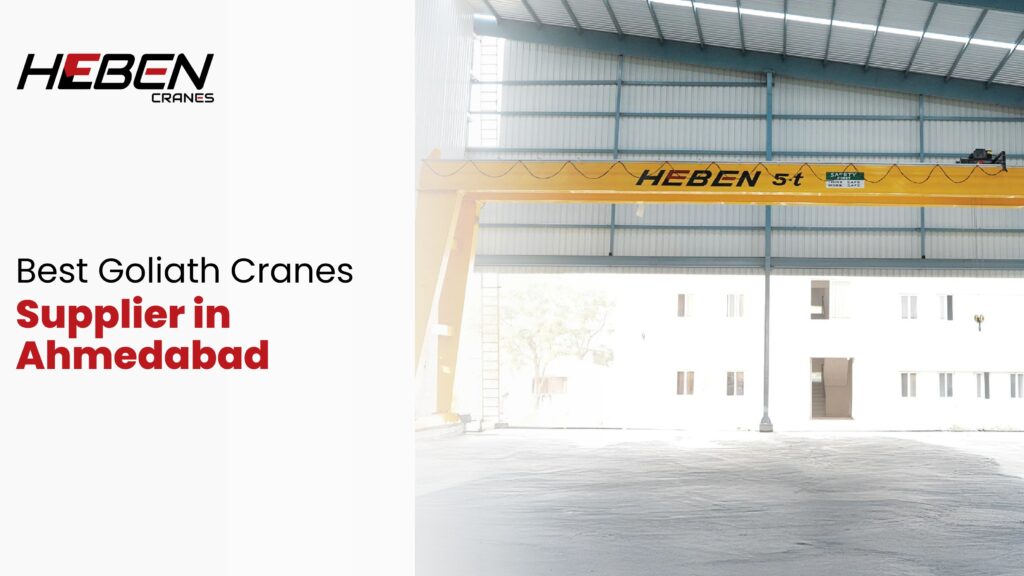
Introduction Your fabrication yard in Ahmedabad needs a Goliath crane, and six suppliers quote similar pricing. Tonnage matches, delivery timelines align, and everyone promises quality. The real challenge is this: most buyers optimize for price per ton and overlook the factors that determine whether your crane operates reliably for 20 years or requires constant repairs within three. This guide covers Goliath crane fundamentals, technical specifications, Ahmedabad’s industrial requirements, supplier evaluation criteria, and a systematic process to identify providers who match your actual yard conditions—not just your purchase specifications. Understanding Goliath Crane Basics A Goliath crane is a gantry crane with legs running on ground rails instead of building-mounted runways. The bridge structure spans between two legs, with the hoist trolley traveling along the girder. This design suits outdoor yards, areas without overhead support, and bay extensions where building structure can’t accommodate overhead cranes. Single girder Goliath cranes handle loads up to 20 tons with simpler construction and lower headroom. Double girder configurations support 20-100+ ton capacities across longer spans with higher lifting heights. The choice depends on your load spectrum and span requirements, not just maximum tonnage. Typical installations span 10-35 meters with lifting heights from 6-18 meters. Outdoor operation demands weatherproofing, corrosion protection, and wind-rated stability that indoor cranes don’t require. Why Ahmedabad Industries Use Goliath Cranes Ahmedabad’s engineering clusters, fabrication yards, precast plants, and logistics hubs rely on Goliath cranes for material handling in open areas. The city’s strong manufacturing base includes steel fabrication, infrastructure projects, and heavy equipment assembly that operates in yards rather than enclosed bays. Common applications include steel plate and structural handling in fabrication shops, precast concrete element movement in infrastructure projects, and container and heavy cargo handling in logistics yards. These operations need equipment that functions reliably in Gujarat’s hot climate and dust conditions. Here’s the pattern most yards miss: they specify capacity based on heaviest anticipated load but ignore duty cycle and lift frequency. A yard moving 15 tons fifty times per shift needs different structural design than one moving 25 tons five times per shift, even if they order the same rated capacity. Technical Specifications That Matter Load capacity segments into practical brackets: 1-10 tons for light fabrication yards, 10-40 tons for general engineering and precast work, and 40-100+ tons for heavy steel fabrication and specialized projects. Each bracket requires different girder sections, wheel configurations, and foundation design. Span and hook height determine if the crane fits your yard layout. Measure clear distance between rail centers and required lifting height from ground to load bottom position. Account for load height and rigging clearances. Wheel loads affect foundation requirements and rail specifications. Heavier cranes need engineered concrete foundations and heavy-duty rails. Lighter systems work on compacted surfaces with appropriate rail mounting. Travel and hoisting speeds influence productivity. Standard speeds of 20-30 m/min for travel and 8-10 m/min for hoisting suit general work. Higher speeds cost more but reduce cycle time in high-frequency operations. Outdoor protection matters in Ahmedabad conditions. IP65 electrical enclosures, corrosion-resistant coatings, and wind stability calculations prevent premature degradation and safety issues. What “Best Supplier” Actually Means Engineering capability separates suppliers who fabricate standard designs from those who engineer for specific yard conditions. In-house design teams calculate wheel loads, specify appropriate foundations, and optimize crane geometry for your space and load patterns. Manufacturing depth includes fabrication quality, welding standards, and load testing infrastructure. Structured quality processes catch issues before installation, not during commissioning. Service reach determines how quickly you get support when the crane stops. A supplier with technicians in Ahmedabad and spare parts inventory in Gujarat responds faster than one operating from distant states. Check actual service infrastructure, not just claimed coverage. Installation experience matters for outdoor cranes. Rail alignment, foundation integration, and electrical systems require different expertise than indoor bridge crane installation. Ask about Goliath-specific project history in Gujarat. Ahmedabad-Specific Buying Factors Yard conditions vary significantly across Ahmedabad’s industrial areas. Soil bearing capacity, drainage patterns, and space for rail extensions affect crane design and foundation requirements. Provide accurate site details during specification. Many Ahmedabad operations mix permanent installations with project-based work. If you handle temporary projects or anticipate yard expansion, design for relocation or runway extension from the start. Retrofitting costs more than initial planning. Power availability and distribution affect electrical design. Confirm available voltage and capacity before finalizing motor specifications. Integration with existing equipment requires coordination during installation. The uncomfortable truth most local buyers avoid: choosing suppliers solely for Ahmedabad proximity often means accepting limited engineering depth or service capability. Geographic location matters less than technical strength and responsive support infrastructure. Common Supplier Selection Mistakes Most buyers compare quotes on price per ton. They ignore girder section differences, motor quality, protection ratings, and structural duty class. A cheaper crane built to lighter specifications costs more over its lifetime through repairs and downtime. Foundation and rail design happens too late. The crane supplier provides wheel loads and rail specifications, but your civil team must verify soil capacity and design proper foundations. This integration should happen during crane specification, not after ordering. Future expansion gets overlooked. Yards that need additional capacity or span within five years should design rails and foundations for extension initially. Retrofitting costs significantly more than proper initial planning. Service evaluation occurs after purchase instead of during supplier selection. Maintenance capability, spare parts availability, and breakdown response should carry equal weight with technical specifications. Step-by-Step Supplier Evaluation Step 1: Document Your Requirements Map load weights across all lifts, not just maximum. Count lifts per shift at various load levels. Specify outdoor exposure, environmental conditions, and duty intensity. Step 2: Shortlist Goliath-Focused Suppliers Filter by capacity range and demonstrated Goliath crane experience. General crane manufacturers often lack specific outdoor gantry expertise. Prioritize suppliers with multiple Goliath installations. Step 3: Compare Technical Proposals Request detailed drawings showing girder specifications, wheel loads, and foundation requirements. Compare protection ratings, duty classifications, and component quality. Verify wind load calculations for Ahmedabad conditions. Step 4: Audit Service Infrastructure Ask for technician
How Single Girder Overhead Cranes Boost Daily Efficiency

Introduction Most facilities measure efficiency in throughput and uptime but overlook the small delays that compound daily. Manual material handling, forklift congestion, and floor-level bottlenecks consume 15-20% of productive time across an average shift. Single girder overhead cranes change this by moving loads through vertical space, cutting handling steps, and clearing floor paths. Facilities report 25-35% faster material flow within three months of installation. This guide examines how single girder systems optimize space, reduce cycle times, lower operating costs, improve safety margins, and integrate with modern control systems to deliver measurable efficiency gains every shift. Understanding Single Girder Overhead Cranes A single girder crane uses one main beam supporting a hoist and trolley system. The hoist travels along the beam while the entire assembly moves on runway rails mounted to building structure. Standard capacities range from 1 to 20 tons with spans of 7.5 to 25 meters. Duty classifications suit intermittent to moderate use patterns—8 to 16 operating hours daily. The design prioritizes simplicity. Fewer structural components mean lighter weight, faster installation, and lower maintenance requirements compared to double girder alternatives. Space Optimization and Layout Efficiency Overhead handling recovers floor area that forklifts and ground-level equipment consume. A facility running three forklifts dedicates approximately 600-900 square meters to aisles and maneuvering zones. Single girder cranes eliminate most of this. Loads travel in straight overhead paths without requiring floor clearance. Production equipment, inventory storage, and workstations move closer together. The compact design suits buildings with 4-6 meter ceiling heights. Low headroom configurations preserve vertical space for tall equipment or stacked storage. Faster Material Flow Direct lift paths cut handling time significantly. A forklift moving materials 50 meters across a crowded floor takes 3-5 minutes including obstacle navigation and load positioning. An overhead crane completes the same move in 45-90 seconds. Reduced handoffs matter too. Traditional floor handling chains material through multiple touch points—forklift to staging area to manual handling to workstation. Each transfer adds delay and damage risk. Single girder cranes serve workstations directly. Materials move from receiving to production in one lift, cutting cycle time by 40-60% in typical assembly operations. Cost and Energy Efficiency Installation costs run 30-50% below double girder systems. The lighter structure requires less robust runway support, simpler foundations, and shorter construction timelines. Energy consumption favors single girder design. Moving lighter structural mass consumes less power per cycle. Facilities report 15-25% lower crane-related electricity costs compared to heavier configurations. Right-sizing prevents overinvestment. A 5-ton crane handling typical 2-3 ton loads costs half what a 10-ton system runs, with proportionally lower operating expenses. Versatility Across Operations A single crane serves multiple work zones. One system covers three to five assembly stations, loading docks, or machining areas that would otherwise need dedicated handling equipment at each location. Load variety presents no barrier. The same crane handles raw material pallets, work-in-process assemblies, tooling, and finished products throughout the shift. Production mix changes require no reconfiguration. The crane adapts to new workflows, products, or station layouts without physical modifications or capital investment. Safety Improvements Manual lifting accounts for 25% of workplace injuries in manufacturing facilities. Overhead cranes eliminate most manual load handling, removing this injury source entirely. Built-in safety features—overload protection, limit switches, emergency stops—prevent the incidents that disrupt production schedules. Each prevented stoppage saves 30-120 minutes of downtime. Smoother movements stabilize output. Loads travel controlled paths at consistent speeds, reducing the variability that creates production bottlenecks and quality issues. Control System Integration Modern pendant controls position operators where they see both the load and the destination. Radio controls provide mobility for complex multi-point moves. Automation-ready systems integrate with production planning software. Load tracking, usage monitoring, and predictive maintenance alerts turn the crane into a data source for process optimization. Variable frequency drives enable precise speed control. Soft starts and stops reduce mechanical stress while improving load positioning accuracy. Selection for Maximum Efficiency Capacity sizing determines long-term value. A crane rated 50% above typical loads handles occasional heavy items without compromising efficiency on routine lifts. Span and coverage area affect material flow. Cranes should reach 90% of required pickup and delivery points without repositioning materials to intermediate locations. Common mistakes include: Underestimating duty cycle, causing premature component wear Ignoring future capacity needs, requiring early replacement Specifying inadequate control systems that limit operator effectiveness Daily Operating Practices Smooth acceleration prevents load swing and reduces cycle time. Operators who master gradual speed changes complete moves 15-20% faster than those using jerky controls. Visual inspection routines catch developing problems. Daily checks of wire rope, hooks, and limit switches take five minutes but prevent hours of unplanned downtime. Operator training focuses on workflow integration. Understanding production sequences and material priorities transforms crane operators into efficiency contributors. FAQs Q: What efficiency gains should I expect in the first month? A: Most facilities see 15-25% improvement in material handling speed immediately. Full efficiency gains—25-35% faster flow—develop over 2-3 months as operators master optimal routing and timing. Q: Can one crane really replace multiple forklifts? A: For overhead handling within a defined area, yes. A single girder crane typically replaces 1-3 forklifts in applications where loads stay within the crane’s coverage zone. Q: How does crane efficiency differ between single and double shift operations? A: Single girder cranes suit both patterns well. The key difference is maintenance scheduling—double shift operations benefit from preventive service during off-hours to maintain consistent efficiency. Q: What ROI timeline is realistic for efficiency improvements? A: Labor savings from reduced handling staff plus productivity gains from faster material flow typically recover crane investment in 18-36 months for moderate-use applications. Q: Do I need expensive controls to get efficiency benefits? A: Basic pendant or radio controls deliver most efficiency gains. Advanced automation adds value primarily in high-volume repetitive operations or where integration with facility systems matters. Conclusion Single girder overhead cranes improve daily efficiency through space recovery, reduced cycle times, lower operating costs, enhanced safety, and adaptable workflows. The gains compound—faster moves enable denser layouts, which reduce travel distances, which improve throughput further.
Top Double Girder Crane Supplier in Rajkot

Most Rajkot workshops pick a crane supplier based on the lowest quote. Six months later, they’re stuck with alignment issues, frequent breakdowns, and a service team that never shows up. The real cost isn’t the purchase price — it’s the downtime, the makeshift repairs, and the loads you can’t lift when production is waiting. This guide shows you how to identify a double girder crane partner in Rajkot who delivers on capacity, precision, and long-term reliability, so your lifting system becomes an asset, not a liability. What Double Girder Cranes Actually Do A double girder EOT crane uses two parallel beams running along overhead rails to support a traveling hoist. The hoist sits on top of the girders, giving you maximum hook height and stability for heavier loads. These cranes handle capacities from 5 tonnes up to 200 tonnes and beyond, with spans reaching 50 meters or more. They’re built for medium to heavy-duty cycles in industries where single girder systems can’t keep up. The dual-beam design distributes weight more evenly. This means less structural stress, longer component life, and the ability to add maintenance platforms or walkways without compromising load capacity. Why Rajkot Industries Need Double Girder Systems Rajkot’s engineering, foundry, and fabrication units routinely move castings, steel sections, and heavy assemblies across shop floors. Single girder cranes max out around 10-15 tonnes and struggle with spans beyond 20 meters. Double girder cranes give you lifting capacity above 15 tonnes, spans over 20 meters, and the structural margin to run multiple shifts without metal fatigue. If your operation involves steel handling, large molds, or automotive components, a single girder setup will bottleneck your throughput. India’s crane market is growing at 7.8% annually through 2028, driven by infrastructure and manufacturing expansion. Rajkot sits at the center of Gujarat’s industrial corridor, which means demand for robust material handling is only going up. The Hidden Cost of Choosing the Wrong Supplier Here’s what buyers miss: a crane isn’t a one-time purchase. It’s a 15-20 year relationship with installation, commissioning, statutory inspections, spare parts, and emergency repairs. Cheap suppliers skip structural safety margins to cut steel costs. They use under-spec motors, generic contactors, and wire ropes that need replacement every six months. The crane works on day one. It fails on day 180. You’ll spend more on downtime and retrofits than you saved on the initial order. A quality supplier engineers to IS 3177, IS 807 standards with documented load testing, proper duty class ratings, and access to OEM components. Technical Capabilities That Separate Leaders from Resellers Top suppliers don’t just assemble cranes — they design them. Look for in-house engineering that can calculate deflection limits, optimize girder profiles, and tailor duty cycles to your actual usage patterns. Box-girder fabrication, precision machining of wheels and axles, and welded connections done to IS 800 specifications are non-negotiable. If the supplier outsources fabrication, you lose quality control and traceability. Customization for Real-World Conditions Rajkot plants deal with heat from furnaces, dust from grinding operations, and corrosion from chemical exposure. A generic crane design won’t last. You need explosion-proof electricals for hazardous zones, heat-resistant components near casting areas, and sealed bearings where dust is heavy. Variable frequency drives (VFDs) give you smooth acceleration, reduced wear, and 30-40% energy savings over contactor-based systems. Low-headroom designs let you maximize hook lift without altering your existing building structure. This matters when retrofitting cranes into established bays where every meter of height counts. What the Spec Sheet Won’t Tell You Duty class ratings — M3, M4, M5, M6 — define how many lift cycles and what load spectrum the crane can handle. Most suppliers quote capacity but hide the duty class. A 20-tonne M3 crane is not the same as a 20-tonne M6 crane, even though both lift 20 tonnes. M3 is for occasional use (workshops, maintenance bays). M6 is for continuous production (steel mills, heavy assembly lines). If you run two shifts and the supplier sold you M3, expect premature bearing failure and girder deflection. Wheel loads determine what your building’s gantry girders need to support. A supplier who doesn’t provide wheel load calculations leaves you with structural cracks and misalignment within two years. Installation and Commissioning: Where Most Projects Fail The crane arrives in sections. It needs precise alignment — rail levelness within ±5mm over span, girder squareness, and end carriage parallelism. Bad erection causes uneven wheel wear, brake drag, and motor overload. A reliable supplier brings site survey teams before fabrication starts. They check bay dimensions, runway beam alignment, electrical supply adequacy, and floor load capacity. Errors caught at this stage save lakhs later. Post-installation, you need load testing (125% of rated capacity), brake tests, limit switch calibration, and operator training. Suppliers who skip statutory documentation leave you non-compliant when the factory inspector arrives. After-Sales: The Real Differentiator You’ll need spares — wire ropes, brake pads, limit switches, contactors — within 12-18 months of operation. If your supplier stocks genuine components locally in Rajkot, downtime is hours, not weeks. Annual maintenance contracts (AMCs) should include lubrication schedules, rope inspections, structural crack checks, and electrical safety audits. Reactive repairs cost 3-5x more than preventive maintenance. Emergency response matters. When a crane stops mid-shift with a 30-tonne load hanging, a supplier who can mobilize a service team within 4 hours saves you a full day’s production. How Heben Cranes Delivers for Rajkot Industries? Heben designs and manufactures double girder EOT cranes from 5 to 200 tonnes, with custom spans and lifting heights tailored to your bay layout. Every crane is engineered to IS 3177 / IS 807 with documented structural calculations and load tests. We build box-girder assemblies in-house with precision welding, low-headroom crab units for restricted bays, and VFD-based controls for smooth, energy-efficient operation. Maintenance platforms and walkways come standard on heavy-duty models. Our service network in Rajkot and across Gujarat provides same-day response for breakdowns, stocked spare parts, and AMC packages that keep your crane compliant and operational. We don’t disappear after installation. Choose a crane
Top Single Girder Crane Supplier in Rajkot

Rajkot hosts over 50 crane suppliers, yet nearly 40% of industrial buyers report dissatisfaction with their first purchase—citing delayed deliveries, poor after-sales support, or equipment failing to meet specifications within two years. The uncomfortable truth: supplier selection based solely on price or proximity creates expensive problems when cranes arrive late, perform inadequately, or lack service support during breakdowns. Rajkot’s industrial sector needs single girder crane suppliers combining manufacturing excellence, customization capability, reliable delivery, and comprehensive after-sales service. This guide examines what defines top suppliers, quality and customization standards, service commitments, selection criteria, and the specific advantages of choosing experienced Rajkot-based manufacturers. What Defines a Top Supplier Manufacturing experience and established reputation separate professional crane suppliers from assembly operations purchasing commodity components. Suppliers operating 10+ years have refined processes, developed technical expertise, and built service infrastructure supporting long-term client relationships. Industry certifications including ISO 9001 quality management demonstrate systematic production controls, while compliance with IS 3177 and other applicable standards proves technical competence. Top suppliers provide documentation, material traceability, and load test certificates validating each crane meets specifications. Client references from similar industries and verifiable project portfolios reveal actual performance beyond marketing claims. Suppliers serving Rajkot’s automotive components, machine tools, textile machinery, and engineering sectors understand local operational requirements and facility constraints. In-house manufacturing capabilities including fabrication, assembly, testing, and quality control provide better oversight than suppliers outsourcing critical work. Facility tours revealing actual production processes, equipment, and quality management systems separate legitimate manufacturers from traders. Product Range and Customization Top suppliers offer comprehensive capacity ranges from 1-20 tons covering light to medium-duty industrial applications. Standard models provide economical solutions for common requirements, while customization capabilities address specific operational needs. Span customization from 7.5 to 31.5 meters accommodates varied facility bay widths and column spacing. Lifting height specifications reaching 30 meters suit applications requiring significant vertical reach. Duty class options from A3 through A5 match light to moderate operational intensities. Suppliers unable to specify duty classifications or offering only generic “standard duty” cranes lack engineering depth for proper application matching. Key Customization Elements Control systems: pendant, wireless remote, or cabin operation based on workflow Hoist speeds: single or dual speed for productivity and precision positioning Environmental protection: dust-proofing, heat resistance, or corrosion protection Safety features: overload protection, emergency stops, limit switches, anti-collision systems Power supply: voltage options matching facility electrical infrastructure Quality Standards and Manufacturing Excellence Material quality determines crane longevity and reliability. Top Rajkot suppliers use IS 2062 grade structural steel, genuine branded motors and gearboxes, and quality electrical components from established manufacturers. Welding quality proves critical for structural integrity. Qualified welders, systematic welding procedures, and non-destructive testing on critical joints prevent premature failures. Request welding procedure specifications and welder qualification records during supplier evaluation. Load testing at 125% rated capacity validates structural design and system performance before delivery. Suppliers skipping comprehensive testing create liability and safety risks that surface after installation. The contrarian insight most buyers miss: the cheapest quote often comes from suppliers using thinner materials, off-brand components, or skipping testing protocols. These “savings” evaporate through frequent repairs, premature replacement, and operational disruptions within 5-7 years. After-Sales Service and Support Installation support determines whether cranes commission smoothly or face expensive delays and corrections. Professional suppliers provide detailed installation drawings, technical guidance, and optional on-site supervision ensuring proper setup. Operator training covering safe procedures, pre-shift inspections, and basic troubleshooting improves safety and extends equipment life. Comprehensive training programs demonstrate supplier commitment beyond equipment sales. Maintenance contract availability ensures ongoing crane health through scheduled inspections, preventive servicing, and priority response for breakdowns. Verify suppliers maintain trained service technicians and spare parts inventory accessible within Rajkot. Response time for emergency repairs separates service-oriented suppliers from sales-focused operations. Top suppliers commit to defined response windows with backup plans when primary technicians are unavailable. Industry Applications in Rajkot Rajkot’s automotive component manufacturers use single girder cranes handling dies, fixtures, and machined parts weighing 2-10 tons. Precision positioning and reliable daily operation suit production environments requiring consistent material flow. Machine tool and engineering works benefit from flexible crane systems moving raw materials, work-in-progress, and finished assemblies. Customized spans matching workshop layouts optimize coverage and operational efficiency. Textile machinery producers handle heavy frames, rollers, and assembled units requiring 5-15 ton capacity with adequate lifting heights for vertical assembly procedures. Construction equipment fabrication facilities use outdoor-rated cranes managing structural components, hydraulic systems, and sub-assemblies in open or semi-covered production areas. Supplier Selection Criteria Local manufacturing presence within Rajkot or nearby Gujarat facilities enables faster service response, easier facility visits for verification, and stronger accountability through established local reputation. Delivery reliability matters more than aggressive promises. Request realistic timelines with milestone schedules rather than accepting optimistic commitments suppliers can’t meet. Check references about actual delivery performance. Warranty coverage typically spans 12-18 months from commissioning with clear terms defining what’s included and excluded. Longer warranties mean nothing if suppliers lack financial stability or service infrastructure to honor commitments. Technical support accessibility through phone, email, or video consultation prevents minor issues from becoming extended downtime. Suppliers providing detailed manuals, electrical schematics, and troubleshooting guides enable facility maintenance teams to handle routine problems independently. Local Advantages for Rajkot Buyers Rajkot’s established engineering ecosystem provides skilled fabricators, quality component suppliers, and experienced technical workforce supporting crane manufacturing excellence. Proximity enables pre-purchase facility tours verifying manufacturing capabilities, quality processes, and completed crane inventory. Physical verification beats catalog promises and website claims every time. Service response within same-day or next-day timeframes minimizes downtime compared to distant suppliers requiring 3-5 days for technician dispatch. Local presence proves valuable during commissioning, operator training, and emergency repairs. Transportation costs decrease significantly for local deliveries versus cranes shipped long distances. Reduced transit time and handling lower damage risk during delivery. Frequently Asked Questions Q: What delivery timelines should Rajkot buyers expect for single girder cranes? A: Standard configurations typically deliver within 4-6 weeks from order confirmation, while customized specifications may require 6-10 weeks depending on complexity. Suppliers promising unrealistic 2-3 week delivery often miss deadlines or