
Advantages of Semi Goliath Cranes
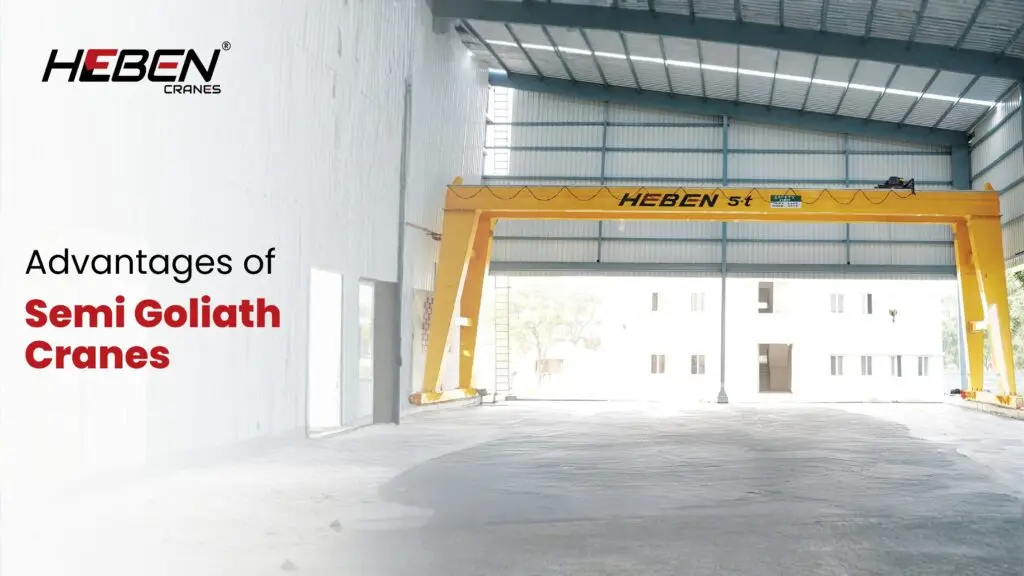
Semi Goliath cranes (also called semi-gantry cranes) combine the strength of full gantry systems with the flexibility of overhead cranes, making them a smart choice for many industrial and construction environments. In this article we explore the key advantages of semi Goliath cranes, explain where they deliver the most value, and offer practical tips for choosing the right configuration for your facility. What is a Semi Goliath Crane? A semi Goliath crane is a type of gantry crane where one side rides on a runway or overhead rail while the other side is supported by a mobile leg that runs on the floor. This hybrid design eliminates the need for two elevated runways (required by full gantry cranes) while retaining large lifting capacities and long spans. Semi Goliath cranes are commonly used in warehouses, fabrication shops, shipyards, and outdoor yards where structural or budget constraints prevent installing dual elevated runways. Primary Advantages Lower installation cost. Semi Goliath cranes require only one runway or support structure instead of two, cutting structural steel and civil-work costs. Reduced installation labor and simpler foundations shorten project timelines and lower upfront expenses. Space efficiency. Because one side runs on floor rails, semi Goliath cranes work well in facilities without continuous elevated runways. They maximize available vertical clearance and free up overhead space for lighting, ductwork, and other utilities. High lifting capacity. These cranes can be engineered for heavy-duty applications, handling large loads typical in steel fabrication, precast concrete handling, and maintenance yards. They offer nearly the same capacity as full gantry systems at a lower installation cost. Flexible span and travel. Semi Goliath cranes can cover long spans and travel distances, either along fixed floor rails or combined with runway systems. This flexibility suits linear workflows like loading/unloading, material transfer between production cells, and outdoor stacking. Easier retrofit and relocation. Compared with full overhead cranes, semi Goliath cranes are simpler to install in existing buildings and can be relocated more readily if your operation changes. This makes them a cost-effective choice for growing businesses. Reduced structural modifications. Facilities that lack the structural depth or bearing capacity to support a second runway benefit from the semi Goliath design, which minimizes building modifications and preserves architectural integrity. Improved safety and ergonomics. Modern semi Goliath cranes include electronic controls, anti-collision systems, and variable-frequency drives that enable smooth lifts and precise positioning, reducing the risk of material damage and operator fatigue. Where Semi Goliath Cranes Deliver Most Value Warehouses and distribution centers: For handling pallets, heavy machinery, or long materials, semi Goliath cranes offer scalable capacity without major overhead infrastructure. Fabrication and steel shops: They provide the heavy lift capacity and span control needed for welding bays, assembly lines, and load-out areas. Outdoor yards and storage yards: Semi Goliath cranes perform well in open yards where installing continuous runway rails is impractical. Maintenance and repair shops: The ability to position a crane close to equipment and then relocate it makes semi Goliath cranes ideal for vehicle or equipment maintenance bays. Design and Configuration Considerations Load capacity and span. Specify maximum rated load and required span early. Over-engineering increases cost; underestimating load risks safety and downtime. Rail and foundation type. Choose between embedded steel rails with reinforced concrete foundations or portable track systems depending on permanence and ground conditions. Travel and speed requirements. Consider variable-frequency drives for smooth acceleration and deceleration, which improve precision and reduce structural stress. Environmental protection. For outdoor or corrosive environments, select weatherproofing, corrosion-resistant materials, and suitable coatings to extend service life. Automation and controls. Options range from pendant control to wireless remote and cab-operated systems. Integrate safety controls like overload protection and anti-sway for precision lifting.
Maintenance Tips for A-Frame Cranes
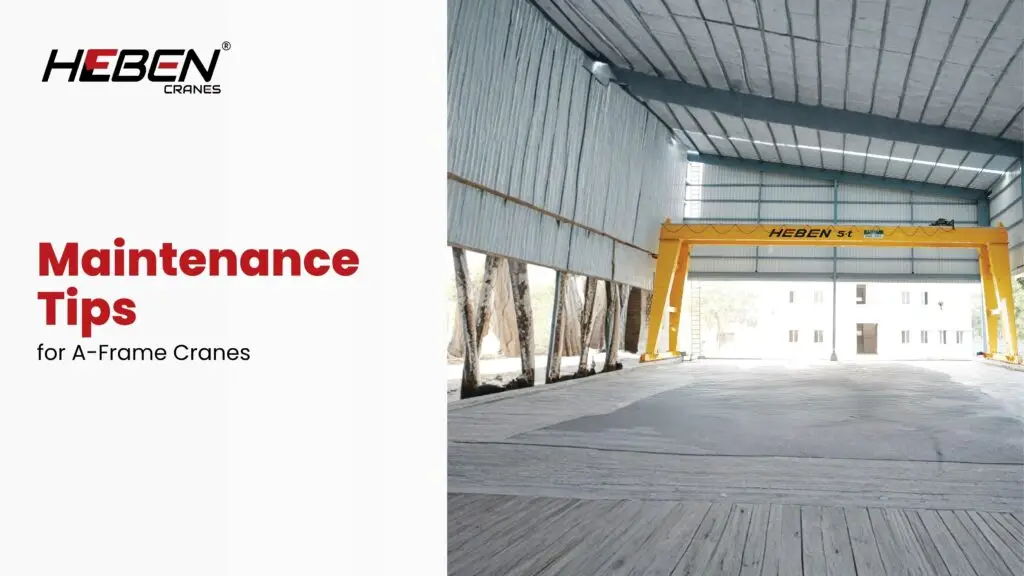
Introduction An A-frame crane that gets used without a maintenance routine does not fail dramatically — it degrades quietly. A worn wheel here, a loose fastener there, a hook that has been overloaded a few times too many. By the time the problem becomes visible, it has already been costly. Research on industrial lifting equipment consistently shows that most crane failures are preceded by detectable warning signs that were simply never checked for. This guide gives you a structured maintenance approach for A-frame cranes — from the 60-second pre-use check to the annual service overhaul. You will get daily, weekly, monthly, and annual tasks broken down by component, plus the most common failure patterns to watch for. Follow this routine and your crane will hold load safely, move smoothly, and remain in service far longer than one that runs on reactive repairs. How to Inspect an A-Frame Crane Before Use Every lift should be preceded by a quick visual and functional check. This takes under two minutes and catches the problems most likely to cause a failure mid-operation. Frame and Beam Check Look for visible cracks, bends, or deformation in the uprights, crossbeam, and leg braces Check all weld points and connection joints for signs of cracking or separation Confirm that height-adjustment pins or locking collars are fully engaged and secured Hook, Rigging, and Lifting Hardware Inspect the hook for any twist, bend, or visible crack — replace immediately if the throat opening has widened beyond 10% of its original size Check that the safety latch snaps closed and holds under light pressure Inspect slings, shackles, and connecting hardware for cuts, corrosion, or distortion Wheels, Casters, and Travel Roll the crane a short distance and listen for grinding, wobbling, or uneven resistance Check that locking brakes engage fully and hold the crane stationary on a level surface Look for flat spots, cracks, or unusual wear on wheel surfaces Daily Maintenance Tips Daily maintenance is not a deep inspection — it is a quick reset that catches accumulating damage before it compounds. Wipe down the crane after use, especially in dusty, humid, or chemically active environments Re-inspect hook and rigging hardware after heavy or repeated lifts during the day Note any noise, vibration, or resistance that was not present at the start of the shift — log it, even if it seems minor Return the crane to a parked position with the hoist at a safe height and brakes locked Weekly Maintenance Tips Weekly checks go one level deeper. Most of the mechanical failures that take cranes out of service originate in parts that are easy to check weekly but are routinely skipped. Lubrication Apply lubricant to wheel axles, swivel points on castors, and height-adjustment mechanisms If the crane carries a chain hoist or wire rope hoist, lubricate the chain or rope per the hoist manufacturer’s interval — dry chain is one of the most common causes of hoist failure Do not over-lubricate; excess grease on wheels or rails attracts debris and accelerates wear Fasteners and Connection Points Check all bolts, nuts, and pins that hold leg braces, crossbeam attachments, and trolley rail connections Torque any fastener that shows movement to its specified value — do not estimate by feel alone Look at the trolley rail or beam flange for signs of wear from repeated trolley travel Monthly Maintenance Tips Monthly checks cover structural integrity and the components that carry the highest share of load stress. Structural Condition Run your hand along the full length of each leg and the crossbeam, feeling for surface cracks that may not be visible under paint or surface coating Check leg-to-beam connection hardware for corrosion, especially in outdoor or high-humidity environments Confirm that height-locking mechanisms have not developed play or slippage under load Brake and Hoist Condition Test the hoist brake under a rated load: raise the load to working height and hold for 60 seconds — any drift is a service indicator, not a normal operating condition Inspect wire rope for broken wires, kinks, bird-caging, or corrosion along the full usable length Check rope drum grooves for wear patterns that suggest misalignment in the reeving Annual Inspection and Service Once a year, the crane needs a full technical review. This is not optional — it is the inspection that validates whether the crane is fit for continued service at its rated capacity. Full structural inspection — Check all welds, joints, and structural members for fatigue cracks. Pay particular attention to weld toes at high-stress points where legs meet the beam. Load test — Perform a proof load test at 110–125% of rated capacity with a static hold. Document the result. Electrical and motor inspection (if powered hoist) — Check wiring insulation, control panel, limit switches, and motor condition Wheel and axle replacement assessment — Measure wheel wear against the manufacturer’s minimum dimensions and replace if below threshold Documentation — Log the annual inspection results, any parts replaced, and the next scheduled service date Common Problems to Watch For Most A-frame crane failures do not arrive suddenly. They build from these recurring issues: Bent or cracked frame members — Often caused by side-loading or shock loading when a swinging load makes contact with the frame Wheel and caster wear — Accelerated by operating on uneven, debris-covered, or hard abrasive floors Hook deformation or latch failure — Frequently caused by lifting loads off-center or at an angle to the hook throat Rope or chain damage — Kinking from improper spooling, overloading, or contact with sharp load edges Fastener loosening — Vibration during travel and repeated loading cycles back fasteners out of torque over time Maintenance Records and Logbook A logbook is not a paperwork exercise — it is a diagnostic tool. A crane without service records cannot be sold, certified, or trusted. Every entry should capture: Date of inspection and inspector name Components checked and their condition Parts replaced, with part numbers and sources Any deviations from normal operation observed during use Next scheduled maintenance
Benefits of Wall Mounted Jib & Travelling Cranes
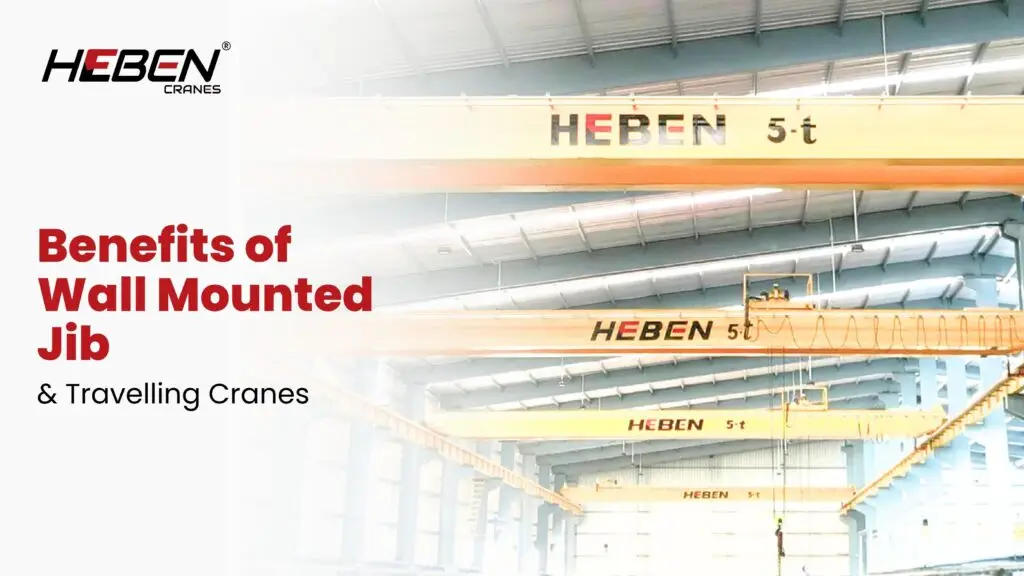
Every manufacturing floor eventually runs into the same ceiling. Not a literal one — a capacity ceiling. Floor space is gone, overhead cranes are maxed out, and forklifts are creating bottlenecks at every workstation. The operation slows down, injury risk goes up, and expansion feels expensive. Wall mounted jib cranes and wall travelling cranes make room where there is none. They pull lifting capacity out of your walls — not your floor — and put precise load control right at the point of work. This post breaks down exactly what they do, where they perform best, and why the right configuration can change the way your facility moves material from day one. What Are Wall Mounted Jib Cranes A wall mounted jib crane is a boom arm fixed to a wall or column. It rotates between 180° and 270°, depending on the mount type, and carries a hoist that lifts and lowers loads within that arc. Two main types exist: Bracketed (Tie-Rod): The jib is supported by a tie rod anchored above the lower hinge. Lower cost, straightforward installation. Cantilevered: Shaped like an inverted L, with two hinges on the weldment. Delivers better hook height and more headroom underneath. Capacities typically run from 250 kg to 5,000 kg. The actual limit depends on the structural integrity of the wall or column it mounts to — not the crane itself. What Are Wall Travelling Cranes Wall travelling cranes take the jib concept and add lateral movement. Instead of rotating around a fixed point, the crane rides along a rail track mounted on the wall, covering a full bay — or several connected bays — in a straight horizontal path. This matters in assembly line environments. One crane can serve four or five workstations instead of just one. The jib arm still rotates and lifts at each station; it just travels the full length of the rail between them. Space Saving Benefits This is the core value proposition. Neither crane type requires floor columns, concrete footings, or additional structural steel. They use what the building already has. No floor obstructions between workstations Aisles stay fully passable Overhead crane runway stays clear — wall cranes operate below it Ideal for low-ceiling plants where overhead cranes cannot be installed A wall travelling crane, in particular, gives you three-axis material movement — vertical lift, rotational reach, and lateral travel — without occupying a single square foot of floor space. Productivity and Efficiency Wall travelling cranes are built for short-distance, high-frequency lifting cycles. That combination — repetitive, controlled, fast — is exactly what assembly lines need. Loads move laterally along the rail without operator repositioning Electric slewing drives make rotation quick and accurate Multiple workstations share one crane, cutting equipment cost and idle time No footings means faster installation, so production interruption is minimal One contrarian insight worth noting: most facilities assume a larger overhead crane solves a bottleneck problem. In practice, adding a wall travelling crane to handle the smaller, frequent picks — freeing the overhead crane for heavy lifts — produces a bigger throughput gain than upgrading the overhead crane itself. Safety and Ergonomics Manual handling injuries are one of the leading causes of lost workdays in manufacturing. Wall mounted jib cranes directly reduce that exposure. Controlled load paths eliminate the improvised carries that cause injuries Built-in overload protection and limit switches prevent unsafe operations Consistent, repeatable lifting reduces operator fatigue across shifts Precise load positioning means fewer collisions in tight spaces The rotation arc of a wall mounted crane keeps loads within a predictable zone, which reduces near-misses compared to freeform forklift movement. Installation and Maintenance Setup is straightforward. No new columns. No concrete pours. The crane attaches to your existing wall or column — provided a structural assessment confirms the load capacity. Ongoing maintenance is minimal: Fewer moving parts than bridge or gantry cranes Electric chain hoists have long service intervals Wall travelling cranes are rated for up to 500,000 lift cycles Easy to inspect, lubricate, and re-certify without extended downtime Industry Applications Wall mounted and travelling jib cranes are most effective where the work is concentrated and repetitive: Machine shops: Tool and part handling at CNC or machining centers Assembly lines: Engine, component, or sub-assembly positioning Warehouses and loading docks: Efficient loading/unloading without forklifts Fabrication shops: Plate and section handling at welding stations Low-clearance facilities: Anywhere overhead bridge cranes cannot fit How to Choose the Right Type Match the crane type to the work pattern. Condition Right Choice One fixed workstation Wall Mounted Jib Multiple stations in a line Wall Travelling Crane High hook height needed Cantilevered Wall Mount Budget-constrained, light duty Bracketed (Tie-Rod) Wall Mount Long bays with frequent movement Wall Travelling with extended rail Before ordering, confirm your wall or column can handle the side-load forces the crane will generate. A structural engineer sign-off protects both the installation and your workforce. FAQs Can wall mounted jib cranes be installed in older buildings? Yes, provided the existing walls or columns pass a structural load assessment. In many cases, existing steel can be reinforced to handle the crane’s side forces without a full rebuild. What is the maximum travel distance for a wall travelling crane? Rail runs are customizable. Standard installations cover 10–40 m, but runs of 100 m or more are achievable when the wall structure supports it. Do wall cranes interfere with overhead bridge cranes? No. Wall travelling cranes operate on a lower level, specifically designed to work beneath overhead cranes without any operational conflict. How long does installation take? Most wall mounted jib cranes are installed in one to two days. Wall travelling systems with longer rail runs take two to four days depending on bay length and number of cranes on the rail. What hoist types work with these cranes? Both crane types are compatible with electric chain hoists, wire rope hoists, air hoists, and manual chain blocks. The hoist choice depends on lift frequency and load weight. Conclusion Wall mounted jib and travelling cranes do
Double Girder vs Single Girder: Which One to Choose?
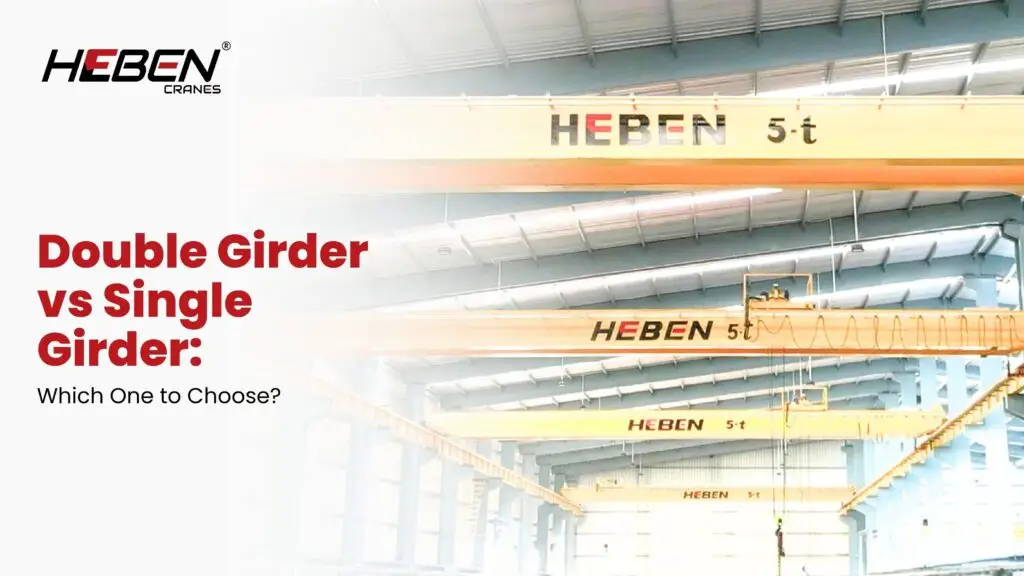
Introduction Most crane purchases go wrong not because the buyer chose a bad product, but because they chose the right product for the wrong application. A double girder crane installed where a single girder would have worked wastes capital. A single girder crane pushed into a heavy-duty cycle fails early — and that failure costs more than the money saved upfront. This guide cuts through the noise. You will get a clear structural breakdown, a side-by-side comparison, application-specific recommendations, and a final decision checklist you can apply to your facility today. Whether you are outfitting a fabrication shop or a steel mill, the answer becomes straightforward once you understand what each crane type is actually designed to do. What Is the Difference Between Single Girder and Double Girder Cranes? Single Girder Crane A single girder crane uses one main bridge beam. The hoist and trolley run along the lower flange of that beam, which positions the hook below the bridge structure. This design keeps the crane compact, light, and cost-efficient. Double Girder Crane A double girder crane uses two parallel main beams set apart. The trolley rides on top of the rails fixed between both beams — not below them. This shifts the hook position upward, delivering significantly more hook height for the same runway elevation. Side-by-Side Comparison Feature Single Girder Double Girder Lifting Capacity Up to 15–20 tonnes 10 to 250+ tonnes Span Range Economical up to ~20–22 m 5 m to 35 m+ Hook Height Limited (hoist hangs below beam) Higher (trolley sits on top) Duty Class A2–A5 A5–A8 Runway Load Lower Higher Maintenance Access From below only Walkway access possible Auxiliary Hoist Typically not feasible Easily accommodated Cost (Supply + Install) 20–40% less than equivalent DG Higher capex When Single Girder Makes Sense Single girder is the right call when your operation stays within these parameters: Capacity at or under 15 tonnes — covers most workshop and light industrial needs Span of 20 metres or less — avoids deflection problems that come with longer beams Duty class A2–A4 — moderate use, not running near rated load continuously Adequate headroom — hook height isn’t a constraint in your bay Tight procurement budget — same lifting performance at significantly lower cost Existing building with light overhead structure — a lighter crane puts less load on the runway and the building itself A concrete example: a 5-tonne crane in a 15-metre span fabrication shop running 30 lifts per day at A3 duty. Single girder, without question. When Double Girder Makes Sense Push past any one of these thresholds and double girder becomes the engineering answer: Capacity above 15 tonnes — single girder becomes structurally limited Span over 22 metres — beam deflection at long spans demands two beams Duty class A5 and above — high-cycle operations need the structural redundancy Maximum hook height required — double girder gains 0.5–1.5 metres of under-hook height versus single girder at the same runway level Auxiliary hoist needed — a secondary hoist on the same trolley is standard on double girder; it doesn’t fit single girder Maintenance walkway required — the space between the two beams carries a walkway for safe top-level access A real-world case: a 25-tonne crane in a 28-metre steel mill bay running at A7 duty, with an auxiliary 5-tonne hoist and the hook needing to clear coiled product on the floor. Single girder is not an option here. Key Factors to Consider Before Choosing Work through these six factors in sequence before committing to a configuration. Load weight and lift frequency — how heavy is the load, and how many lifts per shift? Hook height requirement — does the load need to clear fixed equipment, mezzanines, or floor-stored material? Bay span and travel length — what is the actual distance between runway rails? Duty class — match the crane’s design class to the actual working intensity, not a rough estimate Building structure — what wheel loads can your existing columns and roof structure carry? Future expansion — upgrading from single to double girder later is effectively buying a new crane; factor in where capacity might grow Common Mistakes Buyers Make Over-specifying by default. Many specifications are written as “double girder” as a blanket standard. If your application is 5 tonnes at A3 duty over a 14-metre span, that default costs real money without adding performance. Under-specifying to save on capex. Forcing a 15-tonne operation into a single girder crane with a tight duty cycle shortens its design life and brings forward the replacement cost — often exceeding the initial saving. Skipping the grey zone analysis. Capacities between 10 and 15 tonnes sit in a range where both configurations are technically feasible. The right answer comes from looking at span, duty class, hook height, and auxiliary hoist requirements together — not any single factor alone. FAQs Can a single girder crane be upgraded to a double girder later? Generally no. The runway, end carriages, drives, and electrical systems are all sized for the original configuration. Upgrading is effectively a full crane replacement. If capacity growth is likely, design for it from the start. Which crane type is better for high-frequency production environments? Double girder. Its structural design distributes load across two beams, handles high duty cycles (A5–A8) reliably, and supports longer service intervals without compromising performance. Does double girder always mean higher total cost? Higher upfront, yes — typically 20–40% more for equivalent capacity. But for heavy-duty operations, double girder delivers a lower lifecycle cost through longer design life, better load distribution, and less frequent replacement. Which crane is better when headroom is limited? Single girder with a low-headroom hoist. The under-running trolley configuration keeps the total bridge depth compact, leaving more usable lift height within a constrained bay. Conclusion The choice between single and double girder is not a preference — it is an engineering outcome. Match the crane to your actual capacity, span, duty cycle, and hook height requirements, and the right configuration becomes clear. At Heben Cranes,
Advantages of Single Girder EOT Cranes
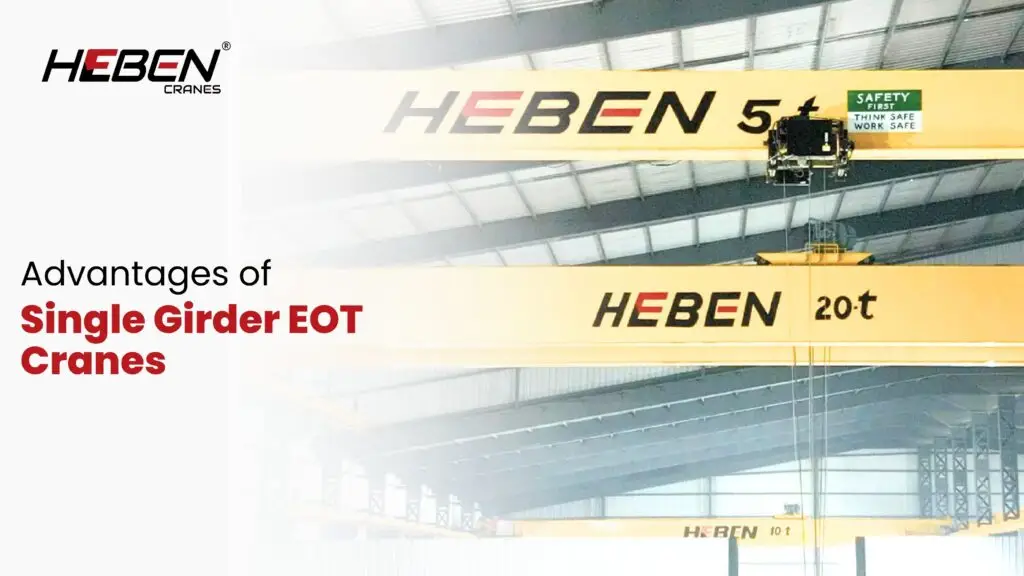
When a factory floor is tight on space, the lifting system can quietly become the bottleneck. Cramped bays, low roof clearances, and modest budgets push plant managers into a difficult corner — invest heavily in heavy-duty infrastructure or accept limited productivity. Single girder EOT cranes cut through that trade-off cleanly. This piece walks through what a single girder EOT crane is, how it delivers real value on the shop floor, and what separates a good crane selection from a costly one. If you’re evaluating lifting solutions for a light-to-medium-duty operation, you’re in the right place. What Is a Single Girder EOT Crane? A single girder EOT (Electric Overhead Travelling) crane runs on a single horizontal beam — the bridge girder — supported by end trucks that travel along runway rails mounted to the building structure. The hoist and trolley are suspended from the bottom flange of that single beam. This is a fundamental design choice, not a compromise. It keeps the crane compact, lightweight, and structurally efficient for loads typically ranging from 1 to 20 tonnes across spans up to 35 metres. How a Single Girder EOT Crane Works The crane moves in three axes: Long travel — the end trucks move the entire bridge along the runway rails Cross travel — the trolley moves along the bridge girder Hoisting — the electric hoist lifts and lowers the load A control panel, pendant station, or remote manages all three movements. The system is driven by electric motors with variable-frequency drives in modern configurations, giving operators smooth, precise control. Key Advantages of Single Girder EOT Cranes Lower Cost, Faster ROI Single girder cranes use less structural steel than double girder alternatives. That directly reduces the fabrication cost, the installation cost, and the load transferred to your building structure. For small-to-medium facilities, this matters enormously — you aren’t paying for overhead capacity you’ll never use. Here’s an insight most buying guides skip: because the crane is lighter, many existing industrial buildings can support a single girder installation without structural reinforcement. That eliminates what is often the single biggest hidden cost in a crane retrofit. Better Headroom in Low-Clearance Buildings The hoist in a single girder crane sits below the bridge beam. This seems like a minor detail until you calculate actual hook height in a building with a 6–7 metre eave. In those environments, every 200mm of hook height is usable lift. Single girder designs routinely deliver 300–500mm more usable lift compared to double girder cranes in the same bay. Easier Installation and Maintenance Fewer components mean fewer points of failure. The single beam structure is faster to erect, easier to align, and simpler to inspect. Routine maintenance — checking the hoist, inspecting the end trucks, greasing the rail contacts — takes less time and requires less scaffolding access. Suitable for a Wide Range of Industries Single girder EOT cranes are deployed across: Engineering workshops — machine loading, component transfer Warehouses and logistics hubs — pallet and unit load handling Automobile ancillary units — sub-assembly lifting Textile mills — roll and bale handling Railway and fabrication yards — beam and plate movement Food processing plants — hygienic lifting in process areas Single Girder vs. Double Girder Factor Single Girder Double Girder Capacity range 1–20 tonnes 10–500+ tonnes Hook height Higher (hoist below beam) Lower (hoist above/between beams) Building load Lower Higher Cost Lower Higher Maintenance access From ground/pendant Dedicated walkway needed The right choice depends on your load, span, and duty cycle — not on a default preference for “more crane.” Things to Consider Before Buying Capacity and span — size the crane to your peak load, not your average load Duty class — IS/FEM classifications determine motor and structure sizing; don’t skip this Headroom — measure hook height at the lowest point of the hoist travel Building structure — verify that your existing columns and runway beams can take the crane’s dead load plus dynamic forces Control type — pendant, radio remote, or cabin; choose based on operator position and load visibility Frequently Asked Questions What is the maximum capacity of a single girder EOT crane? Standard single girder EOT cranes handle up to 20 tonnes. Beyond that, double girder designs are structurally more appropriate due to deflection limits on a single beam. Can a single girder crane be installed in an existing building? Yes — and this is one of their key advantages. Because the dead load is significantly lower than double girder cranes, many existing industrial structures can accommodate a single girder crane without column or truss reinforcement. What is the standard span range? Spans typically run from 6 metres to 35 metres, depending on the manufacturer’s design standards and the load being handled. How long does a single girder EOT crane last? With proper maintenance and correct duty-class selection, a well-built single girder crane routinely operates for 20–25 years. Duty mismatches — running a light-duty crane on a heavy-duty cycle — are the most common cause of premature failure. What safety features are standard? Overload protection, end-of-travel limit switches, emergency stop, and anti-collision systems are standard on quality-built cranes. Variable-frequency drives also reduce mechanical shock, extending component life. Conclusion Single girder EOT cranes deliver exactly what most light-to-medium industrial operations need: reliable lifting, low structural demand, manageable cost, and straightforward maintenance. They aren’t a scaled-down solution — they are the correctly scaled solution for a large share of real factory environments. At Heben Cranes, we engineer single girder EOT cranes built to your bay dimensions, load requirements, and duty classification — not off a generic shelf. Our team carries out full site assessments, recommends the right configuration, and supports you through installation and beyond. If you’re evaluating a lifting solution for your facility, Get in touch with Heben Cranes and let’s build the right fit for your operation.
Types of EOT Cranes: Complete Guide to Overhead Lift Systems
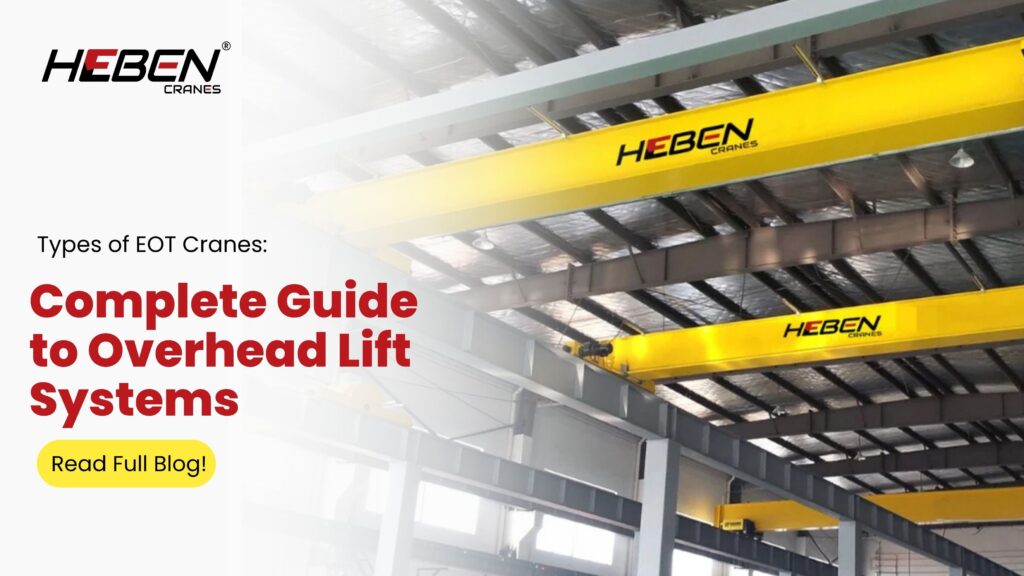
Introduction Your facility needs an overhead crane, but the configuration options are wider than most buyers expect. Choosing the wrong type means structural modifications you didn’t plan for, capacity limits that stop production, or headroom problems discovered only after installation. EOT (Electric Overhead Travelling) cranes cover a full range of configurations — from single girder workshop units to heavy double girder systems for steel plants. This guide breaks down each type, its specifications, application range, and the selection logic that matches crane configuration to your load patterns, bay dimensions, and duty requirements. Single Girder EOT Cranes Single girder cranes use one bridge beam with the hoist trolley running along the bottom flange. The design is compact and cost-effective for light to medium duty applications. End carriages at both beam ends travel on runway beams mounted to building columns. Capacity ranges from 0.5 to 20 tons, with spans covering 5 to 30 meters. Duty classes A3 to A4 suit 2–4 hours of daily intermittent operation. Runway beams are lighter and column reinforcement is minimal compared to double girder alternatives, which reduces total project cost. Double Girder EOT Cranes Double girder cranes use two parallel bridge girders with the hoist trolley traveling on rails mounted between them. The hoist sits between girder tops rather than hanging below a single beam, which increases hook-to-floor distance significantly. Capacity spans 5 to 250+ tons with bridge spans up to 60 meters. Duty classes A5 to A7 serve continuous heavy operation in steel plants, automotive facilities, and power plants. The structural rigidity distributes loads evenly across runway beams, reducing wheel loads and extending rail life. Here’s the counterintuitive reality: facilities often over-invest in double girder cranes for loads under 20 tons. A correctly specified single girder system costs 30–40% less and handles the same operational requirement without excess structural overhead. Underslung EOT Cranes Underslung cranes suspend the bridge from the bottom flange of runway beams rather than riding on top. The hoist hangs below the bridge, which hangs below the runway. The entire crane occupies the lower portion of the building. Capacity limits sit at 1–10 tons for single girder underslung systems, with double girder versions reaching 20 tons. Spans typically range from 3 to 15 meters. Many installations use existing roof structure, avoiding new column work and dramatically reducing installation cost and timeline. Underslung cranes recover 1–2 meters of hook travel that top-running systems lose to structural depth. In a 4.5-meter ceiling building, this difference determines whether the crane is operationally useful or structurally limited. Gantry and Semi-Gantry EOT Cranes Gantry cranes use legs that travel on ground rails instead of building-mounted runways. The bridge spans between these self-supporting legs. Full gantry cranes operate completely independent of building structure — suitable for outdoor yards and facilities without roof support. Semi-gantry cranes run one leg on a ground rail while the other side travels on a building runway. Capacity ranges from 1 to 50 tons across spans up to 35 meters. This configuration suits facilities with partial structural support on one bay side. Gantry cranes cost 20–35% more than equivalent EOT systems where adequate building structure already exists. Choose gantry for outdoor yards or buildings with inadequate columns — not as a default alternative to top-running EOT. Jib Cranes Jib cranes mount to a wall, pillar, or freestanding column and rotate through a horizontal arc. Wall-mounted versions fix to building columns. Pillar-mounted types use independent freestanding columns with engineered foundations. Capacity ranges from 0.5 to 10 tons with outreach up to 10 meters. Rotation spans 180–360 degrees depending on mounting type. Jib cranes suit workstation lifting where loads move through fixed arcs rather than across full bay lengths. Multiple jib cranes create coverage patterns that linear EOT systems can’t match cost-effectively in assembly-intensive workshops. They function best as complements to main EOT systems, not replacements. Key Components Across All Types Every EOT configuration shares a common set of functional components: Bridge girder(s): Main structural span carrying trolley and load End carriages: Contain wheels, drive motors, and brakes for runway travel Hoist and trolley: Vertical lifting and lateral cross-travel Control system: Pendant push buttons, radio remote, or cabin operation Safety devices: Overload protection, limit switches, emergency stops, anti-collision systems Electrical panel: Motor controls, variable frequency drives, circuit protection Wire rope hoists suit heavy continuous lifts. Chain hoists work for lighter precision applications. Duty class ratings define operating intensity across all configurations. How to Select the Right EOT Crane Type Step 1: Calculate Load and Duty Document maximum load, typical operating load, and lifts per shift. Calculate duty class from actual frequency data, not assumed maximum. Duty class mismatch causes 60% of premature failures — it’s the most underweighted specification in most buying decisions. Step 2: Measure Bay Constraints Measure clear span between runway support columns and available headroom. Single girder suits spans up to 30 meters. Double girder extends to 60 meters. For headroom under 5 meters with loads below 10 tons, underslung is the practical answer. Step 3: Assess Building Structure Confirm column and roof beam capacity for your crane type. Top-running EOT cranes require dedicated runway beams with column reinforcement. Underslung cranes transfer loads through existing roof structure — structural verification is mandatory before specifying. Step 4: Choose Control and Safety Specifications Select operation method based on operator visibility and cycle complexity. Pendant controls suit simple repetitive tasks. Radio remotes improve positioning accuracy when operators move with the load. Cabin control applies to high-volume continuous operations. Step 5: Plan for Service and Expansion Specify future capacity scenarios before ordering. Double girder systems accommodate hoist upgrades. Single girder cranes rarely convert to higher capacity without complete replacement. Build service access and maintenance platform provisions into the design, not as afterthoughts. Frequently Asked Questions What’s the practical capacity limit for single girder EOT cranes? The standard ceiling is 20 tons. Beyond this, deflection and structural demands make double girder configurations more economical. Some manufacturers quote 25 tons, but runway and column costs at that capacity make
Top Running Crane vs Underhung Crane: Full Technical Guide
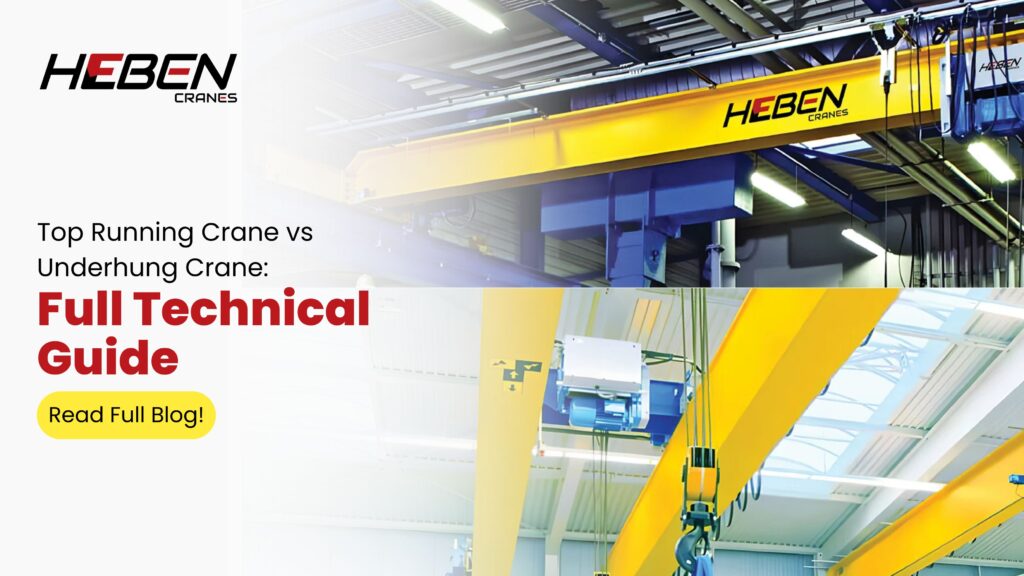
Engineers pick overhead crane configurations the same way most buyers pick cranes — by capacity and cost. They skip the structural analysis, ignore headroom calculations, and overlook the building’s load-bearing limitations. The wrong configuration creates installation problems, reduced hook height, and buildings under stress they were never designed to carry. This guide breaks down the technical and operational differences between top running and underhung cranes. You’ll understand structural requirements, load capacity limits, headroom trade-offs, and the application scenarios where each configuration delivers reliable, long-term performance. What Top Running Cranes Are Top running cranes position their end trucks on top of the runway beams. The bridge girder spans between these rails. The hoist and trolley sit on top of or hang from the bridge girder, depending on single or double girder design. The runway beams carry all crane loads down through columns or wall brackets to the building foundation. This load path is direct and well-understood. It keeps crane loads separate from the roof structure. Top running cranes handle capacities from 5 tonnes to 500+ tonnes. Spans reach 40 meters and beyond. No other configuration matches this range. What Underhung Cranes Are Underhung cranes, also called under-running cranes, position their end trucks on the bottom flange of the runway beams. The bridge girder hangs below. The hoist trolley runs beneath the bridge girder. The runway beams are suspended from the building’s roof or rafter structure. This is the critical difference. Underhung cranes transfer loads upward into the roof, not downward through columns. The roof structure must carry crane dead loads, live loads, and dynamic impact loads simultaneously. Practical capacity limits for underhung systems sit between 5 and 15 tonnes. Engineering theory allows up to 25 tonnes, but local flange bending in the runway and bridge girders makes heavier loads impractical without significant reinforcement. Structural Requirements: What Your Building Actually Needs This is where most installation errors begin. Buyers assume underhung cranes are cheaper because they use the existing building. They frequently are cheaper — until the structural assessment reveals the roof cannot carry the crane loads without reinforcement. Top Running Structural Needs Top running cranes require: Dedicated runway beams, typically wide-flange steel sections Columns or wall brackets sized for vertical wheel loads and lateral thrust Rail clips, end stops, and expansion joints along the runway length Foundation design to handle concentrated column reactions The load path is clean. Crane forces go into dedicated structural members, not the building frame. Underhung Structural Needs Underhung cranes require: Roof or rafter beams with verified capacity for crane dead load, lifted load, and 25–50% dynamic impact Hanger connections from rafter to runway beam, sized for combined vertical and lateral forces Lateral bracing to manage side thrust loads at 20% of rated capacity plus hoist/trolley weight Engineering assessment for every installation — never assumed to fit without calculation Older industrial buildings in India use roof trusses designed for dead load and wind only. Retrofitting an underhung crane into such a structure demands professional structural verification, not a site visit and a quote. Headroom and Hook Height: The Numbers That Matter Top running cranes deliver maximum hook height. The rails sit at the top of the runway beams. The bridge girder rests on the rails. The hoist hangs below the girder. Every component position maximises usable lift height. A 5-tonne top running crane in a 7-meter bay typically achieves 5–5.5 meters of hook height. The same bay with an underhung crane yields 3.5–4 meters because the bridge girder, trolley, and hoist all consume headroom from below. That 1–1.5 meter difference matters when lifting a 2-meter tall machine component over a work table. Top running wins on hook height in any building of equal height. Underhung cranes work in buildings where the roof structure sits lower and dedicated runway beam columns would further reduce available height. The trade-off is hook height, gained in exchange for not introducing new columns into the workspace. Multi-Crane Operations and Flexibility Underhung systems have one clear structural advantage: multiple cranes can share a single runway or pass through each other on intersecting runway systems. An automotive assembly plant running six underhung cranes across crossing runways would require no floor-mounted columns anywhere in the bay. Top running cranes cannot cross each other without complex elevated transfer systems. Each crane needs its own parallel runway set. Adjacent cranes require anti-collision systems and clearance gaps. For facilities running simultaneous multi-crane operations across a large open floor, underhung systems offer better bay utilisation. For facilities needing one or two high-capacity cranes, top running delivers structural efficiency. Maintenance Access and Lifecycle Costs Top running cranes with double girder configurations include maintenance platforms on the bridge girder. Technicians walk on the crane to access hoists, motors, and electrical panels at height. Scheduled maintenance happens without bringing loads to the floor. Underhung cranes provide no platform access. All maintenance requires the crane to return to a ground-level service position. For light-duty applications with infrequent maintenance, this is acceptable. For medium-duty systems with frequent inspection requirements, it adds time and complexity. Rail wear on top running systems concentrates on the top flange of the crane rail. Inspection is visual and straightforward. Underhung runway flange wear occurs on the bottom flange surface and requires closer examination. FAQs Can I convert an underhung crane to top running if my capacity needs increase? Not directly. The two configurations use different structural support systems. A capacity increase typically requires a new runway beam system, column design, and foundation work. Plan for top running from the start if your load requirements may grow beyond 10 tonnes. What is the maximum span for an underhung crane? Engineering guidelines allow spans up to approximately 60 meters, but practical limits sit between 15 and 25 meters due to bridge girder deflection and flange bending at the runway connection. Longer spans require heavier girder sections that increase roof loads significantly. Do underhung cranes need rail? No dedicated crane rail is needed. The end trucks run directly on the bottom
Types of EOT Cranes: Single vs. Double Girder Guide
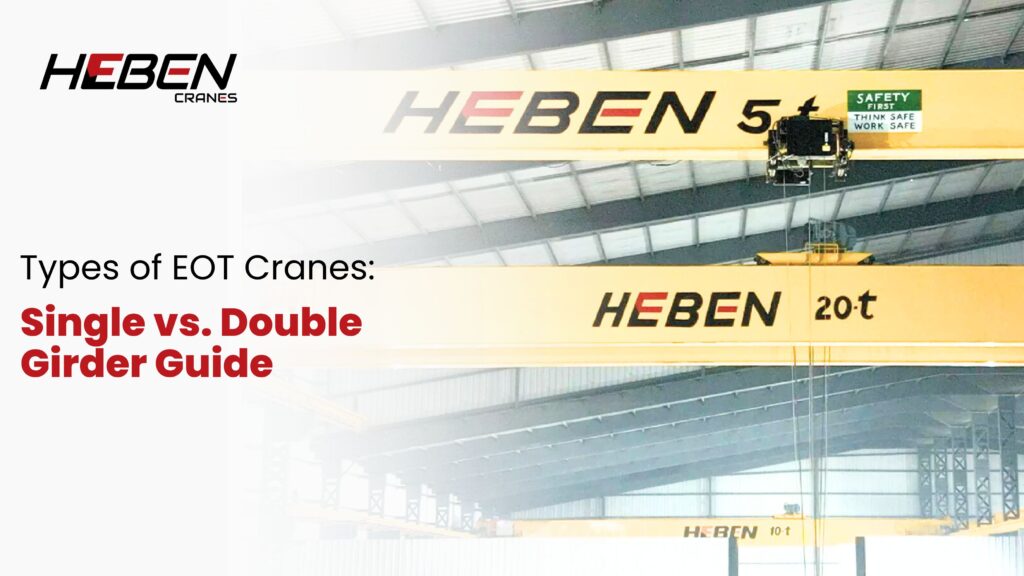
Most facilities spec the wrong EOT crane type and spend years managing the consequences. A single girder crane forced into heavy-duty service wears out in 8-10 years instead of 20. A double girder crane over-specified for light loads adds 30-40% unnecessary cost with no performance return. Electric Overhead Travelling cranes split into two primary configurations—single girder and double girder—and each suits a defined range of load, span, duty, and budget conditions. This guide covers design differences, capacity and span ranges, duty classification matching, installation requirements, and the decision criteria determining which configuration fits your specific project. What Are EOT Cranes? EOT cranes are electrically operated bridge cranes travelling on elevated runway beams. A bridge spans the runway rails. An end truck assembly rides each rail. A hoist and trolley system handles the load. The entire bridge travels along the runway. The trolley travels across the bridge. This two-axis movement covers the full working floor area beneath the crane. Single and double girder variants share this basic structure but differ significantly in how the bridge is built. Single Girder EOT Cranes Single girder cranes use one main beam forming the bridge. The hoist hangs from the lower flange of this beam. The trolley runs below the girder, which limits hook height but reduces overall crane depth. Capacity range sits between 1 and 20 tons. Span covers up to 30-35 meters in standard configurations. Duty classes A3-A5 cover the operational range—light to moderate service with 5-12 lift cycles per hour. Where Single Girder Works Best Workshops and fabrication shops with loads under 15 tons Buildings with limited headroom needing shallow crane profiles Cost-sensitive projects requiring fast installation and lower structural load Operations with moderate duty cycles under 5,000 hours annually Double Girder EOT Cranes Double girder cranes use two parallel main beams. The crab mechanism—hoist and trolley combined—rides on top of the girders. This raises the hook to the maximum available height and supports far heavier loads. Capacity starts at 10-20 tons and scales to 250+ tons. Spans exceed 40 meters routinely. The dual beam structure distributes loads more evenly and resists deflection across long spans. Duty classes A5-A8 apply—moderate to severe service in steel mills, foundries, and multi-shift production facilities. Where Double Girder Works Best Heavy manufacturing with consistent loads above 20 tons Wide-bay facilities requiring spans over 30 meters Operations needing maximum hook height under the roof structure High-cycle environments running intensive multi-shift operations Key Design Differences The hook height difference is the most underestimated factor. Single girder cranes lose 600-900mm of vertical clearance because the hoist hangs below the beam. Double girder cranes recover this height with top-mounted crab units. In a facility with 8-meter clearance, that difference determines whether tall loads can be handled at all. Maintenance access differs fundamentally. Double girder bridges include walkway platforms along the girder tops. Technicians reach the crab, hoist, and electrical systems at crane level. Single girder cranes require external platforms, ladders, or mobile equipment for the same access. Structural weight splits the cost equation. Single girder cranes weigh 30-40% less. Lighter cranes need lighter runway beams and supporting columns. This reduces building structure costs, which often equals or exceeds the crane cost itself in new construction. Duty Class and Application Matching Duty class governs structural design, not just operational tempo. A crane specified below its actual duty class experiences accelerated fatigue. Bearings, welds, and structural joints fail earlier—often before the first major overhaul interval. Single girder suits A3-A5 duty reliably. Double girder handles A5-A8 without structural compromise. The contrarian insight: many facilities running A5 duty with 15-ton loads choose single girder to save cost—then replace the crane at year 12 instead of year 22. The 25% initial saving costs far more over time. Installation and Building Requirements Single girder cranes suit both new and retrofit installations. The lighter structure works with smaller runway beams. Existing building columns often carry single girder loads without reinforcement. Double girder cranes require heavier runway beams and stronger column bases. New construction can account for this in the structural design. Retrofitting an existing building for double girder loads often triggers significant structural work adding 20-35% to project cost. Headroom requirements differ by design. Single girder cranes need less vertical clearance. Double girder systems consume more height due to the crab mechanism sitting above the bridge. Measure available headroom carefully before specifying either type. Frequently Asked Questions Can a single girder crane handle 20-ton loads? Single girder cranes can be manufactured for 20 tons, but the practical upper limit before double girder becomes more cost-effective and structurally reliable is 15-17 tons. At 20 tons on spans beyond 20 meters, deflection and fatigue risk increase measurably. Specify double girder for consistent 20-ton operations above 20-meter spans. What is the lifespan difference between single and double girder cranes? Properly duty-matched single girder cranes last 18-22 years. Double girder cranes in A6-A8 service deliver 20-25 years when maintained correctly. The gap closes when single girder cranes are run above their rated duty class—where service life drops to 10-14 years. Matching duty class to actual operating intensity determines lifespan more than girder count. Does double girder always cost more installed? Equipment cost is higher—typically 30-50% above equivalent single girder. But total installed cost depends on building structure. In new construction where columns are designed for double girder loads from the start, the cost gap narrows. In retrofits, structural upgrades can make double girder total project cost 60-80% higher than single girder. Which type suits a 10-ton, 20-meter span application? Single girder handles this confidently at A3-A5 duty. The span and load sit well within standard single girder capability. Double girder would over-specify the requirement, adding unnecessary cost. Only upgrade to double girder here if the duty class exceeds A5 or if hook height is a critical constraint. How do control systems differ between types? Control systems—pendant, wireless remote, or cabin—apply to both types equally. Double girder cranes more commonly include operator cabins because the larger bridge structure accommodates cabin mounting
Industrial EOT Cranes: Types, Features, and Applications
Most factories choose EOT cranes by price and capacity alone. They buy a 15-tonne system because it fits the budget. Six months later, the crane runs constantly, the hoist overheats, and the maintenance team discovers the duty class was rated for occasional use, not continuous production. The crane works — until it doesn’t. This guide explains how to match EOT crane type, features, and duty classification to your actual material handling demands. You’ll learn the structural differences between single and double girder systems, the duty class framework that determines component life, and the application-specific features that separate efficient operations from chronic breakdowns. What EOT Cranes Do in Industrial Operations EOT stands for Electric Overhead Traveling. The crane moves on rails mounted to the building structure. It covers the full bay length and width without occupying floor space. The system consists of a bridge girder, end carriages with wheels, a hoist for vertical lift, and controls for operator input. Unlike mobile cranes or forklifts, EOT cranes handle repetitive lifting in a fixed area with precise positioning and no fuel costs. Capacity ranges from 500 kg to 500 tonnes. Spans reach 40 meters in industrial bays. The crane delivers materials to workstations, moves production between process stages, and loads vehicles at dispatch zones. Single Girder vs Double Girder: The Core Decision Single girder cranes use one main beam. The hoist hangs from the bottom flange and travels along it. This design suits capacities up to 25 tonnes and spans up to 20 meters. The advantages: lower initial cost, simpler installation, reduced building load, and adequate hook height for most workshops. The limitations: restricted lifting height because the hoist sits below the girder, less structural capacity for heavy loads, and limited maintenance access. Double girder cranes use two parallel beams with a crab mechanism on top. This configuration handles 25 tonnes to 500+ tonnes and spans beyond 40 meters. The trade-offs: higher structural cost, increased building load requirements, but maximum hook height, integrated maintenance platforms, and capacity for process-duty cycles in steel plants and heavy industry. You pay more upfront. You gain operational flexibility and longer component life under heavy use. Duty Classes: The Specification Most Buyers Ignore Duty class defines how hard the crane can work. It’s not about capacity. It’s about cycle frequency, load distribution, and operational hours per day. India uses IS/BIS classifications from Class I (light) to Class V (heavy). International standards use FEM/ISO designations from M2 to M9. What the Classes Actually Mean M3/Class II: Occasional use, 1-2 hours per day, light loads M5/Class III: Standard manufacturing, 8 hours per day, moderate cycles M7/Class IV: Heavy production, 16+ hours, frequent full-capacity lifts M8/Class V: Process duty for steel mills, continuous operation A 10-tonne crane rated M3 costs 30-40% less than the same capacity rated M7. The structural steel is thinner. The motor is smaller. The bearings have lower cycle ratings. It works fine for a maintenance shop doing 50 lifts per week. It fails catastrophically in a production line doing 200 lifts per shift.[] Research shows that 65% of premature crane failures result from duty class mismatch, not component defects. Buyers spec capacity correctly. They ignore the usage profile entirely. Safety Features That Separate Compliant from Dangerous Limit switches stop the hoist before it hits the trolley (two-blocking) or unspools rope off the drum. Travel limits prevent collision with end stops or adjacent cranes. These are mandatory, not optional. Brake systems include hoist brakes that hold the load when power cuts, and travel brakes that stop crane motion. Every motion — hoist, cross-travel, long-travel — needs independent braking. Single-brake systems create drift in wind or on inclines. Overload protection shuts down lifting before structural damage occurs. Load cells measure actual weight. Torque limiters sense motor load. Either system must trigger before you exceed the safe working load by more than 10%. Anti-collision sensors detect obstacles or other cranes in the travel path. They reduce speed or stop motion before impact. Plants with multiple cranes operating in the same bay cut collision incidents by 80% when they install active proximity systems. Control Systems and Operational Efficiency Pendant push-button controls hang from the crane. The operator walks with the load. This works for slower operations where load visibility matters more than operator position. Radio remote controls let operators stand at the best vantage point. They improve safety by removing the operator from beneath the load. VFD-based controls provide smooth acceleration, reduced mechanical shock, and 30-40% energy savings over direct-on-line starters. Cabin controls suit high-bay operations where the operator can’t see the load from ground level. Steel mills and scrap yards use cabin cranes for visibility and environmental protection.[] Application-Specific Configurations Steel plants need high-duty cranes with heat-resistant components, cabin controls, and dual hoists for wide loads. Spans reach 40 meters. Capacities exceed 200 tonnes. Duty classes run M7 to M8. Chemical plants require explosion-proof electrical systems, corrosion-resistant coatings, and sealed components. The crane operates in atmospheres where a single spark creates catastrophic risk.[] Engineering workshops use single girder cranes with wire rope hoists, radio remotes, and VFD controls. Capacities range from 5 to 20 tonnes. Duty classes sit at M4 or M5 for standard two-shift operations. Warehouses favor underslung cranes that maximize vertical space, chain hoists for short lifts, and simple controls. The focus is low headroom and cost efficiency, not heavy capacity. How Heben Cranes Engineers EOT Systems Heben matches crane type, duty class, and features to your shift schedule, cycle frequency, and load patterns — not industry averages or catalogue specs. We document the duty class calculation so you know the crane is engineered to your actual usage, not under-spec’d to meet a price target. Our single girder cranes run from 1 to 25 tonnes with VFD controls, sealed bearings, and hardened wheels as standard. Double girder systems handle 25 to 200 tonnes with maintenance platforms, dual brakes, and process-duty ratings for steel, chemical, and heavy manufacturing. We provide installation support, statutory testing, operator training, and long-term
Underslung vs. EOT Crane: Key Differences & Selection Guide
Introduction Most buyers ask for an “EOT crane” when they mean a top-running overhead system. Then they discover their facility lacks the headroom or structural capacity to support it. The confusion stems from terminology—EOT simply means Electric Overhead Travelling, which includes both top-running and underslung configurations. The difference determines whether you need 5 meters of headroom or 3, whether your building needs reinforcement or works as-is, and whether you spend $15,000 or $35,000 for similar capacity. This guide clarifies the structural distinctions, capacity limits, installation requirements, and application patterns that determine which configuration actually fits your facility and operational needs. What an EOT Crane Actually Is EOT stands for Electric Overhead Travelling crane. The term describes any overhead bridge crane that runs on parallel runway beams, powered electrically, and travels horizontally. EOT includes both single girder and double girder designs. Single girder handles 1-20 tons across spans of 7.5-31.5 meters. Double girder extends to 320+ tons with spans reaching 40+ meters. Standard top-running EOT cranes position the bridge girder on top of runway rails. The hoist travels along the top or bottom of the girder depending on design. Typical lifting heights range 3-15 meters for single girder, extending to 30+ meters for double girder configurations. What an Underslung Crane Is An underslung crane is an EOT crane where the bridge girder hangs from the bottom flange of runway beams instead of sitting on top. The entire assembly suspends from ceiling structure. Trolley wheels run on the bottom flange of the girder, with the hoist hanging below. This configuration suits facilities with 3-4 meters of headroom where top-running systems cannot fit. The crane operates within existing vertical space rather than consuming additional height. Capacity typically ranges 0.25-10 tons, occasionally reaching 16 tons in heavy-duty variants. Spans work up to 22.5 meters though most installations stay under 15 meters. Structural and Mounting Differences Top-Running EOT Configuration The bridge girder rests on rails mounted to the top of runway beams. Wheel assemblies roll along these rails, supporting the crane from above. Building structure carries vertical loads through columns or walls. Runway beams must handle crane weight plus maximum lifted load. Underslung Configuration The bridge girder hangs from trolleys or hangers attached to runway beam bottom flanges. The suspension system reverses the load path. Existing building beams often serve as runways without modification. Installation time drops to 2-5 days versus 7-14 days for top-running systems. Key Technical Differences Headroom Requirements Top-running EOT needs the full crane height above the load plus adequate clearance. A 10-ton system typically requires 5-6 meters of total headroom. Underslung design operates within 3-4 meters. The hoist hangs into working space, not above it. Facilities gain 1.5-2.5 meters of effective lifting height from the same building envelope. Capacity and Performance Here’s the uncomfortable reality: underslung systems reach practical limits around 10-16 tons. Beyond this, structural deflection and suspension stresses favor top-running design regardless of headroom. Top-running EOT handles heavier continuous-duty operations. The supported load path provides stability that suspended designs cannot match at higher capacities. Installation and Cost Considerations Underslung installation costs 40-60% below equivalent capacity top-running systems. The savings come from simpler runway preparation and faster assembly. Structural modifications matter more for top-running cranes. Adding robust runway beams, reinforcing columns, or upgrading foundations adds $8,000-$20,000 to projects. Underslung systems often mount to existing building beams without reinforcement. A structural engineer verifies capacity, but modifications rarely exceed $2,000-$5,000. Floor space implications differ minimally. Both configurations preserve ground-level area equally well. Operational Use Cases Underslung Applications Light manufacturing suits underslung perfectly. Assembly lines handling 1-5 ton components across 10-15 meter spans operate efficiently within headroom constraints. Warehousing and logistics facilities use underslung for intermittent lifting—loading docks, storage retrieval, occasional heavy items. Duty cycles stay below 10 lifts per hour. Retrofit situations favor underslung. Existing buildings gain lifting capability without structural upgrades that approach new crane costs. Top-Running EOT Applications Heavy manufacturing demands top-running capacity. Steel fabrication, foundry work, equipment assembly—operations lifting 10+ tons continuously throughout shifts. Long-span facilities need top-running stability. Spans beyond 20 meters develop deflection and vibration issues with underslung design that compromise positioning accuracy. Future capacity expansion justifies top-running investment. A facility expecting load growth from 8 to 15 tons within five years chooses top-running from the start. Safety and Maintenance Safety features overlap substantially. Both configurations include overload protection, limit switches, emergency stops, and similar control systems. Maintenance access differs significantly. Top-running cranes allow walkway installation along the bridge for service during off-shifts. Underslung systems require lifts or scaffolding for major maintenance. Deflection behavior impacts safety margins. Underslung bridges flex more under load, requiring conservative capacity ratings. Top-running designs tolerate higher duty cycles without fatigue concerns. Duty classifications range A1-A5 for both types, but underslung rarely exceeds A3 in practice while top-running commonly operates at A4-A5. Selection Framework Choose Underslung When: Headroom stays under 4 meters Capacity needs remain below 10 tons Operations involve intermittent lifting (under 8 hours daily) Budget prioritizes low initial cost Existing building structure can support suspension loads Choose Top-Running EOT When: Capacity exceeds 10 tons or may grow beyond current needs Continuous heavy-duty cycles (12+ hours daily) Spans exceed 20 meters Maintenance access and long service life matter Building structure supports runway installation FAQs Q: Can I convert underslung to top-running later? A: Not cost-effectively. The conversion requires removing the underslung system, installing new runway beams, and purchasing top-running components—totaling more than initial top-running installation would have cost. Q: What structural verification does underslung need? A: A structural engineer must confirm that ceiling beams, connections, and supporting columns can handle crane weight plus maximum load without exceeding design limits. This typically costs $1,500-$3,000. Q: How does span length affect the choice? A: Underslung works well under 15 meters, acceptably to 20 meters, and poorly beyond. Top-running handles 30+ meter spans without the deflection issues that limit underslung performance. Q: Do both types use the same hoists? A: Yes, electric wire rope hoists work with both configurations. The mounting orientation differs but