
Energy-Efficient Cranes for Sustainable Material Handling
Industrial cranes consume 3-7% of total facility electricity in typical manufacturing plants, yet most operators treat this as fixed overhead rather than controllable expense. Here’s the data that shifts perspectives: facilities running multi-shift operations waste 30-40% of crane energy through resistance braking, oversized motors, and inefficient drives that convert electricity into heat rather than useful work. Energy-efficient crane technology cuts consumption 25-50% through variable frequency drives, regenerative braking, high-efficiency motors, and smart controls. This translates to measurable reductions in operating costs, carbon footprint, and thermal load on facility cooling systems. This guide examines the technologies enabling efficient material handling, their operational benefits, specification criteria, and the business case beyond environmental compliance. What Makes Cranes Energy-Efficient Energy efficiency in cranes means delivering required lifting, travel, and positioning performance while minimizing electrical consumption per operating cycle. Traditional resistance-controlled cranes waste significant power through braking resistors that dissipate kinetic energy as heat during each stop. Modern efficient cranes integrate four key elements: high-efficiency motors rated IE3 or IE4, variable frequency drives controlling all motions, regenerative braking recovering energy during lowering and deceleration, and optimized structural design reducing deadweight requiring less power to move. Duty cycle intensity determines actual energy impact. Cranes running intensive operations with frequent starts, stops, and load changes show greater efficiency gains from advanced technology than occasional-use equipment. A foundry crane cycling 40 times hourly benefits more from regenerative systems than a maintenance crane lifting twice daily. Variable Frequency Drives VFDs control motor speed electronically rather than through mechanical contactors and resistors. This enables soft starts reducing inrush current by 60-70%, gradual acceleration minimizing mechanical shock, precise speed control improving positioning accuracy, and controlled deceleration that can recover energy. Traditional resistance-controlled cranes draw full starting current every cycle, creating demand charges and heating equipment. VFDs limit current draw to actual load requirements, cutting peak demand and reducing motor stress. The contrarian insight most facilities miss: VFD cost premiums of 15-20% recover within 2-4 years through energy savings alone in multi-shift operations, ignoring additional benefits of reduced maintenance, extended component life, and improved process control. VFD Efficiency Gains 20-35% reduction in total energy consumption vs resistance controls 60-70% lower starting current reducing demand charges Smooth acceleration extending mechanical component life 40-50% Precise speed control enabling faster safe cycle times Regenerative Braking Systems Conventional braking converts kinetic energy into heat through resistor banks, wasting the potential to recover power invested in accelerating loads. Regenerative systems reverse this process, using motors as generators during lowering and deceleration. Energy flows back to facility electrical systems, offsetting consumption by other equipment or feeding directly to the grid where regulations permit. Facilities with multiple cranes, heavy loads, and high lift heights see the greatest benefit—recovered energy can reach 15-30% of total crane consumption. Steel mills, container terminals, and scrap handling operations report 20-40% energy reductions combining VFDs with regenerative capability. The technology proves most effective when lowering loaded hooks and decelerating heavy bridge or trolley motions rather than just controlling hoist descent. Power electronics convert recovered AC motor output to DC, then invert back to AC matching facility electrical characteristics. Modern regenerative drives integrate this seamlessly, requiring minimal additional equipment beyond standard VFD installations. High-Efficiency Motors and Drives Motor efficiency ratings (IE1 through IE4) represent losses converting electrical input to mechanical output. IE3 motors reduce losses 15-20% compared to older IE1 standards, while IE4 premium efficiency motors gain another 15% improvement. Helical-bevel gearboxes offer 92-96% efficiency versus 75-85% for older worm-gear designs. This difference compounds across hoist, trolley, and bridge drives, creating significant cumulative savings in multi-axis crane systems. Smart motor controllers optimize torque delivery, adjust performance based on load sensing, and prevent unnecessary operation when cranes sit idle. These features add marginal cost but deliver measurable consumption reductions. Power Distribution and System Losses Busbar conductor systems reduce resistive losses 30-50% compared to trailing cable power delivery. The lower resistance path decreases I²R heating losses, maintains voltage stability under load, and eliminates cable wear requiring frequent replacement. Properly sized conductors matching actual load requirements prevent oversizing waste while ensuring adequate capacity. Undersized systems create voltage drops degrading motor performance and wasting energy as heat in conductors. Installation layout affects efficiency. Shorter power paths, minimized joints and connections, and strategic transformer placement all reduce cumulative losses in large crane systems. Operational Practices for Efficiency Equipment capability means little without operational discipline. Operators leaving cranes energized during extended breaks waste power on controls, lighting, and auxiliary systems. Smart facilities implement automatic idle shutdown after preset intervals. Load management reduces unnecessary movements. Combining multiple small lifts into single optimized cycles, planning travel paths minimizing empty travel distance, and staging materials efficiently all cut energy consumption 10-20% without equipment changes. Maintenance condition directly affects efficiency. Worn bearings increase friction, misaligned wheels create drag, and dirty electrical contacts raise resistance. Systematic maintenance sustains design efficiency levels that degrade 15-25% over time without proper care. Specification and Selection Criteria Request regenerative braking specifications including power recovery capacity, grid-feed capability, and any utility coordination requirements. Not all “regenerative” systems provide equal performance—some dump recovered energy to resistors rather than returning usable power. Verify motor efficiency ratings meet IE3 minimum standards with IE4 options for high-cycle applications. Require documentation proving ratings rather than accepting generic efficiency claims. Demand energy consumption estimates based on actual duty cycle specifications: lifts per hour, average load percentages, travel distances, and operating hours. Generic consumption figures based on nameplate ratings mislead badly for facilities with specific operational patterns. Include monitoring and measurement capability enabling ongoing consumption tracking, comparison against baselines, and identification of degradation or operational inefficiencies. Frequently Asked Questions Q: How much can energy-efficient cranes actually reduce electricity costs? A: Facilities report 25-50% energy consumption reductions when replacing resistance-controlled cranes with VFD and regenerative systems. Actual savings depend on duty cycle intensity, load characteristics, and operational practices. High-cycle operations see greater absolute savings than occasional-use equipment, typically recovering technology premiums within 2-5 years through energy cost reductions alone. Q: Does regenerative braking work with existing facility electrical
Choosing the Best Overhead Crane System: A Guide
Introduction Most facilities buy overhead cranes based on capacity alone and regret it for 20 years. They ignore duty cycle, misjudge environmental factors, skip structural assessments, and end up with equipment that either breaks down early or sits underutilized while costing too much to operate. Industry data shows that lifecycle costs exceed purchase price by 3-5 times over a crane’s service life. The right selection process considers application workflows, technical parameters, facility constraints, safety requirements, and total cost of ownership. This guide walks through the systematic approach that prevents costly mismatches and ensures your crane system delivers reliable performance across its full operational lifespan. Understanding Overhead Crane Basics Overhead crane systems consist of bridge structures, hoists, trolleys, runway beams, and controls that work together to lift and move loads through three-dimensional space. The main families include bridge cranes (single and double girder), gantry cranes, jib cranes, workstation cranes, and monorail systems. Top running cranes mount on rails positioned on top of runway beams, while underhung cranes suspend from the bottom flange of beams. Each configuration affects headroom requirements, structural loads, and operational capabilities differently. Understanding these fundamental distinctions prevents the common mistake of requesting quotes before defining which crane family actually fits your application. Define Your Application and Loads Map your complete workflow before specifying any technical parameters. Document where loads originate, their destination points, and any intermediate handling stations. Load characteristics matter beyond simple weight. Consider size, shape, center of gravity location, and handling frequency. A facility lifting 10 tons once per shift needs different equipment than one lifting 2 tons 50 times per shift. Special materials require specialized features: Hot materials need heat-resistant components and thermal shielding Corrosive environments demand protective coatings and sealed electrical systems Fragile items require precise speed control and soft-start capabilities Hazardous locations need explosion-proof certification Key Technical Parameters to Specify Duty cycle classification determines component robustness and expected service life. FEM standards rate cranes from M1 (light use) to M8 (continuous heavy duty), while ASME uses Class A through F. Here’s the uncomfortable truth: most buyers underestimate duty requirements. A crane rated for 8-hour daily use that runs 16 hours fails prematurely, creating safety risks and unplanned downtime. Specify these parameters accurately: Maximum load capacity with safety factor Span between runway rails Lifting height from floor to maximum hook position Travel speeds for cross-travel, long-travel, and hoisting Control modes (pendant, radio remote, cabin, or automation-ready) Match Crane Type to Your Facility Single Girder vs Double Girder Single girder cranes cost 30-40% less initially and suit loads up to 20 tons with moderate duty cycles. Double girder designs handle 5-320+ tons with heavy-duty capabilities and longer service lives. The crossover point isn’t just capacity—it’s operational intensity. Continuous heavy use justifies double girder investment even at moderate tonnages. Configuration Selection Top running configurations maximize hook height and handle heavier capacities. Underhung designs work in facilities with limited headroom or when integrating into existing structures without runway support modifications. Gantry cranes suit outdoor applications or facilities lacking adequate building structure. Semi-gantry configurations work when one side has building support while the other needs independent legs. Space, Structure, and Environment Headroom determines whether top running or underhung configurations are feasible. Building geometry—column spacing, bay layout, obstacles—constrains span and runway positioning. Structural assessment isn’t optional. Your building must support runway loads, crane weight, and maximum capacity without exceeding design limits. Retrofitting inadequate structures can cost as much as the crane itself. Environmental conditions directly impact component selection and service life. Temperature extremes, dust, chemicals, moisture, and explosion risks all require specific protective measures. Safety, Compliance, and Ergonomics Modern crane systems include overload protection, limit switches, anti-collision sensors, and emergency stop systems as standard safety features. These aren’t optional extras—they prevent the accidents that regulation and liability make increasingly costly. Compliance with applicable codes (OSHA, ASME B30 series, FEM standards) is the buyer’s responsibility, not just the manufacturer’s. Verify that your specification references the correct standards for your location and industry. Operator ergonomics affect productivity and safety. Controls should be intuitive, visibility unobstructed, and noise levels manageable for 8+ hour shifts. Lifecycle Cost and Future-Proofing Purchase price represents only 20-30% of total lifecycle cost. Energy consumption, maintenance labor, spare parts, and downtime constitute the remaining 70-80%. Duty cycle alignment prevents both overspec waste and premature failure. A light-duty crane costs less initially but fails quickly under heavy use. A heavy-duty crane handling light loads wastes capital on unused capacity. Plan for future needs now. Can the runway support higher capacity later? Will the control system integrate with facility automation? Can you add auxiliary hoists or extend the runway without rebuilding infrastructure? Evaluating Vendors and Project Delivery Engineering capability separates qualified suppliers from equipment brokers. Look for vendors who ask detailed questions about your application, challenge assumptions, and propose solutions you hadn’t considered. The project process should include site survey, engineering design, manufacturing oversight, installation management, load testing, and operator training. Anything less creates gaps where problems hide. Documentation matters for inspections, maintenance, and eventual parts replacement. Verify that complete manuals, electrical schematics, maintenance schedules, and spare parts lists come with delivery. FAQs Q: How do I know if I need a single girder or a double girder? A: If your loads exceed 20 tons or you operate more than 10 hours daily with frequent lifts, double girder delivers better lifecycle value despite higher initial cost. Single girder suits lighter, intermittent use where capital cost matters most. Q: What’s the most common mistake in crane selection? A: Underestimating duty cycle causes 40-50% of premature crane failures. Buyers focus on capacity but ignore operational intensity, leading to equipment that can lift the weight but can’t handle the frequency. Q: Can I add automation to a crane later? A: Only if you specify automation-ready controls initially. Retrofitting standard cranes with position feedback, variable frequency drives, and PLC integration costs 2-3 times more than including these features in the original design. Q: How long should an overhead crane last? A: Properly specified
Manual Hoists Supplier in Gujarat
Manual hoists by Heben Cranes are reliable, safe, and efficient mechanical lifting devices operated by human force to lift and lower heavy loads. They feature a hand chain mechanism that multiplies force through precision-engineered gears, enabling a single operator to handle loads typically ranging from 0.5 to 20 tonnes with minimal effort. These hoists are widely used in workshops, garages, and industries where electric power sources may be unavailable or occasional lifting is needed. Features of Heben Manual Hoists Heben’s manual hoists incorporate robust safety features such as built-in brake systems that automatically hold the load in place when not moving, double pawl systems for enhanced reliability, and hooks designed to bend safely under overload rather than snap. The hoists use high-strength alloy steel load chains and are housed in durable steel or powder-coated casings to protect internal components from dust, moisture, and impacts. They can be fixed or mounted on trolleys for horizontal movement. Operation and Safety Tips Operating Heben manual hoists is straightforward: pulling the hand chain turns gears that lift the load. The brake system engages automatically when the hand chain is released, securing the load safely. For safe use, the hoist must be attached to a certified anchor point, the load hooked properly beneath the hoist’s center of gravity, and lifting or lowering should be done smoothly without jerky movements. These safety measures ensure reliable performance even in demanding and high-risk environments. Applications and Benefits Manual hoists from Heben are ideal for maintenance, occasional lifting tasks, and environments without power access. They offer portability and simplicity, making them suitable for diverse industries including manufacturing, construction, and logistics. The mechanical advantage and safety features make them effective tools for lifting heavy loads precisely and securely with manual control.
EOT Crane Manufacturer
If you’re searching for reliable EOT crane solutions with cutting-edge technology and custom engineering, Heben Crane stands apart as a global leader among EOT crane manufacturers, delivering excellence, innovation, and trusted performance for diverse industries. Why Choose Heben Crane for EOT Solutions? Heben Crane redefines material handling with an unwavering commitment to quality and precision. The brand’s robust EOT cranes have revolutionized productivity and safety standards in sectors such as manufacturing, construction, warehousing, automotive, steel & metal, power generation, and waste management. Durability: Every crane is engineered for toughness, ensuring uninterrupted operation under the most demanding conditions. Customization: Solutions are tailored to meet unique operational requirements, maximizing efficiency for every client. Reliability: Backed by 200+ specialists, Heben Crane guarantees 24/7 support and a rapid issue resolution commitment to minimize downtime. Innovation: Heben’s research-driven approach leads to advanced lifting technology, driving higher business productivity. Key Features of EOT Cranes by Heben Crane EOT (Electric Overhead Traveling) cranes from Heben Crane are built for performance and safety, maintaining leading certifications that meet or exceed industry standards. Load Capacity: Hoisting capabilities of up to 100 tons, suitable for heavy steel, industrial components, and specialized materials. Minimal Maintenance: Designed for smooth operation and reduced service needs, increasing project uptime. Precision Controls: Advanced pulleys and motor systems for accurate, safe material movement. Industry Applications Heben Crane systems support: Manufacturing: Seamless assembly line material handling. Construction: Safe lifting of building materials and infrastructure components. Logistics & Warehousing: Optimized goods storage and retrieval. Steel & Metal: Transport of coils and metal profiles. Automotive: Precise handling in production and maintenance. Power Generation: Heavy equipment management. Printing & Paper Mill: Efficient roll handling. Waste Management: Safe sorting and recycling. Heben Crane’s Vision: Lifting the Nation Since its emergence in 2016, Heben Crane has achieved global recognition by focusing on sustainability, excellence, and long-lasting partnerships with clients. The company’s mission statement centers on delivering customized solutions that elevate operational benchmarks and foster economic growth. Why Heben Cranes Dominate the Market In 2023 alone, sales exceeded 5,000 EOT cranes globally, earning the brand immense trust and popularity. Certified for safety and tested for performance, Heben Cranes consistently lead innovations that improve timelines and revitalize entire sectors. Contact Heben Crane Today Ready to transform your material handling workflow? Reach out for expert consultation, personalized quotations, or to learn more about Heben Crane’s world-class EOT solutions.
Underslung Overhead Cranes: Optimal for Low Clearance Facilities
Introduction Most facility managers assume low ceilings mean they can’t automate lifting operations. They accept manual material handling or work around a space constraint that seems permanent. The reality? Underslung cranes fit where top running systems can’t, costing 60-70% less to install while solving the headroom problem entirely. They max out at 10-16 tons and work best for intermittent light to medium-duty work, but within those parameters, they turn cramped warehouses and manufacturing plants into efficient material handling operations. This guide explains what underslung cranes are, when they make financial sense, how they perform in tight spaces, and what maintenance they actually demand. What Are Underslung Overhead Cranes? An underslung crane suspends from existing ceiling beams or roof structures rather than running on top of them. Think of it hanging down like a load on a rope, except the rope is reinforced steel and the load capacity ranges from 500 kg to 10 tons. The trolley and hoist travel along the underside of ceiling rails. This flips the load path compared to top running cranes—instead of pressing down on building structure from above, underslung designs pull down from attachment points you already have. Installation happens fast because you’re not adding runway beams or runway support structures. Electricians run cable, technicians bolt the suspension points to existing frame members, and you’re operational in days instead of weeks. Advantages for Low Clearance Facilities Headroom is the game-changer. A 5-ton underslung crane operates effectively in 8-10 feet of clearance, while a comparable top running system needs 16-20 feet. Here’s why: the hoist sits underneath instead of between girders, so the additional height needed for structure and mechanisms stays below your working area rather than consuming it. A manufacturing facility with 12-foot ceilings that seemed incompatible with automation suddenly becomes viable. Space preservation matters too. You don’t need to install independent runway support structures. The crane integrates into your existing roof or secondary beams, leaving floor space open for production equipment, inventory, or workflow optimization. Flexibility and Mobility Underslung track systems handle curves, switches, and directional changes. This means the crane doesn’t run in one straight line—it can navigate around columns, equipment, and facility layout variations. This flexibility supports short, frequent lifts and intermittent operations. If your workflow involves moving materials between three or four stations throughout the day rather than continuous heavy lifting, underslung design matches the pattern efficiently. The compact footprint also allows multiple underslung systems to operate in the same facility without interfering with each other. Cost Efficiency The price difference is substantial. A 1-5 ton underslung system costs $3,000-$10,000 installed. A comparable capacity top running crane runs $10,000-$30,000 with structural modifications. This 60-70% savings comes from skipping runway beam installation, structural reinforcement, and extensive facility downtime. Installation labor costs drop too because the work happens during normal business hours without shutting down the facility. But long-term cost matters more than sticker price. A quality underslung crane lasts 15-25 years with proper maintenance. Annual maintenance runs $1,000-$3,000 depending on usage intensity. Spread over its lifespan, the cost-per-lift becomes negligible compared to manual labor or rental equipment. Safety and Operational Features Modern underslung systems include overload protection that stops lifting when weight exceeds capacity. Emergency stop buttons sit within easy reach for instant shutdown. Suspension point inspection becomes critical because the crane’s entire weight rests on ceiling attachment points. Monthly safety device checks ensure brackets, bolts, and suspension hardware remain secure. Keeping equipment suspended rather than resting on floors actually improves workplace safety by clearing floor space of hazards and preventing trip incidents. Common Industries and Applications Warehousing and storage facilities with limited headroom represent the primary market. Textile manufacturing, automotive assembly, food and beverage processing, and pharmaceutical facilities commonly operate underslung systems. Retrofitting existing buildings makes up a significant share of installations. Companies with decades-old facilities that lack the height for top running cranes upgrade their material handling without major structural work. Light manufacturing, fabrication shops, and assembly lines where loads rarely exceed 15 tons see regular underslung crane deployment. Key Design Considerations Load capacity between 0.5 and 10 tons covers most applications, with custom designs reaching 16 tons. Spans range from 7.5 to 22.5 meters depending on ceiling structure and beam capacity. Lifting heights adapt to your specific needs, typically 3-45 meters, depending on hoist and facility configuration. Lifting speeds vary from 0.7-8 m/min, with trolley speeds around 20 m/min. Customization ensures the crane fits your building’s specific dimensions and your production workflow’s specific requirements. Maintenance and Longevity Underslung cranes require semi-monthly wire rope inspection and cleaning, plus monthly checks of gears, wheels, and motors. Control systems need daily cleaning and button dexterity checks. This preventive maintenance approach catches issues 4-8 weeks before failure, keeping equipment reliable and minimizing unplanned downtime. The suspension design actually simplifies maintenance compared to top running systems because technicians have direct access to components. FAQs What’s the maximum weight underslung cranes can handle? Standard underslung systems top out at 10 tons, with custom designs reaching 16 tons. Beyond that, top running cranes become more practical and cost-effective. Can underslung cranes run in curves? Yes, track systems support curves and directional changes, allowing cranes to navigate around facility obstacles and equipment. How long does installation take? Typical underslung installation completes in 3-7 days depending on facility complexity and existing ceiling structure. What maintenance schedule do underslung cranes follow? Daily control system checks, semi-monthly wire rope and track inspection, monthly safety device and motor checks. Annual comprehensive inspections by qualified technicians ensure everything remains safe and functional. Can I upgrade headroom later with a top running crane? Retrofitting would require removing the underslung system, adding runway beams, and potentially reinforcing ceiling structure—often matching or exceeding the cost of the original installation. Conclusion Underslung cranes solve the low-headroom problem cost-effectively, lasting 15-25 years while requiring straightforward maintenance. They fit warehouses, manufacturing plants, and assembly lines where 10-16 tons per lift handles your material flow. Ready to evaluate whether an underslung crane transforms your facility? Contact us for
Top Running vs Underslung Crane: Essential Factors for Choosing
Introduction Most facility managers choose the wrong crane type and pay for it for 20 years. The choice between top running and underslung cranes isn’t just about capacity—it’s about building structure, headroom availability, and operational requirements that directly impact your budget and efficiency. Here’s the reality: underslung cranes cost 30-50% less to install but max out at 20 tons, while top running cranes handle up to 800 tons but demand stronger building support. This guide walks through the essential differences, showing you how each configuration works, where they excel, and how to match the right choice to your facility’s constraints. Definitions and Basic Differences A top running crane mounts rails on top of the runway beams, with the trolley and hoist traveling above the structural beam. The crane sits on top of your building’s frame, like a train on elevated tracks. An underslung crane (also called underhung) suspends from the bottom of existing beams or ceiling structures. The hoist hangs down, using the building’s roof or secondary beams as the support point. The key difference: top running cranes load the building from above, while underslung cranes load from below, pulling down on existing structures. Load Capacity and Span Capabilities Top running cranes handle the heavy lifting. Standard models range from 5 to 320 tons, with custom builds reaching 800 tons. They span 10 to 40+ meters without struggling. Underslung cranes work for lighter duty. Typical capacities max out at 20 tons, though some industrial variants reach higher. For most fabrication shops, assembly lines, and warehouses handling routine materials, underslung capacity is sufficient. The span difference matters too—underslung designs work best for narrower spaces because they suspend from existing structures rather than creating independent runway systems. Space Utilization and Installation Constraints This is where the uncomfortable truth emerges: underslung cranes fit where top running systems don’t. A 40-ton top running crane needs 18-20 feet of headroom. A 5-ton underslung needs only 10 feet. Underslung installation takes days, not weeks. They attach directly to ceiling or roof structures without requiring runway beam installation, track work, or extensive structural modifications. This matters when retrofitting existing facilities—no facility-wide shutdown needed. Top running cranes demand structural assessment. Your building must support the additional load from above, often requiring reinforcement columns or independent support structures. This adds time, cost, and construction disruption. Operational Efficiency and Functionality Top running cranes offer better hook height efficiency because the hoist positions between the girders rather than below them. You get maximum lifting height from minimal headroom. Underslung designs sacrifice vertical space to gain installation simplicity. The hoist hangs below, limiting how high you can lift relative to ceiling clearance. Speed and precision differ too. Top running systems handle continuous heavy-duty cycles—steel mills, casting operations, frequent high-tonnage lifting. Underslung systems excel at intermittent or light-duty work where load frequency matters less than installation cost. Applications and Industry Use Cases Top running cranes dominate steel mills, foundries, heavy manufacturing, and any facility running continuous operations or handling tonnage above 20 tons. These environments justify the higher upfront investment through years of intensive use. Underslung cranes fit fabrication shops, assembly lines, warehousing, and light manufacturing. They’re perfect for facilities where capacity never exceeds 20 tons and headroom is limited. Retrofit projects almost always favor underslung. Retrofitting a top running system into an existing building triggers structural engineering work and potential reinforcement costs—sometimes exceeding the crane purchase price. Structural and Safety Considerations Top running cranes place load directly on building frame members. This requires structural engineering to verify your columns, roof trusses, and foundation can handle the additional stress. Underslung cranes pull down on ceiling members. Buildings designed with load-bearing roof or secondary beam structures can often accommodate underslung cranes without reinforcement. Both designs include safety features—load indicators, limit switches, emergency stops—but top running systems manage higher speeds and heavier loads, requiring more sophisticated braking and control systems. Cost and Lifecycle Considerations Initial investment heavily favors underslung. A 5-ton underslung crane costs $10,000-$30,000 installed. A comparable top running system runs $40,000-$80,000 or more with structural modifications. But lifecycle costs shift the equation. Top running cranes run 20-30 year service lives with moderate maintenance if used for heavy-duty work. Underslung cranes suit shorter payoff periods—5-10 years—because continuous heavy use degrades suspension systems. Maintenance access differs. Top running cranes offer walkways along the beam for technician access without stopping production. Underslung cranes require more frequent hoist inspections because the suspension system bears all load stress. Making the Right Choice for Your Facility Ask yourself these questions: What’s your maximum load? How many times per shift do you lift? What’s your available headroom? Do you have 18-24 months for structural reinforcement, or do you need operational capability in weeks? Choose top running if you lift loads above 20 tons regularly, operate 15+ hours daily, have adequate headroom, or run continuous production. The higher cost pays back through longevity and efficiency. Choose underslung if you handle light to medium loads intermittently, have headroom constraints, need fast installation, face budget pressure, or are retrofitting existing buildings. FAQs Can I upgrade from underslung to top running later? Not without significant expense. Switching systems means removing the underslung crane, adding runway beams, reinforcing structure, and installing top running equipment—often approaching the cost of building new infrastructure. Plan correctly the first time. How much headroom does an underslung crane actually need? A 5-ton underslung needs approximately 10 feet. A 15-ton needs closer to 12-14 feet. Always verify with your supplier based on hoist model and desired lifting height. Which crane requires more maintenance? Underslung systems demand frequent suspension point and attachment inspections. Top running systems need routine track and trolley maintenance but often cover less total distance per year. Both require annual comprehensive inspections. Can my existing building structure support top running? Only a structural engineer can confirm this. If your building was designed for light loads or lacks reinforced roof members, installing top running may require column reinforcement, beam upgrades, or foundation work—adding 30-50% to equipment costs. What if
In-Depth Look at Double Girder Overhead Crane Varieties
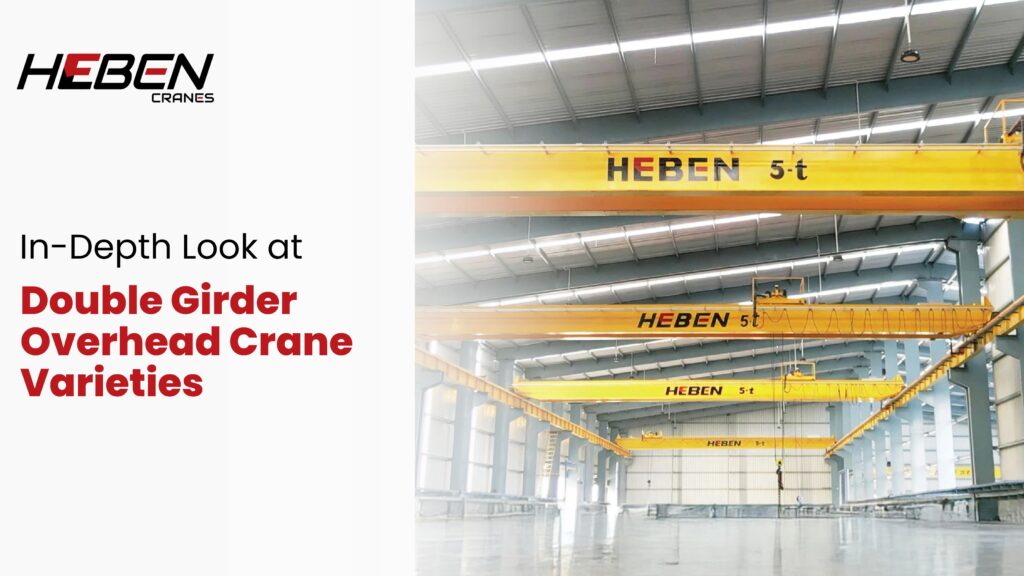
Introduction Choosing the wrong overhead crane costs more than the initial purchase price. It creates bottlenecks in production, limits future expansion, and forces expensive retrofits when capacity needs grow. Double girder overhead cranes dominate 45% of the global crane market because they solve problems single girder systems can’t handle. They lift heavier loads, span wider distances, and operate in harsher conditions. This guide breaks down the varieties available, from basic top-running models to specialized electromagnetic and grab bucket systems, helping you match the right crane type to your operational requirements. Types of Double Girder Overhead Cranes Top Running Double Girder Cranes Top running cranes mount on rails installed along the top of runway beams. The trolley travels on tracks positioned on top of the two main girders. This configuration maximizes hook height since the hoist sits between the girders rather than below them. Manufacturing plants with high-volume operations use top running designs because they offer lifting heights from 12 to 60 meters compared to single girder’s 3.2 to 40 meters. The design spans from 10.5 to 40.5 meters, making it suitable for facilities that need wide coverage areas. Underhung Double Girder Cranes Underhung cranes suspend from the bottom flange of runway beams that integrate into the building’s ceiling structure. They work in facilities with limited headroom or when you need to preserve overhead clearance. These systems cost more to install than top running designs because they require specialized mounting hardware. But they’re worth considering when building height restrictions make top running configurations impractical. Hoist Trolley vs Open Winch Systems Hoist trolley systems (LH series) use electric wire rope hoists that travel along the girders. They handle loads from 3 to 63 tons efficiently and keep initial costs lower. Open winch systems (QD series) employ separate drum winches that provide finer load control. They’re built for heavy-duty work from 3 to 550 tons with work duty classifications from A3 to A8, while single girder cranes max out at A1 to A5. Specialized Double Girder Varieties Grab Bucket Cranes (QZ Series) handle bulk materials like coal, ore, and sand. They use clamshell or orange peel grabs for loading and unloading loose materials. Electromagnetic Cranes (QC and QL Series) lift steel plates, scrap metal, and ferrous materials. The electromagnetic system includes battery backup that prevents load drops during power failures. Explosion-Proof Cranes (QB Series) operate in hazardous environments where flammable gases or dust create explosion risks. All electrical components meet explosion-proof certification standards. Insulated Cranes (QY Series) work in electrolyzing facilities for aluminum and magnesium production. They protect operators from electrical hazards in high-voltage environments. Key Features and Specifications Double girder cranes handle lifting capacities that would overload single girder systems. Standard models range from 5 to 320 tons, with custom builds reaching 800 tons. Lifting speeds vary from 0.63 to 63 meters per minute depending on load requirements. Crane traveling speeds reach 16 to 110 meters per minute, significantly faster than single girder systems. Work environment temperatures range from -20°C to +50°C, exceeding single girder capabilities of -20°C to +40°C. This extended range matters for steel mills, foundries, and outdoor applications. Design Considerations for Different Applications Manufacturing and Assembly Operations General manufacturing needs QD or LH series cranes with standard hook configurations. These handle routine lifting tasks across production lines and assembly areas. Work duty class A5 or A6 suits moderate-use facilities operating one to two shifts daily. Higher duty classes (A7-A8) support steel mills and heavy manufacturing running continuous operations. Steel and Metallurgical Industries Casting cranes (QDY and YZ series) handle molten metal ladles with heat-resistant components. They include special safety systems that prevent catastrophic failures in high-temperature environments. Double trolley cranes (QE series) coordinate two independent hoists for tandem lifting. This configuration balances extremely long or heavy loads that single-point lifting can’t manage safely. Port and Logistics Operations Gantry-style double girder cranes work at ports and outdoor storage yards. They use box girder or truss girder designs that resist weather exposure and handle container movements efficiently. The double girder gantry segment captured the largest market share in 2024 due to superior lifting capacity and stability compared to single girder alternatives. Advantages Over Single Girder Systems Double girder cranes deliver higher load capacities without sacrificing operational flexibility. Market data shows they account for the largest revenue share because they meet heavy-duty industrial demands. Longer spans create fewer support column requirements, opening up floor space for production equipment and workflow optimization. The dual girder structure provides stability that reduces load sway during movement. Maintenance access improves through walkways mounted on the bridge structure. Technicians can inspect and service components without shutting down adjacent operations. Production lead times run 30 to 45 days for standard models, with European-style designs requiring up to 45 days. This timeline allows proper engineering review and quality control before delivery. Maintenance and Operational Requirements Regular inspections focus on structural girders, wire ropes, trolley wheels, and braking systems. Double girder systems require more complex maintenance than single girder units, but their robust construction extends service life. Operator training covers load calculations, rigging procedures, and safety protocols specific to high-capacity lifting. Work duty classifications from A3 to A8 demand operators who understand the equipment’s capabilities and limitations. Power systems use cable reels, bare copper slip lines, or diesel generators depending on the facility layout. Each option affects maintenance schedules and operational costs differently. FAQs What’s the practical capacity limit for double girder cranes? Standard models reach 320 tons, with custom configurations handling up to 800 tons. Capacities beyond 500 tons require specialized engineering and extended lead times for proper structural analysis and component sourcing. How do I choose between hoist trolley and open winch systems? Hoist trolley systems cost less initially and work well for loads under 63 tons with moderate duty cycles. Open winch systems handle heavier capacities up to 550 tons and provide finer load control for precision placement in heavy manufacturing. Can double girder cranes operate in extreme temperatures? Yes, they’re rated for -20°C to +50°C
Top 5 Factors for Choosing a Single Girder Crane
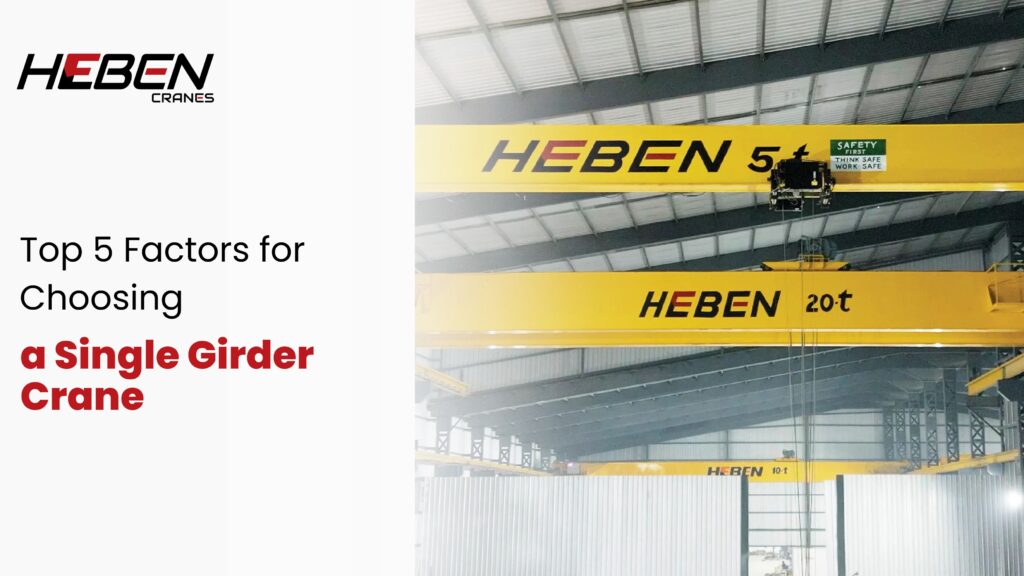
Single girder cranes account for roughly 65% of overhead crane installations globally, yet most buyers make selection decisions based on incomplete information. The reality: choosing the wrong capacity, span, or duty class costs 30-50% more over the crane’s lifespan through frequent repairs, premature replacement, or operational limitations forcing workflow compromises. Light to medium-duty operations need cranes balancing capacity, structural requirements, classification, and budget with long-term performance and reliability. This guide examines the five critical factors determining whether a single girder crane meets your needs efficiently: load capacity limits, span requirements, duty classification, configuration choices, and total ownership costs. Load Capacity Requirements Single girder cranes handle 1-20 ton capacities effectively, with most applications falling in the 5-15 ton range. Beyond 15-20 tons, double girder configurations become necessary due to structural capacity and safety requirements. Here’s the mistake most facilities make: specifying capacity matching only current maximum loads without growth buffer or dynamic load factors. A 10-ton fabrication part plus 1-ton rigging equipment under dynamic lifting conditions creates 12-13 tons of actual crane stress. Specifying an 11-ton crane leaves no margin, accelerating component wear and creating safety risks. The smart approach builds in 20-30% capacity buffer accommodating production growth, specialty tooling, and dynamic loading without premature crane replacement. This buffer costs 5-10% more upfront but avoids the 100% replacement expense when operations outgrow undersized equipment within 3-5 years. Capacity Selection Guidelines Calculate maximum load including rigging, lifting beams, and attachments Add 20-30% buffer for dynamic forces and future requirements Verify capacity matches realistic operational needs, not just peak theoretical demands Consider multiple smaller lifts versus occasional heavy loads impacting duty classification Span Length and Workspace Dimensions Single girder cranes economically cover spans up to 60-65 feet (18-20 meters). Beyond this length, material availability limitations and deflection concerns make double girder designs more practical and cost-effective. Span directly affects crane cost, structural requirements, and building modifications. A 30-foot span crane weighs approximately 40% less than a 60-foot unit of identical capacity, reducing runway support requirements and installation complexity. Measure your facility accurately. Column spacing determines maximum practical span, minus clearances for crane end trucks and safety margins. Most specifications require 18-24 inches total clearance, directly impacting usable lifting area. Duty Classification and Usage Intensity Duty class governs structural design, component quality, and expected service life. Single girder cranes typically operate in Class A through D ranges, with A3 and A4 most common for light industrial applications. Classification breakdown: Class A (standby/infrequent use) handles precise slow-speed lifting. Class B (light service) manages 2-5 lifts hourly. Class C (moderate service) completes 5-10 hourly lifts averaging 50% capacity. Class D (heavy service) performs 10-20 lifts per hour at 65% of rated capacity. The data most buyers ignore: a Class C crane operating under Class D conditions experiences 2-3 times normal wear rates, requiring major component replacement at 8-10 years instead of the designed 15-20 year lifespan. The 15-20% premium for proper duty classification pays back through extended service intervals and avoids early replacement. Duty Classification Matching Class A/B: Maintenance shops, occasional material handling, precise positioning requirements Class C: General manufacturing, fabrication shops, moderate cycling 5-10 lifts/hour+1 Class D: Production facilities, intensive material handling, 10-20 lifts/hour Class E/F: Typically exceed single girder practical limits; require double girder designs Top Running vs Under Running Configuration Top-running single girder cranes ride on rails mounted atop runway beams, offering higher capacity and easier maintenance access. Maximum capacities reach 15-20 tons with robust structural support. Under-running (underhung) cranes suspend from the bottom flange of runway beams, maximizing floor space when mounted to existing ceiling structures. This eliminates columns consuming production area but limits practical capacity to 10 tons and complicates service access. The contrarian insight: if building structure can’t support a 12-ton top-running crane, two 6-ton underhung units might provide equivalent capacity without expensive structural reinforcement. Total cost often favors this creative approach over single-crane building modifications. Maintenance accessibility differs significantly. Top-running designs allow direct technician access to wheels, rails, and drive components. Under-running systems require suspension rigging for component service, extending downtime and labor costs 40-60%. Total Cost of Ownership Initial purchase price represents only 40-60% of lifecycle costs over a crane’s 20-25 year service life. Maintenance frequency, component longevity, energy consumption, and downtime determine the remaining expenses. Single girder cranes cost 30-40% less initially than comparable double girder units due to lighter construction and simpler trolley designs. Installation expenses run 25-35% lower from reduced weight and faster assembly. Maintenance costs favor single girder designs through fewer components and simplified service procedures. Annual maintenance typically runs 3-4% of crane value versus 5-6% for double girder configurations. Energy efficiency depends more on control systems than structural design. Variable frequency drives reduce consumption 30-40% compared to resistance controls, recovering the 15% equipment premium within 3-4 years in facilities operating 2,000+ hours annually. Cost Comparison Reality Single girder advantages disappear when mismatched to applications. A Class C crane forced into Class D duty requires major overhauls at 8-10 years instead of designed 15-20 years, negating initial savings through premature failure. Proper specification matching application intensity delivers advertised lifecycle value. Frequently Asked Questions Q: Can single girder cranes be customized with platforms and walkways? A: Limited customization is possible but becomes difficult and expensive compared to double girder designs. The single main girder structure restricts attachment points for heavy platforms, service walkways, or specialized under-hook devices. Evaluate customization needs during specification—extensive modifications may justify double girder configurations offering better mounting flexibility. Q: What’s the maximum practical span for single girder cranes? A: Most single girder cranes limit spans to 60-65 feet (18-20 meters) due to standard rolled section availability and deflection concerns. Longer spans require fabricated box girders or double girder configurations providing necessary structural capacity. Pushing single girder designs beyond practical limits creates excessive deflection, reduced positioning accuracy, and accelerated wear. Q: How does duty classification affect crane lifespan? A: Duty class directly determines structural design strength and component quality targeting specific operational intensities. A Class C crane handles approximately 63,000 lifts
Economical 3-Ton Cranes for Light Industrial Lifting
Budget-conscious buyers make a costly mistake when they prioritize the lowest purchase price over total ownership value. Here’s the data that shocks most procurement teams: a 3-ton crane costing 20% less upfront but requiring 40% more maintenance over 10 years actually costs 15-25% more in total expenses than a quality unit with higher initial investment. Light industrial operations need reliable lifting equipment that balances affordability with durability, safety, and serviceability. This guide examines economical 3-ton crane types, essential features preventing expensive repairs, customization optimizing value, typical applications, cost considerations beyond sticker price, and selection criteria ensuring smart purchasing decisions. Types of Economical 3-Ton Cranes Single girder overhead cranes dominate the 3-ton capacity range due to their lightweight structure, reduced material costs, and simpler installation requirements. They handle spans from 7.5 to 31.5 meters with lifting heights reaching 30 meters, covering most light industrial applications. Low headroom designs optimize vertical space by positioning the hoist mechanism on the bridge side rather than below, gaining 20-30% additional hook height compared to standard configurations. Facilities with ceiling clearance constraints benefit significantly from this design without sacrificing lifting capacity. Gantry cranes provide portable alternatives when building structures can’t support overhead installation. Three-ton gantry options include fixed position models, semi-gantry designs using one runway beam and building support, and adjustable height units accommodating varied workflows. Crane Type Selection Guide Standard Single Girder: Spans 7.5-31.5m, most economical for typical workshops, A3 duty class for 8-10 hour daily operation Low Headroom: Same capacity with 20-30% improved hook height, ideal for space-constrained facilities Underhung: Suspension from existing structure, eliminates floor supports, capacity typically limited to lighter ranges Portable Gantry: Flexible positioning, no building modification required, trade-off in stability vs mobility Essential Features for Long-Term Value Control system selection impacts both initial price and operational efficiency. Pendant controls offer the most economical option for stationary operator positions. Wireless remote controls increase cost 15-20% but improve operator visibility and positioning flexibility. Full cabin controls suit intensive operations requiring extended operator presence but add 30-40% to base price. Variable frequency drives (VFD) provide precise speed control, smooth acceleration reducing structural stress, and significant energy savings offsetting higher upfront costs. Dual-speed hoists enable both rapid transit at 8m/min and precision positioning at 2m/min. Safety features separate quality manufacturers from budget vendors cutting corners. Essential inclusions are overload protection preventing dangerous lifts, emergency stop systems with redundant controls, limit switches halting over-travel, and anti-sway technology improving load positioning. Customization Maximizing Value Span length and lifting height customization ensures cranes match facility dimensions without over-specification waste. Standard spans range 7.5-31.5 meters, with customization accommodating unusual building layouts or future expansion plans. Duty class selection affects structural design, component quality, and service life. A3 classification suits light to moderate use totaling 8-10 hours daily with lifting cycles under 25% of rated capacity. A5 duty handles more intensive operations but costs 20-30% more through heavier construction and upgraded components. Environmental adaptations prevent premature failure in challenging conditions. Dust-proof electrical enclosures protect components in cement or woodworking facilities. Heat-resistant materials and thermal protection suit foundries or high-temperature environments reaching 60°C. Corrosion-resistant coatings extend life in chemical processing or coastal locations. Power supply compatibility matters more than buyers expect. Verify voltage requirements (220V-660V options available) match facility electrical systems to avoid expensive transformer installations. Typical Applications and Use Cases CNC machining workshops benefit from 3-ton cranes handling precision molds weighing 0.8-2.5 tons, stainless steel shafts and titanium components ranging 0.5-2.7 tons, and tool-changing system modules. The combination of accurate positioning and adequate capacity supports efficient material flow without equipment over-sizing. Concrete production facilities use low headroom 3-ton cranes for cement bags, precast components under 2.7 tons, and production molds. The compact design adapts to limited vertical space while delivering 90% coverage of typical load demands in the sector. Steel pipe processing operations leverage 3-ton cranes moving 6-meter pipes weighing up to 2.7 tons individually or bundled loads of 1.5-2.8 tons. Remote control operation ensures stability handling long materials, with typical facilities completing 30-50 lifts daily. Warehousing and logistics applications use 3-ton capacity for inventory management, container handling, and loading operations where mobility and precision matter more than heavy lifting capability. Cost Considerations Beyond Purchase Price Initial investment for 3-ton cranes varies significantly by type and features. Standard single girder models range $2,130-$7,680 depending on span, lifting height, and specifications. Low headroom versions add approximately 5% premium. European FEM-standard cranes cost $4,980-$11,050 through enhanced materials and precision manufacturing. The uncomfortable truth most buyers ignore: purchase price typically represents 40-60% of total ownership cost over a crane’s 20-25 year lifespan. Maintenance frequency, component replacement rates, energy consumption, and downtime expenses determine the remaining 40-60%. Energy efficiency deserves calculation beyond marketing claims. VFD-equipped cranes consume 30-40% less electricity than resistance-controlled alternatives in typical duty cycles. For operations running 2,000+ hours annually, energy savings recover the 15-20% VFD premium within 3-4 years. Component quality from reputable manufacturers (motors, gearboxes, electrical controls) reduces maintenance frequency and extends intervals between major overhauls. Cheap alternatives require component replacement 2-3 times more frequently, negating initial savings through labor costs and downtime. After-Sales Support Value Installation support determines whether cranes operate reliably from commissioning or require expensive corrections. Professional manufacturers provide detailed assembly guidance, remote technical assistance, and optional on-site supervision ensuring proper setup. Operator training prevents equipment abuse extending service life and improving safety. Comprehensive programs cover safe operating procedures, pre-shift inspection protocols, load handling techniques, and emergency response. Maintenance contracts optimize uptime through scheduled inspections, predictive component replacement, priority response for breakdowns, and discounted parts. The investment typically costs 3-5% of crane value annually but reduces unplanned downtime 40-60% compared to reactive maintenance approaches. Spare parts availability affects both downtime duration and repair costs. Manufacturers maintaining stock and providing rapid shipping minimize production interruptions when components fail. Generic parts from lowest-cost sources often require modification, create compatibility issues, or fail prematurely. Frequently Asked Questions Q: What is the realistic lifespan of an economical 3-ton crane in light industrial use? A: Quality 3-ton cranes operate
Overhead or Underhung Cranes: Which Is Best?
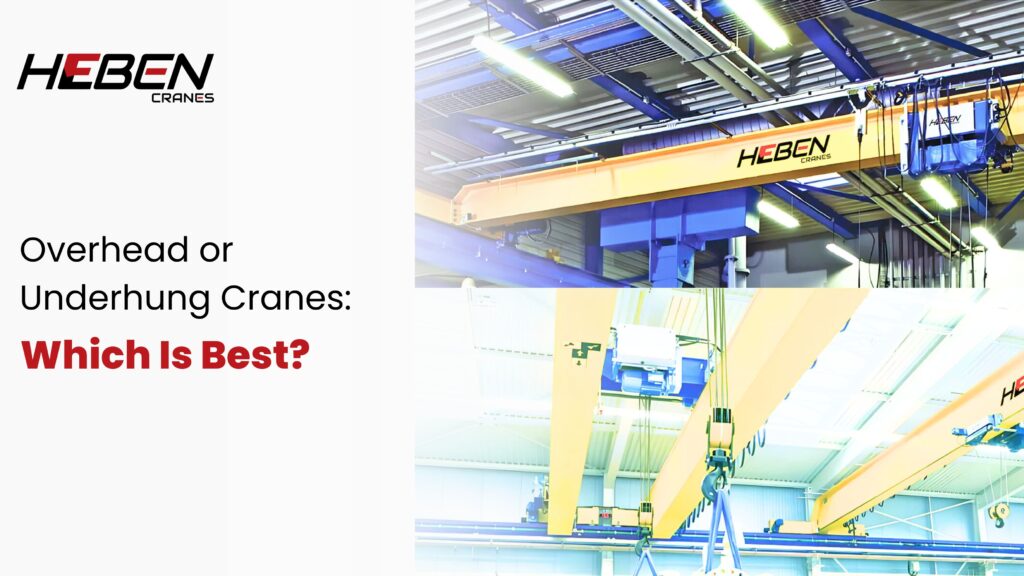
Choosing between overhead (top-running) and underhung (under-running) cranes confuses many facility managers because both systems appear to accomplish the same task—lifting and moving loads. Yet picking the wrong configuration costs thousands in unnecessary structural modifications, limits operational capacity, or creates maintenance headaches lasting decades. Here’s the surprising reality: most facilities choose based on upfront price alone, ignoring factors like headroom optimization, floor space utilization, and long-term service requirements that determine total ownership value. This guide examines how each crane type operates, their capacity and structural differences, key advantages and limitations, and the critical decision factors ensuring you select the optimal configuration for your facility’s specific needs. Basic Design and Operating Differences Overhead cranes ride on rails mounted atop runway beams, with end trucks carrying the bridge along the top of the support structure. The hoist and trolley can run beneath the bridge on single girder designs or on top of the bridge on double girder configurations, maximizing hook height. Underhung cranes suspend from the bottom flange of runway beams, traveling underneath the support structure. The entire crane system hangs from the runway, with wheels moving along the lower beam flange rather than riding on top-mounted rails. This fundamental structural difference affects everything from building requirements to maintenance procedures. Overhead systems require stronger runway beams capable of supporting rail systems and crane loads from above. Underhung systems distribute weight differently, often allowing integration with existing ceiling structures without major reinforcement. Capacity and Lifting Height Comparison Load capacity represents the clearest distinction between configurations. Overhead cranes handle anywhere from 1/4-ton to over 400 tons with no practical upper limit. They scale from light-duty applications through the heaviest industrial lifting requirements. Underhung cranes typically max out at 10-15 tons capacity, though some specialized designs push slightly higher. The suspended design and lighter structural components limit practical capacity for most applications to the light-to-medium duty range. Capacity Guidelines Overhead Single Girder: 1/4-ton to 20 tons, spans under 65 feet, light to medium duty Overhead Double Girder: 20-400+ tons, spans over 65 feet, medium to heavy duty Underhung Systems: 1/4-ton to 15 tons, spans under 65 feet, light to medium duty Hook height differences matter more than most buyers expect. Overhead cranes—particularly double girder configurations—provide 3-6 feet additional lifting height because the hoist runs atop the bridge girders. This extra height proves critical in facilities with limited headroom or requiring maximum vertical reach. Underhung systems sacrifice lifting height because the bridge and hoist hang beneath the runway beams. Facilities with abundant ceiling clearance handle this limitation easily, but space-constrained operations face real constraints. Structural and Installation Requirements Building structure capacity determines which configuration works without expensive reinforcement. Overhead cranes demand robust runway beam support capable of handling concentrated loads from rail-mounted crane travel. Older facilities or lighter construction often require structural upgrades adding significant cost. Underhung cranes frequently integrate with existing ceiling trusses or roof structures because the suspended design distributes loads differently. This compatibility reduces or eliminates structural modification expenses in many installations. Freestanding support becomes necessary when building structures can’t accommodate crane loads. Overhead cranes use columns supporting runway beams and rails. Underhung systems similarly require columns when ceiling attachment proves impractical. Both freestanding configurations consume valuable floor space that might otherwise support production or storage. Here’s the insight most specifications miss: if your building can’t support a 10-ton overhead crane, two 5-ton underhung cranes might provide equivalent lifting capacity without structural reinforcement. This creative approach avoids construction costs while maintaining operational capability. Advantages of Overhead Cranes No capacity limitations represent the primary advantage—overhead configurations handle any lifting requirement from fractional tons through hundreds of tons. This scalability accommodates current needs and future growth without replacement. Easier maintenance and service access stems from the top-mounted design. Wheels, rails, and drive components sit accessible on top of runway beams rather than requiring suspension from below. Service and alignment procedures complete faster with less downtime. Maximum hook height and lifting reach suit facilities needing every available inch of vertical clearance. Double girder designs particularly excel when headroom optimization determines operational capability. Higher speeds for trolley and bridge movement accelerate cycle times in high-volume operations. The robust construction supports faster travel without structural concerns limiting performance. Advantages of Underhung Cranes Floor space maximization happens when underhung cranes mount to existing ceiling structures, eliminating columns that would otherwise consume production area. Facilities where every square foot counts gain significant value from this space efficiency. Better side approach and coverage across building width results from the suspended design. Underhung configurations can position loads closer to walls and edges than overhead systems where runway structure creates clearance requirements. Fewer tracking problems occur because underhung cranes bolt directly to I-beams secured to building structure. This attachment limits movement and reduces rail misalignment issues that top-running systems experience more frequently. Lower initial costs in facilities with suitable ceiling structure make underhung systems attractive for budget-conscious operations. Eliminating runway support columns and using lighter components reduces material and installation expenses. Service and Maintenance Considerations Overhead crane rail alignment requires more frequent checking but proves easier to perform. Technicians access rails and wheels directly without complex rigging. Service completes quickly with minimal downtime. Underhung crane alignment happens less frequently due to the stable I-beam attachment. However, when service becomes necessary, suspension and rigging requirements extend downtime significantly compared to overhead systems. The complexity of accessing suspended components increases both time and cost. Parts availability favors overhead configurations, particularly for common capacities and spans. Standardization and market dominance mean replacement components ship faster and cost less than specialized underhung parts. Decision Factors for Selection Load capacity requirements drive the fundamental choice. Operations regularly handling over 15 tons need overhead configurations. Lighter-duty applications gain flexibility choosing based on other factors. Existing building structure and ceiling height determine practical options. Limited headroom favors overhead cranes maximizing hook height. Facilities with robust ceiling structures but restricted floor space benefit from underhung designs. Budget constraints including installation costs matter, but smart buyers evaluate total ownership expenses rather