
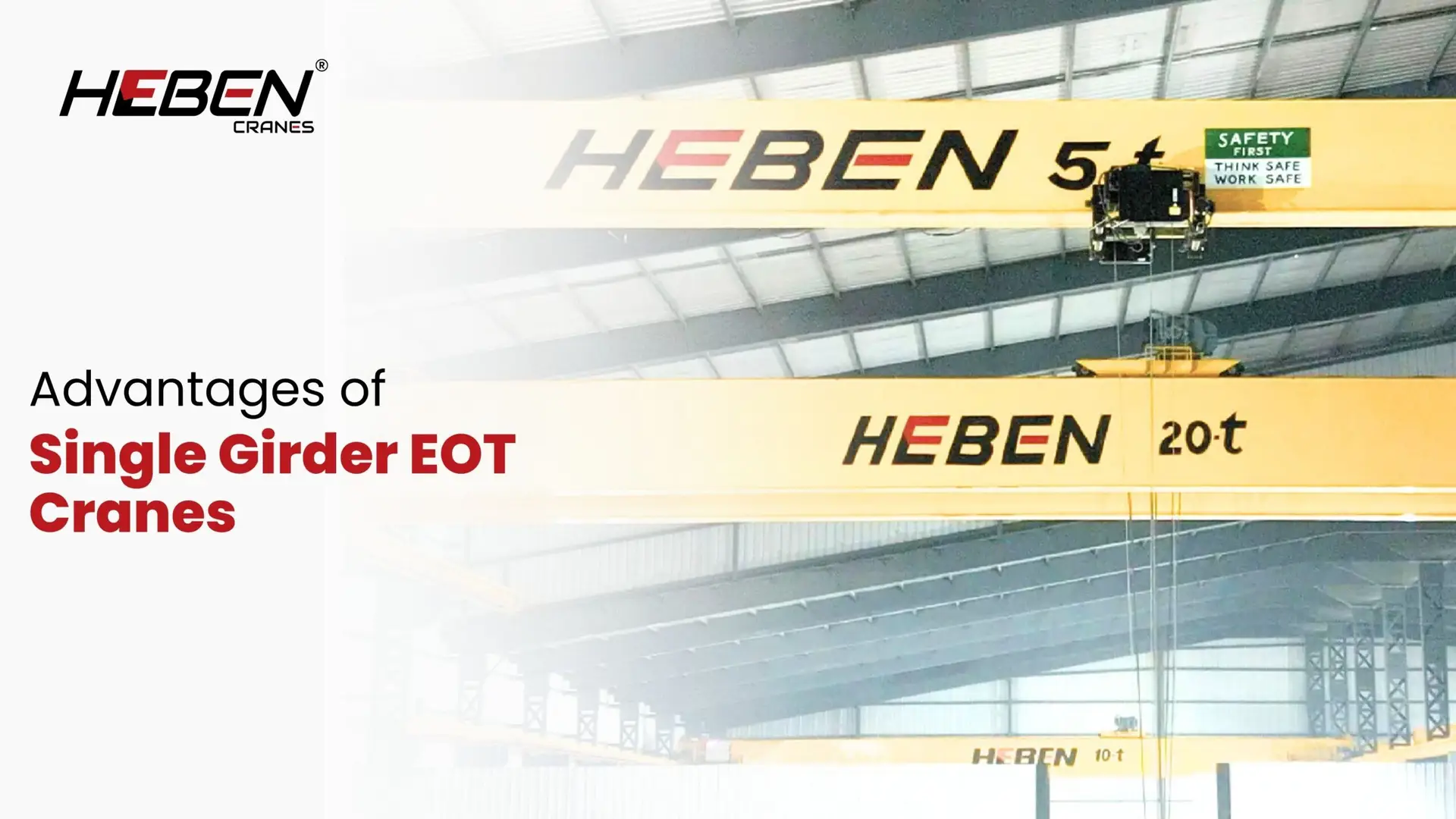
When a factory floor is tight on space, the lifting system can quietly become the bottleneck. Cramped bays, low roof clearances, and modest budgets push plant managers into a difficult corner — invest heavily in heavy-duty infrastructure or accept limited productivity. Single girder EOT cranes cut through that trade-off cleanly.
This piece walks through what a single girder EOT crane is, how it delivers real value on the shop floor, and what separates a good crane selection from a costly one. If you’re evaluating lifting solutions for a light-to-medium-duty operation, you’re in the right place.
What Is a Single Girder EOT Crane?
A single girder EOT (Electric Overhead Travelling) crane runs on a single horizontal beam — the bridge girder — supported by end trucks that travel along runway rails mounted to the building structure. The hoist and trolley are suspended from the bottom flange of that single beam.
This is a fundamental design choice, not a compromise. It keeps the crane compact, lightweight, and structurally efficient for loads typically ranging from 1 to 20 tonnes across spans up to 35 metres.
How a Single Girder EOT Crane Works
The crane moves in three axes:
- Long travel — the end trucks move the entire bridge along the runway rails
- Cross travel — the trolley moves along the bridge girder
- Hoisting — the electric hoist lifts and lowers the load
A control panel, pendant station, or remote manages all three movements. The system is driven by electric motors with variable-frequency drives in modern configurations, giving operators smooth, precise control.
Key Advantages of Single Girder EOT Cranes
Lower Cost, Faster ROI
Single girder cranes use less structural steel than double girder alternatives. That directly reduces the fabrication cost, the installation cost, and the load transferred to your building structure. For small-to-medium facilities, this matters enormously — you aren’t paying for overhead capacity you’ll never use.
Here’s an insight most buying guides skip: because the crane is lighter, many existing industrial buildings can support a single girder installation without structural reinforcement. That eliminates what is often the single biggest hidden cost in a crane retrofit.
Better Headroom in Low-Clearance Buildings
The hoist in a single girder crane sits below the bridge beam. This seems like a minor detail until you calculate actual hook height in a building with a 6–7 metre eave. In those environments, every 200mm of hook height is usable lift. Single girder designs routinely deliver 300–500mm more usable lift compared to double girder cranes in the same bay.
Easier Installation and Maintenance
Fewer components mean fewer points of failure. The single beam structure is faster to erect, easier to align, and simpler to inspect. Routine maintenance — checking the hoist, inspecting the end trucks, greasing the rail contacts — takes less time and requires less scaffolding access.
Suitable for a Wide Range of Industries
Single girder EOT cranes are deployed across:
- Engineering workshops — machine loading, component transfer
- Warehouses and logistics hubs — pallet and unit load handling
- Automobile ancillary units — sub-assembly lifting
- Textile mills — roll and bale handling
- Railway and fabrication yards — beam and plate movement
- Food processing plants — hygienic lifting in process areas
Single Girder vs. Double Girder
| Factor | Single Girder | Double Girder |
| Capacity range | 1–20 tonnes | 10–500+ tonnes |
| Hook height | Higher (hoist below beam) | Lower (hoist above/between beams) |
| Building load | Lower | Higher |
| Cost | Lower | Higher |
| Maintenance access | From ground/pendant | Dedicated walkway needed |
The right choice depends on your load, span, and duty cycle — not on a default preference for “more crane.”
Things to Consider Before Buying
- Capacity and span — size the crane to your peak load, not your average load
- Duty class — IS/FEM classifications determine motor and structure sizing; don’t skip this
- Headroom — measure hook height at the lowest point of the hoist travel
- Building structure — verify that your existing columns and runway beams can take the crane’s dead load plus dynamic forces
- Control type — pendant, radio remote, or cabin; choose based on operator position and load visibility
Frequently Asked Questions
What is the maximum capacity of a single girder EOT crane?
Standard single girder EOT cranes handle up to 20 tonnes. Beyond that, double girder designs are structurally more appropriate due to deflection limits on a single beam.
Can a single girder crane be installed in an existing building?
Yes — and this is one of their key advantages. Because the dead load is significantly lower than double girder cranes, many existing industrial structures can accommodate a single girder crane without column or truss reinforcement.
What is the standard span range?
Spans typically run from 6 metres to 35 metres, depending on the manufacturer’s design standards and the load being handled.
How long does a single girder EOT crane last?
With proper maintenance and correct duty-class selection, a well-built single girder crane routinely operates for 20–25 years. Duty mismatches — running a light-duty crane on a heavy-duty cycle — are the most common cause of premature failure.
What safety features are standard?
Overload protection, end-of-travel limit switches, emergency stop, and anti-collision systems are standard on quality-built cranes. Variable-frequency drives also reduce mechanical shock, extending component life.
Conclusion
Single girder EOT cranes deliver exactly what most light-to-medium industrial operations need: reliable lifting, low structural demand, manageable cost, and straightforward maintenance. They aren’t a scaled-down solution — they are the correctly scaled solution for a large share of real factory environments.
At Heben Cranes, we engineer single girder EOT cranes built to your bay dimensions, load requirements, and duty classification — not off a generic shelf. Our team carries out full site assessments, recommends the right configuration, and supports you through installation and beyond. If you’re evaluating a lifting solution for your facility,
Get in touch with Heben Cranes and let’s build the right fit for your operation.