
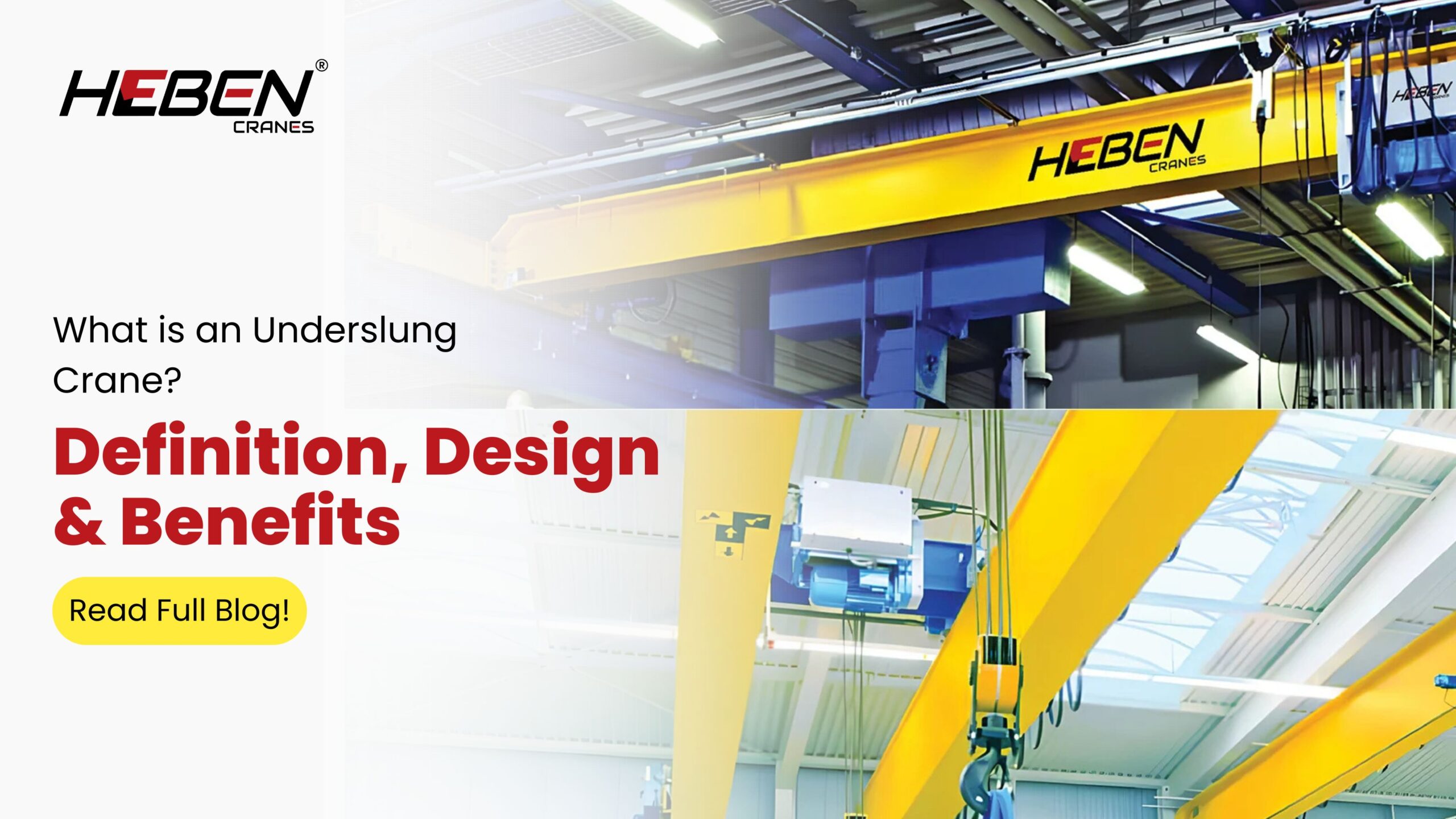
Facilities try to add overhead lifting and immediately hit a ceiling—literally. Standard top-running cranes consume 600–1,200mm of vertical clearance for runway beams, rail height, and crane structure. In buildings with 5–7 metre eaves, that headroom loss is the difference between the crane working and being useless. Underslung cranes solve this by suspending from the existing roof structure rather than sitting on top of it—recovering critical height and eliminating the need for floor-level support columns. This guide covers the definition, structural design, key benefits, common applications, installation requirements, and the conditions where underslung cranes make clear operational sense.
What Is an Underslung Crane?
An underslung crane is an overhead travelling crane that runs on the bottom flange of its runway beams rather than on top-mounted rails. The entire crane bridge hangs below the runway structure. The hoist and trolley travel beneath the bridge girder.
The terms underslung, underhung, under-running, and suspension crane all refer to the same configuration. The defining characteristic is the suspended position—crane weight and lifted load both hang from the building structure rather than bearing down through a separate ground-supported framework.
This is the key difference from a conventional EOT crane. Top-running cranes ride rails fixed to the tops of runway beams. Underslung cranes hang from the flanges of those same beams or directly from roof steelwork. The structural logic is reversed, and the implications for headroom, floor space, and installation cost follow directly.
How the Design Works
The runway consists of I-section beams attached to the building’s roof structure or ceiling steelwork. End trucks carrying the bridge travel along the lower flanges of these runway beams. The bridge girder, single or double, spans between the two end trucks below the runway level.
The hoist and trolley hang from the bridge girder. Load travel follows the same two-axis pattern as any overhead crane: bridge moves along the runway, trolley moves across the bridge. The working envelope covers the full floor area beneath the runway, minus clearance margins at each end.
Single girder underslung designs handle most light and medium industrial applications. Double girder variants extend capacity and span range while maintaining the suspended configuration. Both share the same runway attachment principle—the structural logic stays consistent regardless of girder count.
Key Design Features
Underslung cranes are compact by design. The crane profile sits within the depth of the runway beams rather than projecting above them. This directly reduces the overall height consumed by the crane system in any given building.
Low headroom is the primary structural feature. Standard top-running cranes need dedicated runway beam height above the crane. Underslung designs use the beam depth that already exists in the roof structure. The recovered height is real and measurable—typically 600–1,200mm depending on the building.
Main Design Characteristics
- Suspension from building roof steel or dedicated runway beams fixed to roof structure
- End trucks run on lower I-beam flanges, no top-mounted rail required
- Single or double girder bridge configurations
- Capacity typically from 250kg to 20 tons
- Spans from 4 to 25 metres depending on building structure
Main Benefits
Floor space is the most immediate benefit. No support columns reach from floor to runway. The entire floor area below the crane remains clear for machinery, vehicles, storage, and workflow. In production facilities where floor space is expensive, this matters directly.
Retrofit capability is the benefit most buyers don’t anticipate. Underslung cranes attach to existing roof steelwork rather than requiring new foundations and columns. This makes them the practical solution for adding crane coverage to buildings that weren’t designed for overhead cranes.
The contrarian insight: facilities that plan for top-running cranes from the start often spend 30–50% more on building structure than underslung installations require. Columns, crane girders, and rail systems are all additional line items. Underslung installations use what the building already has.
Installation speed follows from this logic. Less new structural work means faster commissioning and less disruption to existing operations during installation.
Applications and Industries
Manufacturing and assembly operations use underslung cranes at workstation and bay level. The clear floor space suits production lines where forklift paths and operator movement must remain unobstructed.
Warehouses and logistics centres benefit from underslung coverage across full floor width with no column interference in racking aisles or loading zones. Pallet handling, container unloading, and inventory transfer all suit the configuration.
Typical Industry Fits
- Fabrication workshops with low eaves needing maximum hook height
- Maintenance buildings where floor access matters as much as lifting
- Clean rooms and pharmaceutical facilities where floor-level structure creates contamination risk
- Electronics and light assembly environments requiring precise, low-impact lifting
- Steel service centres and engineering shops in existing low-bay buildings
Capacity and Span Limits
Practical capacity for underslung cranes sits between 250kg and 20 tons. Most applications fall in the 500kg to 10-ton range. Above 15–20 tons, the runway beam flange loading and deflection considerations make top-running configurations more structurally efficient.
Spans cover 4 to 25 metres in standard configurations. Long spans at higher capacities require professional structural verification of the runway beams and their connections to building steelwork. Deflection limits govern design at the upper end of the span range.
Duty classification typically matches A3–A5 light to moderate service. Intensive high-cycle operations demanding A6–A8 ratings need the structural mass of top-running double girder configurations. Underslung designs serve the moderate-duty band well but aren’t the right tool for the most demanding lifting regimes.
Installation Requirements
Existing building steel must carry the crane loads. This is not optional and not assumable. Structural analysis verifies that runway beams, their connections, and the primary roof structure can handle crane dead weight plus rated lifted load plus dynamic impact factors.
Beam alignment is critical. Runway beams must be parallel, level, and within straightness tolerances of ±3mm along the span. Misaligned runways cause uneven wheel loading, accelerated flange wear, and crane tracking problems that compound over time.
The uncomfortable reality: approximately one in three existing buildings assessed for underslung crane installation requires some structural upgrade before the crane can be installed safely. The upgrade may be minor—additional beam connections or local stiffening—or significant. Structural assessment before procurement avoids cost surprises.
Safety and Maintenance
Underslung cranes require systematic inspection of wheel-to-flange contact, runway beam condition, suspension connections, and hoist mechanism function. Inspection intervals match duty class—monthly for regular service, more frequently for intensive use.
Safety devices follow standard overhead crane requirements: end travel limit switches on bridge and trolley, hoist upper and lower limits, overload protection, and emergency stop. Control options range from pendant and wireless remote to cabin for larger installations.
Component life is comparable to equivalent top-running designs when runway alignment is maintained and service schedules are observed. The suspended configuration doesn’t inherently reduce service life—misalignment and deferred maintenance do.
Frequently Asked Questions
Can underslung cranes be installed in any building?
No. The building’s roof structure must have verified capacity to carry crane loads. Professional structural assessment is mandatory. Buildings with steel roof frames are the most straightforward candidates. Concrete, timber, or lightweight steel roofs require careful analysis and often structural enhancement before underslung crane installation proceeds.
What is the maximum practical capacity for an underslung crane?
Most underslung cranes operate effectively up to 10–15 tons. Capacities up to 20 tons are achievable with appropriate runway beam design. Above this threshold, top-running double girder configurations deliver better structural efficiency and should be specified instead. The limiting factor is runway beam flange bending capacity and deflection under combined load.
How much headroom does an underslung crane recover versus a top-running crane?
Typical headroom savings range from 600mm to 1,200mm depending on building and crane specifications. This recovery comes from eliminating the top-mounted rail system and the vertical distance between rail base and crane bridge. In low-bay buildings with 5–7 metre eaves, this difference directly determines whether a crane can function or not.
Are underslung cranes suitable for outdoor use?
Standard underslung cranes are designed for indoor sheltered environments. Outdoor installation requires weatherproofed electrical components, corrosion-resistant finishes, and structural provisions for wind loading and temperature variation. These are achievable but must be specified explicitly—standard indoor configurations are not suitable for outdoor exposure without modification.
How do underslung cranes compare in cost to top-running installations?
In buildings with adequate existing roof structure, underslung installation costs 25–40% less than a comparable top-running crane including runway and structural work. The saving comes from eliminating new columns, foundations, and crane girder sections. When structural upgrades to existing steelwork are required, the cost advantage narrows and must be recalculated on a project-specific basis.
Conclusion
Underslung cranes solve the headroom and floor-space problems that prevent conventional cranes from working in low-bay or retrofit building conditions. The design is technically straightforward and commercially well-proven across manufacturing, logistics, and maintenance applications. The prerequisite is structural verification—get that confirmed early and the rest of the project follows cleanly. Contact Heben Cranes today for a site assessment and underslung crane specification matched to your building and lifting requirements.
Heben Cranes manufactures underslung single and double girder crane systems for capacities from 250kg to 20 tons and spans to 25 metres. Our engineering team conducts building structure reviews, verifies runway beam capacity, designs crane configurations recovering maximum headroom, and manages installation through commissioning. Every project includes structural load calculations, full safety documentation, operator training, and warranty coverage. Whether you’re retrofitting an existing facility or specifying a new low-bay building, we deliver underslung crane solutions that fit the structure you have. Contact Heben Cranes for a building assessment and customised underslung crane proposal.