
Introduction
Your facility handles heavy loads across wide spans, and a single girder crane won’t hold. The structural limits of one-beam configurations become clear fast — insufficient hook height, inadequate capacity, and spans that flex under load. A double girder crane solves this with two parallel main beams that carry the hoist between them, delivering higher capacity, longer spans, and greater hook height than single girder alternatives. This guide covers the definition, structural design, key components, types, applications, and selection criteria to help you match the right configuration to your actual load patterns and bay dimensions.
What Is a Double Girder Crane?
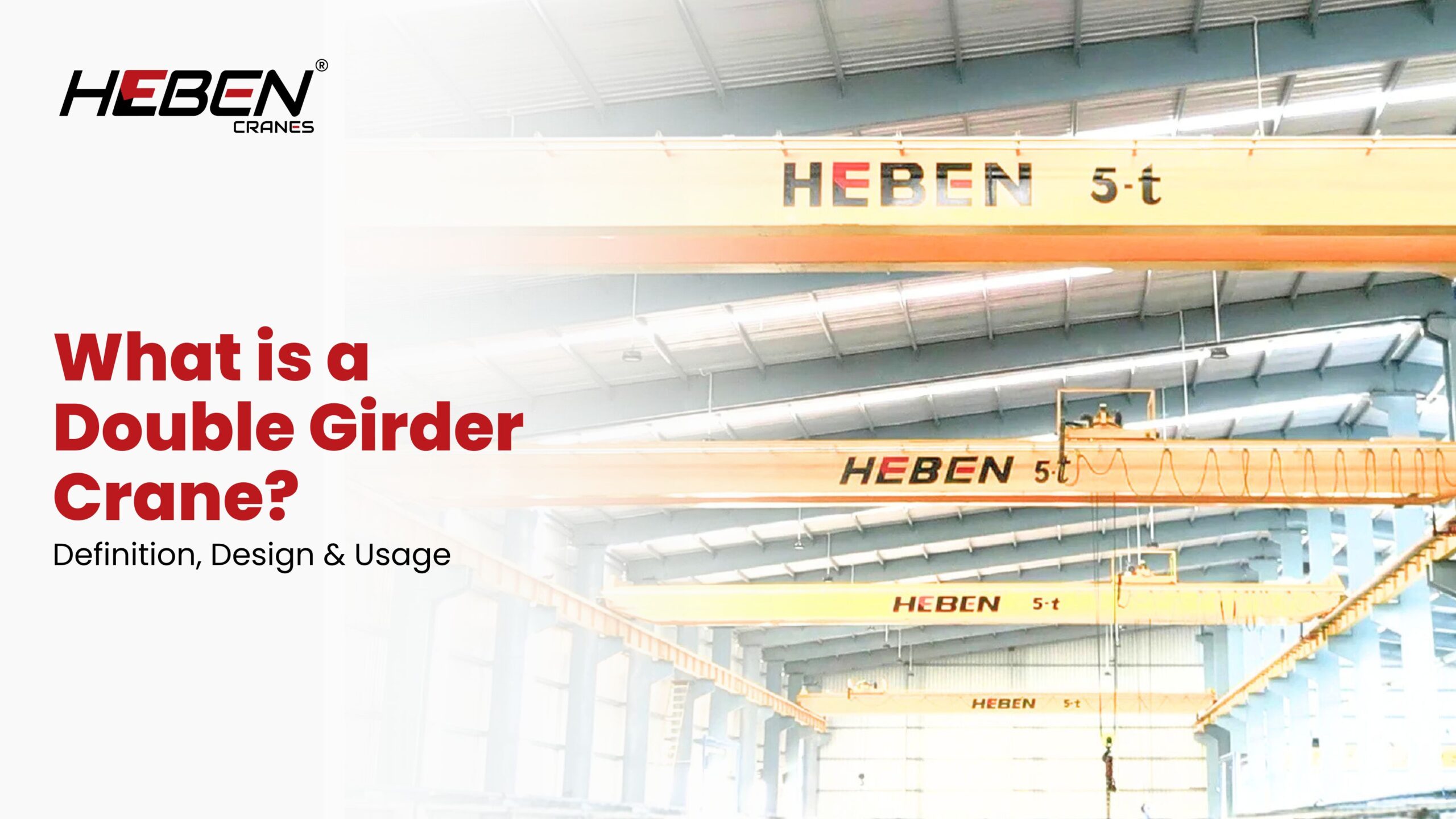
A double girder crane is an overhead travelling crane that uses two parallel main bridge beams instead of one. The hoist trolley rides on rails mounted on top of or between these two girders. End carriages connect both girder ends and travel along runway beams fixed to building columns.
This configuration directly addresses the structural limits of single girder design. Two beams resist deflection under heavy loads, support wider spans without sagging, and allow the hoist to sit higher — closer to the runway level — which increases the usable hook-to-floor distance.
The double girder crane is the standard configuration in steel plants, automotive facilities, and power plants across India. It is not a premium upgrade from single girder — it is a separate class of crane serving a different operational requirement.
Design and Structure
Two box section or I-beam girders span the full width of the bay. The girders sit parallel to each other at a fixed spacing that accommodates the hoist trolley between or above them. End carriages bolt to both ends of both girders, forming a rigid rectangular bridge structure.
Top-running designs position the bridge on top of runway beams. Under-running designs suspend the bridge from the bottom flange of runway beams, used in low-headroom facilities. Top running is the more common industrial configuration for heavy-duty applications.
Box girder construction is standard for higher capacities. The hollow rectangular section provides superior torsional stiffness compared to open I-beam profiles. This stiffness matters when loads swing dynamically or when trolley travel speeds are high.
Key Components
Every double girder crane uses the same functional set of parts:
- Bridge girders: Two parallel structural beams spanning the bay width
- End carriages: Connect girder ends and contain wheels, drive motors, and brakes for runway travel
- Hoist and trolley: Hoist provides vertical lifting; trolley travels laterally between or on the girders
- Runway beams: Fixed to building columns and carry the full bridge load
- Control system: Pendant, radio remote, or operator cabin mounted on the bridge
- Safety devices: Overload protection, limit switches, emergency stops, anti-collision sensors
Electrical panels house motor controls, variable frequency drives, and circuit protection for all drives.
Advantages Over Single Girder Cranes
The structural case for double girder is straightforward. Two beams handle what one beam cannot:
- Higher capacity: Practical range extends from 5 tons to 250+ tons
- Greater hook height: Hoist sits above or between the girders rather than below a single beam, recovering 0.5–1.5 meters of hook travel
- Longer spans: Spans up to 60 meters without excessive deflection
- Better load distribution: Two girders spread wheel loads across runway beams, reducing peak stresses
- Heavy-duty suitability: Duty classes A5 to A7 for continuous high-frequency operation
Here’s the pattern most buyers miss: over 60% of facilities that later retrofit to double girder cranes could have specified the right configuration at the outset with a proper load study. The cost of retrofit — new runway beams, column reinforcement, full crane replacement — far exceeds the initial specification difference.
Types and Configurations
Double girder cranes vary by mounting method and structural class:
- Top running: Bridge rides on top of runway beams — dominant configuration for heavy industry
- Under running: Bridge suspends from runway beam bottom flange — used in low-headroom applications
- Standard duty: A3–A4 class for moderate industrial use
- Heavy duty: A5–A6 class for steel, automotive, and process plants
- Extra heavy / metallurgical: A7–A8 class for continuous operation in ladle cranes and cast houses
Custom multi-girder configurations exist for loads above 250 tons in specialized applications.
Specifications to Review
Before specifying any double girder crane, confirm:
- Capacity: Maximum load including rigging — standard range is 10–250 tons
- Span: Clear distance between runway beam centerlines
- Lifting height: Floor to hook in lowest position
- Duty class: Based on actual lift frequency and load percentage, not assumed maximum
- Hoist speed: 3–10 m/min for standard applications; VFD control for precision positioning
- Travel speed: Bridge at 30–80 m/min; trolley at 15–40 m/min
- Power supply: Three-phase 415V AC standard in India
Applications and Usage
Double girder cranes serve the widest range of heavy industrial environments:
- Steel plants and foundries: Ladle handling, billet transfer, and material movement under continuous duty
- Heavy fabrication and engineering: Large component assembly, press loading, and structural steel handling
- Power plants: Turbine maintenance, transformer handling, and equipment replacement access
- Warehouses and logistics: High-bay storage movement for loads above 20 tons
- Automotive and assembly: Body shop overhead handling, engine assembly, and press room operations
The double girder configuration suits any environment where a single girder crane would require constant structural accommodation — oversized runway beams, reduced travel speeds, or span limitations.
How to Choose the Right Double Girder Crane
Step 1: Define Load and Duty
Document maximum load, typical operating load, and lifts per shift. Calculate duty class from actual cycle data. Duty class mismatch is the leading cause of premature failure and the most frequently underweighted specification at the purchase stage.
Step 2: Measure Bay Dimensions
Measure clear span between columns and required hook height from floor to lowest obstruction. Factor in hoist height at full retraction. Confirm ceiling clearance for the bridge structure above the runway.
Step 3: Assess Building Structure
Top-running double girder cranes concentrate higher wheel loads than single girder systems. Building columns and runway beams must be verified by a structural engineer. Older facilities often require column reinforcement before installation.
Step 4: Choose Hoist and Control Type
Wire rope hoists suit loads above 5 tons and continuous duty. Variable frequency drives enable smooth acceleration and precise load positioning. Select radio remote for operators who move with the load; cabin control for high-volume multi-crane environments.
Step 5: Plan Installation and Maintenance Access
Specify maintenance walkways between girders during the design phase, not post-installation. Confirm runway beam alignment tolerances of 3–5mm across full span. Schedule load testing to 125% of rated capacity before commissioning.
Frequently Asked Questions
What’s the main difference between single and double girder cranes?
Single girder cranes use one main beam with the hoist running below it. Double girder cranes use two beams with the hoist between or above them. The double girder design delivers greater capacity, longer span, and higher hook position — not just a structural upgrade but a different operational category.
Can a double girder crane be under-running?
Yes. Under-running double girder cranes suspend the bridge from existing roof beams and suit low-headroom applications up to 20 tons. Top-running configurations are more common for loads above 20 tons because dedicated runway columns handle the higher wheel loads more efficiently.
What duty class should I specify for a steel plant or foundry?
A5 at minimum, A6–A7 for continuous multi-shift operations. Duty class determines motor sizing, brake specification, and structural fatigue design. Specifying A3 or A4 in a foundry environment causes premature failure within 2–3 years regardless of stated capacity.
How long does a double girder crane installation take?
Standard configurations between 20–80 tons take 2–4 weeks including runway installation and commissioning. Larger capacities or facilities requiring column reinforcement extend this to 6–10 weeks. Structural preparation and runway alignment take the most time — not crane assembly itself.
Conclusion
Double girder cranes handle what single girder configurations cannot — higher capacity, longer spans, and greater hook height across demanding duty cycles. Specify load, span, duty class, and structural capacity correctly at the outset and the crane delivers reliable performance for 25+ years. The configuration is determined by your application, not by convention.
Heben Cranes designs and manufactures double girder EOT cranes engineered to your exact load patterns, bay dimensions, and duty requirements. We conduct structural assessments, produce detailed GA drawings, and deliver certified load-tested systems with full installation and AMC support. Contact our engineering team today for a site assessment and proposal matched to your facility.