
Introduction
Your facility needs overhead lifting but has no building structure to support runway beams. Renting floor space or running temporary operations makes permanent installation impractical. An A-frame crane solves this directly — it stands independently on two angled legs, carries a hoist beam across the top, and requires no building columns or roof support. This guide covers the definition, structural design, key components, operating functions, crane types, applications, and a selection framework to match the right A-frame configuration to your load requirements and site conditions.
What Is an A-Frame Crane?
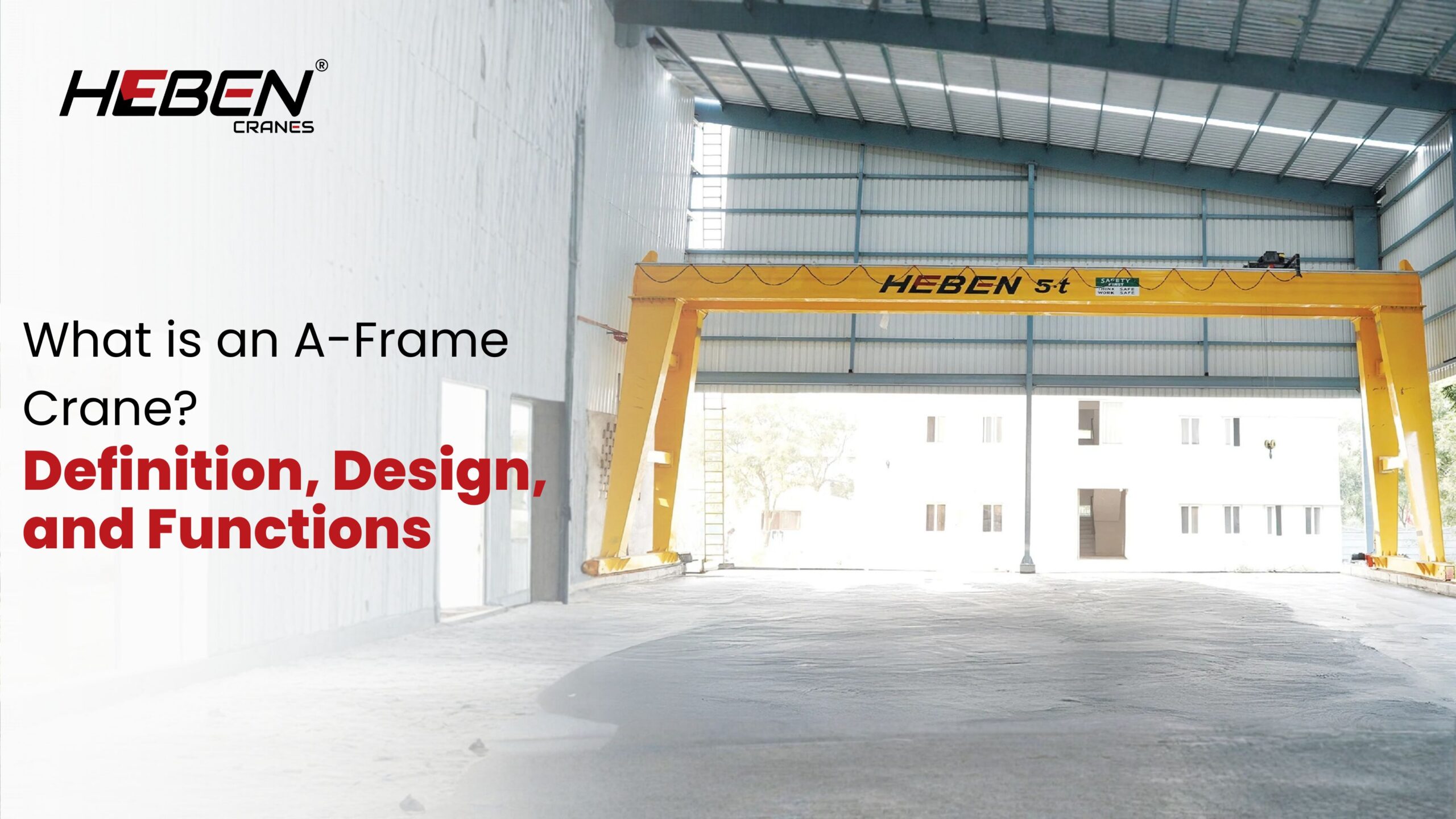
An A-frame crane is a gantry-type lifting system where two angled support legs form an “A” shape when viewed from the end. A horizontal beam spans between the tops of these legs, carrying a hoist and trolley for load lifting and movement. The entire structure stands on its own without connection to building walls or roof.
The A-frame is a subset of the gantry crane family. The distinguishing feature is the angled leg geometry, which provides lateral stability through triangulation rather than vertical leg bracing. This makes the design inherently stable under load without requiring wide base footings.
Most buyers encounter A-frame cranes as portable or mobile units. However, fixed and rail-mounted A-frame cranes serve permanent industrial installations where building-supported runways aren’t viable.
Design and Structure
Two angled side frames converge at the top where the main beam connects. The angle of the legs determines the base footprint and the structural depth available for load transfer. Wider leg angles increase stability but consume more floor space.
The horizontal beam sits at the apex of the A-frame and carries the full load. Box section or I-beam profiles are standard depending on capacity and span. The beam length defines the crane’s working coverage area.
The angled geometry distributes vertical load into both compressive and lateral forces through the legs. This triangulated load path reduces bending moments in the beam compared to vertical-leg gantry designs at equivalent spans. The result is a lighter structure for the same rated capacity.
Key Components
Every A-frame crane uses a consistent functional set:
- A-frame legs: Angled steel members forming the support structure
- Main crossbeam: Horizontal beam spanning between leg tops carrying the trolley and hoist
- Hoist and trolley: Hoist provides vertical lifting; trolley moves laterally along the beam
- Base assembly: Feet, casters, wheels, or rail-mounted end trucks for ground travel
- Control system: Push-button pendant, radio remote, or manual chain operation
- Safety devices: Overload limiters, end stops, emergency cut-off
Adjustable-height models add telescoping leg sections, allowing beam height to change between jobs.
How It Works
The hoist motor lifts loads vertically from ground level to beam height. The trolley carries the load laterally across the beam width, providing horizontal coverage across the work area. Combined hoist and trolley motion allows precise three-dimensional load positioning.
Ground travel happens through wheels, swivel casters, or rail-mounted end trucks. Wheeled and castered units reposition manually or with drive motors. Rail-mounted A-frame cranes travel on fixed ground rails for defined travel paths.
Here’s the pattern most facilities overlook: A-frame cranes handle up to 80% of light-to-medium industrial lifting tasks that would otherwise require permanent overhead installation. The default assumption that overhead cranes are always necessary leads to over-investment in building structure for intermittent or relocatable operations.
Types of A-Frame Cranes
A-frame cranes split into four practical configurations:
- Portable A-frame: Lightweight aluminum or steel frames on casters, 0.5–5 ton capacity, manually relocated
- Mobile A-frame: Steel construction with motorised wheel drives for powered travel, 1–10 tons
- Fixed A-frame: Bolted to floor plates or rail systems for permanent installations
- Adjustable-height A-frame: Telescoping legs for variable headroom across different work areas
- Single girder A-frame: One main beam for loads up to 10 tons
- Double girder A-frame: Two parallel beams for loads above 10 tons and longer spans
Technical Specifications
Capacity ranges from 0.5 tons for light workshop portable units to 50+ tons for heavy fixed or rail-mounted A-frame systems. Span lengths typically run from 2 meters for portable units to 20+ meters for industrial-grade fixed installations.
Standard duty classes A3–A5 cover most A-frame applications. Power options include electric hoist motors with pendant or remote controls, or manual chain hoists for simpler intermittent work. Travel mechanism varies from manual push to fully motorised VFD-controlled drives.
Applications and Use Cases
A-frame cranes serve a wide operational range:
- Machine shops and fabrication workshops: Tool and component handling where overhead runways don’t exist
- Warehouses and storage yards: Load positioning across open floor areas without fixed infrastructure
- Precast concrete plants: Mould handling and element movement in production yards
- Shipyards and rail yards: Heavy component handling in open, semi-structured environments
- Construction sites: Temporary lifting on sites before permanent structures are built
- Leased or temporary facilities: Relocatable lifting that moves with the operation
How to Choose the Right A-Frame Crane
Step 1: Define Load and Duty
Document maximum load, operating load, and lifts per shift. Calculate duty class from actual cycle frequency. Light workshop use suits A3; regular multi-shift operations require A4–A5.
Step 2: Measure Available Space
Measure floor area, ceiling height, and travel path. The A-frame base footprint must clear all obstructions. Beam height determines maximum hook-to-floor working distance.
Step 3: Choose Configuration
Select portable for relocatable light duty. Choose mobile for powered travel between work zones. Specify fixed or rail-mounted for permanent production applications.
Step 4: Specify Hoist and Control
Match hoist capacity to maximum load with 20% safety margin. Choose electric hoist with radio remote for operator mobility. Manual chain hoists suit infrequent lifts only.
Step 5: Plan Installation and Safety Compliance
Verify floor bearing capacity under wheel or foot loads. Confirm base fixing method for fixed installations. Schedule load testing to 125% rated capacity before first use.
Frequently Asked Questions
Is an A-frame crane the same as a gantry crane?
An A-frame crane is a type of gantry crane distinguished by angled leg geometry. All A-frame cranes are gantry cranes, but not all gantry cranes are A-frame designs. Vertical-leg gantry cranes use straight support columns instead of the triangulated A-shape.
Can an A-frame crane work indoors and outdoors?
Yes. Portable and mobile A-frame cranes operate on flat indoor floors and compacted outdoor surfaces. Fixed outdoor installations require weather-rated electrical components and corrosion-resistant coatings. Wheel or rail design must suit the ground surface type.
What’s the maximum practical capacity for A-frame cranes?
Double girder fixed A-frame systems reach 50+ tons in specialized applications. Most industrial A-frame cranes fall in the 1–20 ton range where the portable or semi-mobile design delivers practical advantage. Above 20 tons, fixed gantry or overhead EOT cranes often become more cost-effective.
Do A-frame cranes need building permits or structural approvals?
Fixed installations require structural sign-off for floor anchor loads and rail design. Portable units under 5 tons typically don’t require permits but do need pre-use load testing and operator competency records. Local regulations vary — verify with your site safety team before installation.
Conclusion
A-frame cranes deliver freestanding lifting capacity where building structure doesn’t exist or isn’t practical. Portable units suit temporary and relocatable operations. Fixed configurations handle permanent medium-duty applications. Specify capacity, duty class, and configuration from actual load data — not assumed requirements — and the crane performs reliably for its full service life.
Heben Cranes designs and manufactures A-frame gantry cranes for portable, mobile, and fixed industrial applications. We engineer each system to your load requirements, floor conditions, and operational duty — and deliver load-tested, certified systems with full installation and service support. Contact our engineering team today for a site assessment and custom proposal.