
Introduction
Most buyers searching for heavy lifting solutions encounter “Goliath crane” and “gantry crane” used interchangeably—then discover they mean different things in different contexts. The confusion leads to misspecified equipment, undersized capacity, or unnecessary structural investment. A Goliath crane is a specific class of large-scale, rail-mounted gantry crane built for high-capacity permanent operations—not a generic term for any ground-supported crane. This guide defines Goliath cranes precisely, breaks down their core components, explains how they work, covers the main types, and maps the applications where Goliath design is the only practical choice.
What is a Goliath Crane?
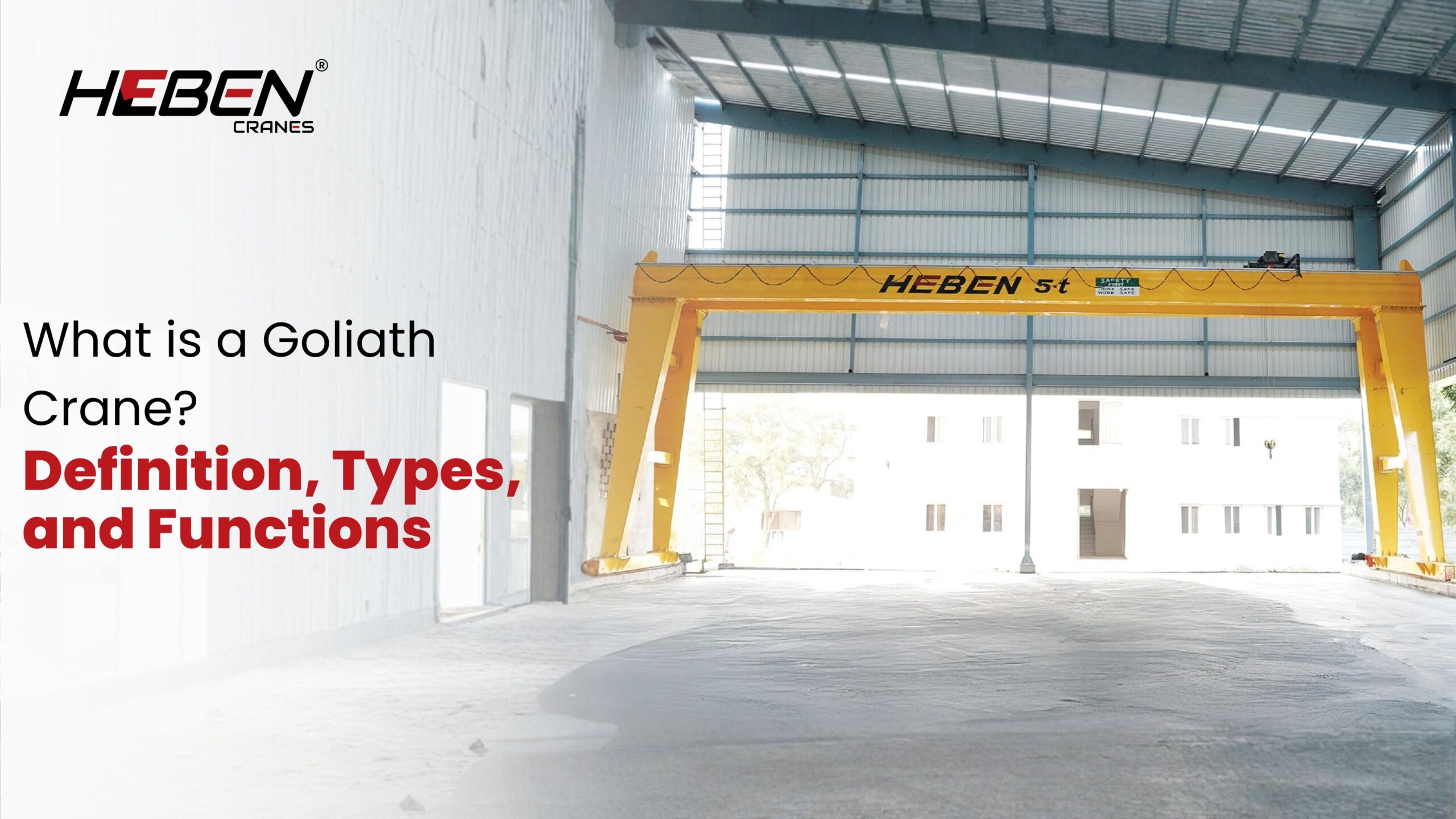
A Goliath crane is a large overhead lifting system with two freestanding legs supporting a horizontal bridge beam. The legs travel on ground-level rails rather than relying on building structure for support.
The name reflects scale. Goliath cranes start at 50 tons capacity and extend to 1,000+ tons. Spans run from 30 to 60+ metres—dimensions that building-mounted overhead cranes cannot match.
Every Goliath crane is a gantry crane, but not every gantry crane qualifies as a Goliath. The distinction lies in scale, permanent installation, and the engineering depth that extreme load requirements demand.
Main Components
A Goliath crane consists of these structural and mechanical elements:
- Bridge beam: Single or double girder spanning the full working width, fabricated in box-section or truss construction
- Gantry legs: Heavy box-section steel structures transferring all loads to ground-level rail systems
- End carriages: Drive and non-drive truck assemblies carrying the leg wheel sets along embedded ground rails
- Electric hoist: Wire rope hoist unit with rope drum, sheaves, and hook block rated to working load limit
- Trolley: Wheeled frame carrying the hoist, traveling along the bridge beam
- Control system: Pendant, radio remote, or enclosed cabin controls for operator use
- Safety system: Overload protection, limit switches, emergency stops, rail clamps, and wind monitoring
How It Works
Three independent axes cover the full working envelope.
The hoist raises and lowers loads vertically. The trolley moves the hoist left and right along the bridge beam. The entire crane assembly travels forward and backward along ground rails.
This three-axis movement positions loads anywhere within the crane’s coverage zone—without building attachment, without floor-level obstruction, and without repositioning the load manually between stations.
Types of Goliath Cranes
Single Girder Goliath Crane
One horizontal beam spans between the legs. This configuration suits 50-150 ton applications with moderate span requirements. Lower structural weight keeps foundation and rail costs manageable.
Double Girder Goliath Crane
Two parallel beams provide the bridge structure. Standard for capacities above 100 tons and spans beyond 30 metres. The dual beam allows maintenance walkways and supports auxiliary hoists for tandem lifting.
Semi-Goliath Crane
One side runs on a building runway beam. The other travels on a ground rail with a single leg. This suits facilities with partial overhead support on one side—reducing foundation cost without sacrificing coverage.
Heavy-Duty Port Goliath Crane
Permanently installed on wide-gauge ground rails for container handling and ship loading. Spans reach 60+ metres with leg heights up to 30 metres. These are purpose-built for port infrastructure.
Special-Purpose Variants
Insulated Goliath cranes serve electrolyzing facilities. Explosion-proof versions operate in chemical and fuel environments. Electromagnetic variants lift ferrous scrap and steel plates.
Key Features
Six features define Goliath crane capability:
- Structural independence: No building roof or columns bear any crane load
- High capacity: 50-1,000+ tons in permanent rail-mounted configurations
- Wide span coverage: 30-60+ metres without intermediate support columns
- Outdoor suitability: Weather-resistant electrical systems and storm anchoring rated to 150 km/h winds
- Precision load control: Variable frequency drives on all axes for fine positioning at extreme loads
- Configurable design: Leg height, span, capacity, and hoist type all customizable
Technical Specifications
Standard Goliath crane parameters:
- Capacity: 50-1,000+ tons
- Span: 18-60+ metres
- Lifting height: 6-30+ metres
- Lifting speed: 0.3-8 metres per minute
- Travel speed: 5-30 metres per minute (crane), 10-40 metres per minute (trolley)
- Duty class: A5-A8 for continuous industrial operations
- Rail gauge: 2.5-15+ metres depending on application
Functions and Benefits
Goliath cranes solve problems other crane types cannot. Mobile cranes complete 10-15 lifts per day at high cost per cycle on permanent sites. Goliath systems handle the same volume at a fraction of the per-lift cost over a 25-35 year service life.
The counterintuitive reality: Goliath cranes often cost less per ton of capacity than smaller alternatives because structural efficiency improves with scale. A 200-ton Goliath doesn’t cost four times a 50-ton model.
Building-mounted overhead cranes require the building structure to bear all crane loads—limiting capacity to what the building can support. Goliath cranes carry their own loads entirely, enabling capacities that buildings could never support.
Applications
Goliath cranes dominate where load, span, and permanence combine:
- Shipyards: Hull section assembly, outfitting, and launching operations up to 500+ tons
- Steel mills: Slab and coil handling across wide production yards
- Ports and container terminals: Inter-yard transfer and stack operations
- Power stations: Turbine, generator, and heavy component installation
- Heavy fabrication yards: Pressure vessel, structural steel, and large equipment assembly
- Rail cargo stations: Rolling stock maintenance and freight transfer
Safety and Maintenance
Protection systems specific to Goliath scale include:
- Anemometer-linked automatic shutdown at 20-28 km/h wind speed
- Rail clamp systems locking crane during non-operating storm conditions
- Overload protection halting all motion at rated capacity
- Upper, lower, and travel limit switches on all axes
- Emergency stop accessible from pendant, remote, and cabin controls
Maintenance follows defined intervals. Weekly checks cover rail condition and wheel wear. Monthly service includes drive system lubrication and wire rope inspection. Annual comprehensive inspection by qualified engineers covers structural, mechanical, and electrical systems.
FAQs
What separates a Goliath crane from a standard gantry crane?
Scale and engineering depth. Standard gantry cranes handle 0.5-50 tons with relatively simple foundations. Goliath cranes start at 50 tons and require specialist rail foundation engineering, high-current electrical infrastructure, and wind-loading structural analysis.
How long does Goliath crane installation take?
Foundation preparation takes 4-8 weeks depending on soil conditions and scale. Rail installation and crane assembly add 4-6 weeks. Total project timelines typically run 3-6 months from order to commissioned operation.
Can Goliath cranes operate indoors?
Yes, in large industrial facilities with 15-30+ metres of vertical clearance. Rail systems install on indoor concrete floors. The constraint is ceiling height, not indoor/outdoor designation.
What duty class do Goliath cranes use?
A5 to A8 depending on operation intensity. Port Goliath cranes running continuous container operations typically operate at A7-A8. Steel mill and shipyard applications commonly use A5-A6.
What is the realistic service life?
Properly maintained Goliath cranes deliver 25-35 years of service. Structural components typically outlast electrical systems, which require upgrades every 12-15 years as control technology evolves.
Conclusion
Goliath cranes are permanently installed, rail-mounted gantry systems built for 50-1,000+ ton capacities across 30-60+ metre spans. They operate independently of building structure, suit outdoor heavy industry, and deliver lower per-lift costs than mobile alternatives across long service lives.
Contact us to discuss Goliath crane specifications matched to your capacity, span, site, and duty requirements.
Heben Cranes manufactures Goliath and heavy-duty gantry crane systems for shipyards, steel mills, port operations, and large-scale fabrication facilities. Our engineering team manages the complete project from site survey through foundation design, structural engineering, fabrication, rail installation, crane assembly, load testing, and operator training. We specify leg structures, bridge configurations, drive systems, wind resistance provisions, and electrical infrastructure matched to your duty class and environmental conditions. Every system includes comprehensive documentation, safety certifications, and a maintenance programme designed for 25-35 year service life. Visit hebencranes.com to discuss your heavy lifting requirements and receive an engineered Goliath crane solution matched to your load, span, and site.