
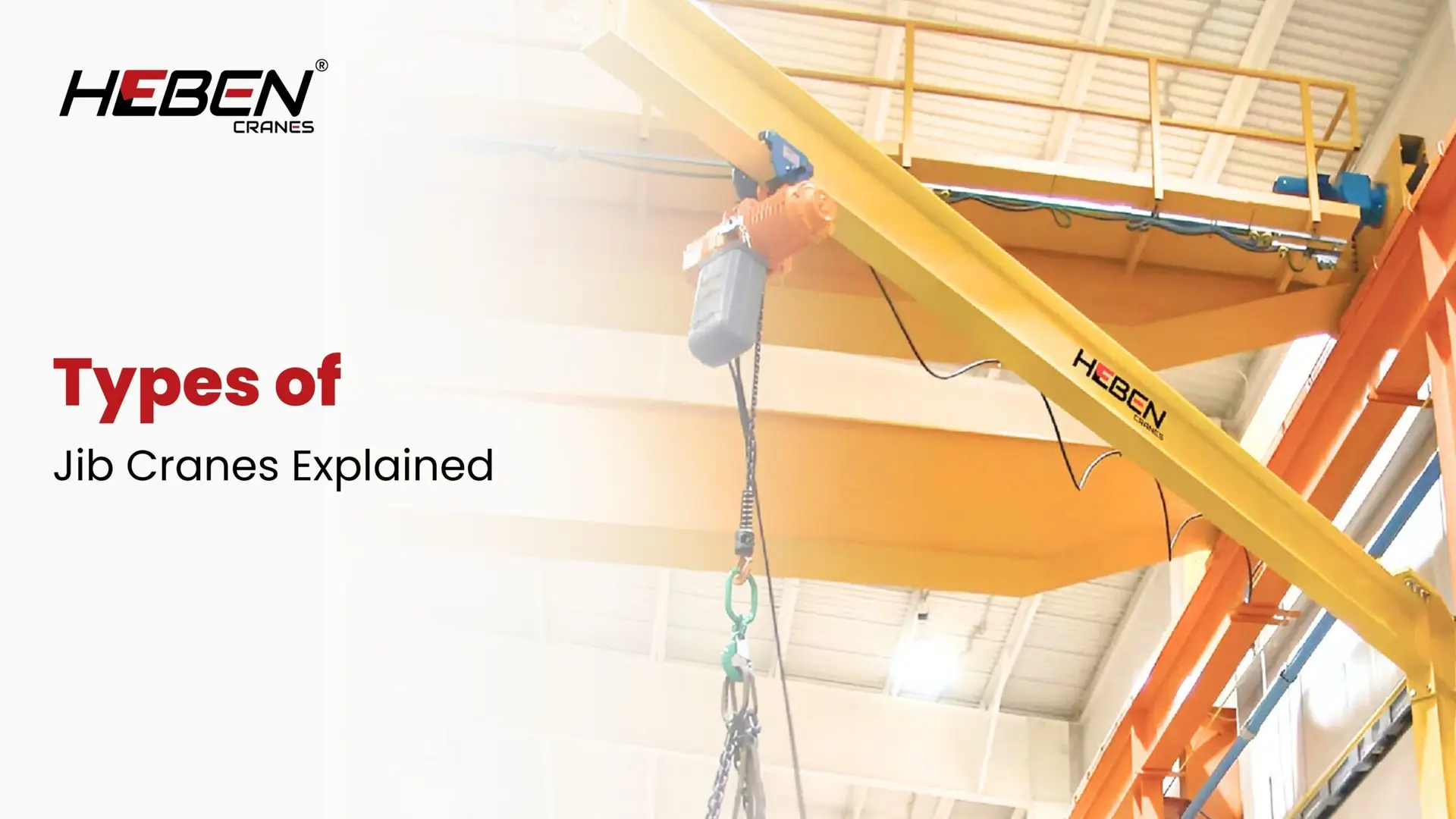
Most facilities buying a jib crane pick the wrong one. Not because the options are complicated — there are only a handful of types — but because the selection gets driven by price or habit rather than the actual work pattern. A crane that covers 360° when you only need 180° costs you floor space. A wall-mounted crane ordered for a job that needs longitudinal travel leaves operators carrying loads the final ten metres by hand.
This guide breaks down every main type of jib crane, what each one is built for, and what separates them technically. By the end, you will have a clear basis for matching crane type to application — whether you run a single machining cell or a 60-metre assembly bay.
What Is a Jib Crane
A jib crane is a material handling crane built around a horizontal boom — the jib — that carries a hoist and trolley. The boom rotates, travels, or articulates depending on the type. The hoist lifts; the trolley moves loads along the boom’s length; the boom sweeps across the working area.
What makes jib cranes distinct from bridge and gantry cranes is their point-of-work design. They mount directly at — or above — a workstation and serve a defined coverage zone rather than an entire bay. That precision is both their strength and their boundary.
Free Standing Jib Cranes
A freestanding jib crane anchors directly to the floor through a steel column. It needs no wall, no ceiling beam, no adjacent structure — just a suitable foundation. That independence gives it the widest rotation of any type: up to 360°.
Three mounting options exist:
- Foundation/Insert Mount: The column sets into a concrete sleeve buried in the floor. Handles the heaviest loads and longest jib spans.
- Base-Plate Mount: The column bolts to a steel plate anchored to the slab. Faster to install, easier to remove.
- Sleeve-Insert Mount: A removable design — the crane lifts out of the sleeve when the station layout changes.
Capacities run from 250 kg to 15 tonnes. The freestanding type is the default choice for open floor plans, isolated heavy-lift stations, and anywhere building structure cannot carry the side loads of a wall-mounted design.dgcrane
Foundationless Jib Cranes
The foundationless type replaces the buried column with a weighted base — either a ballasted steel frame or a cement-filled pallet. No core drilling. No concrete cure time. The crane arrives, levels off, and is operational the same day.
The tradeoff is capacity. Most foundationless designs carry below 1,000 kg with jib spans under 4 metres. They suit temporary setups, production lines that reconfigure regularly, and facilities where floor penetration is not permitted. Moving the crane from station to station takes a forklift and ten minutes.cranesdq
Wall Mounted Jib Cranes
Wall mounted cranes fix to an existing wall or structural column, which eliminates the floor footprint entirely. The rotation arc runs between 180° and 200° — sufficient for most workstation lifting tasks.cranewerks
Two boom configurations:
- Bracketed (Tie-Rod): The boom is held by a diagonal rod anchored above the lower hinge. Lower cost, compact profile.
- Cantilevered: An inverted-L weldment with two hinges and no tie rod. Delivers more hook height and full clearance under the boom.
The critical constraint is the wall itself. The crane transfers significant side-load forces into the mounting structure. A structural assessment before installation is not optional — it is what determines the maximum safe capacity. Facilities that skip this step end up with cranes under-utilised because operators don’t trust the mount.cranewerks
Wall Travelling Jib Cranes
Wall travelling cranes run on a longitudinal rail mounted along the wall at elevation. The crane body rides the rail; the jib arm rotates and lifts at each stop. One crane services an entire line of workstations rather than one fixed point.emech
A counterintuitive finding from multi-station facilities: adding a wall travelling crane to handle frequent light picks — and leaving the overhead crane for heavy lifts — produces a larger throughput gain than increasing the overhead crane’s capacity. The overhead crane stays free for the jobs it was sized for.emech
Best conditions for wall travelling:
- Bay lengths of 10–100 metres
- Three or more workstations in a straight line
- Loads up to 2 tonnes with high cycle frequency
Mast Type Jib Cranes
Mast type cranes are supported at two points: the floor and an overhead beam. That dual support allows 360° rotation while requiring a smaller foundation than a freestanding column.hoistsandcrane
Two boom styles:
- Full Cantilever: The boom attaches above centre height. Maximum hook clearance under the boom.
- Drop Cantilever: The boom drops below the top mount. Useful where the overhead connection is the only structural point available.
Capacity reaches 10 tonnes. The mast type is a practical retrofit choice for workshops that have an existing ceiling beam but lack the floor space for a full freestanding column base.
Articulating Jib Cranes
The articulating crane adds a second hinged arm to the primary boom. That knuckle joint lets the outer arm fold around obstacles — pillars, machine housings, open fixtures — that a straight boom cannot reach.dgcrane
Coverage is non-linear. Instead of sweeping a clean arc, the operator steers the load around obstructions with two independent rotation points. Capacity is lighter — typically 250 kg to 800 kg — but the access it provides in a cluttered machining cell or precision assembly area cannot be replicated by any other type.
Portable Mobile Jib Cranes
Mobile cranes roll on wheels from a counterweighted base. No anchoring, no electrical tie-in beyond a plug socket, no structural commitment. Capacity stays below 1,000 kg and jib span is short.cranesdq
They work on job sites, in facilities that reconfigure frequently, and as supplementary lifts during shutdowns or equipment moves. The base is large — it has to counterbalance the load moment — so they occupy more floor area per kilogram of capacity than any other type.
How to Choose the Right Jib Crane
Work through five questions in order:
- What is the heaviest load? Add 15–20% safety factor, then add hoist and trolley weight.
- What coverage shape does the work need? Arc → wall-mounted or freestanding. Line → wall travelling. Obstacle navigation → articulating.
- What is the ceiling height and hook height requirement? Low ceilings favour mast-type drop cantilever. High clearance opens up full cantilever and freestanding options.
- What can the building structure carry? Walls need assessment for side loads. Floors need assessment for column base reactions. Ceilings need assessment for mast-type top connections.
- How often will the crane cycle? High-frequency, short-distance picks suit wall travelling and wall mounted types. Occasional heavy lifts suit freestanding.
| Type | Rotation | Max Capacity | Floor Space | Best For |
| Freestanding | 360° | 15 tonnes | Required | Open floor, heavy loads |
| Foundationless | 360° | 1,000 kg | Required (base) | Temporary, flexible layouts |
| Wall Mounted | 180°–200° | 5 tonnes | Zero | Single workstations |
| Wall Travelling | Linear | 2 tonnes | Zero | Multiple stations in a line |
| Mast Type | 360° | 10 tonnes | Small base | Limited overhead clearance |
| Articulating | Multi-angle | 800 kg | Small base | Obstructed, tight spaces |
| Portable Mobile | Manual pivot | 1,000 kg | Large base | Job sites, temporary use |
FAQs
Can a wall mounted jib crane be installed on any wall?
No. The wall or column must be structurally capable of carrying the lateral forces the crane generates under full load. A structural engineer’s assessment determines the permissible capacity. Concrete, brick, and steel columns can all work — it depends on the specific section and condition of the structure.
What is the difference between a mast type and a freestanding jib crane?
Freestanding cranes carry all forces through the floor column alone. Mast type cranes share the load between the floor and an overhead support beam. Mast types need a smaller foundation but require a suitable ceiling structure. Freestanding types are fully independent of the building above.
Can a jib crane be converted from manual to electric operation later?
Yes, in most cases. The structural frame stays the same. The manual chain hoist and hand-pushed trolley get replaced with an electric hoist and motorised trolley. The electrical supply and pendant control are added at that point. Confirm the boom section rating can carry the added weight of the electric components before converting.
How much rotation do most factory applications actually need?
Most single-workstation lifting tasks use between 90° and 180° of the available arc — even on 360° cranes. The practical implication: if your workstation sits against a wall, a 180° wall-mounted crane covers the same functional area as a 360° freestanding model at a lower cost and without a floor foundation.
Conclusion
The right jib crane type is not the most expensive one or the one the previous supplier recommended — it is the one that fits the work pattern, the building structure, and the cycle frequency. Get those three factors right and the crane runs efficiently from day one. Get them wrong and you spend the next five years working around a crane that almost does the job.
If you are in the process of specifying a jib crane for your facility, start with the five-question selection process above. Then contact our team.
At Heben Crane, we manufacture and supply the full range of jib crane types — freestanding, wall mounted, wall travelling, mast type, and articulating — built to your capacity, span, and site conditions. Every enquiry includes a technical review of your application before any specification is finalised.
Tell us your lifting requirement. Contact Heben Crane and our engineers will recommend the right configuration for your facility.