
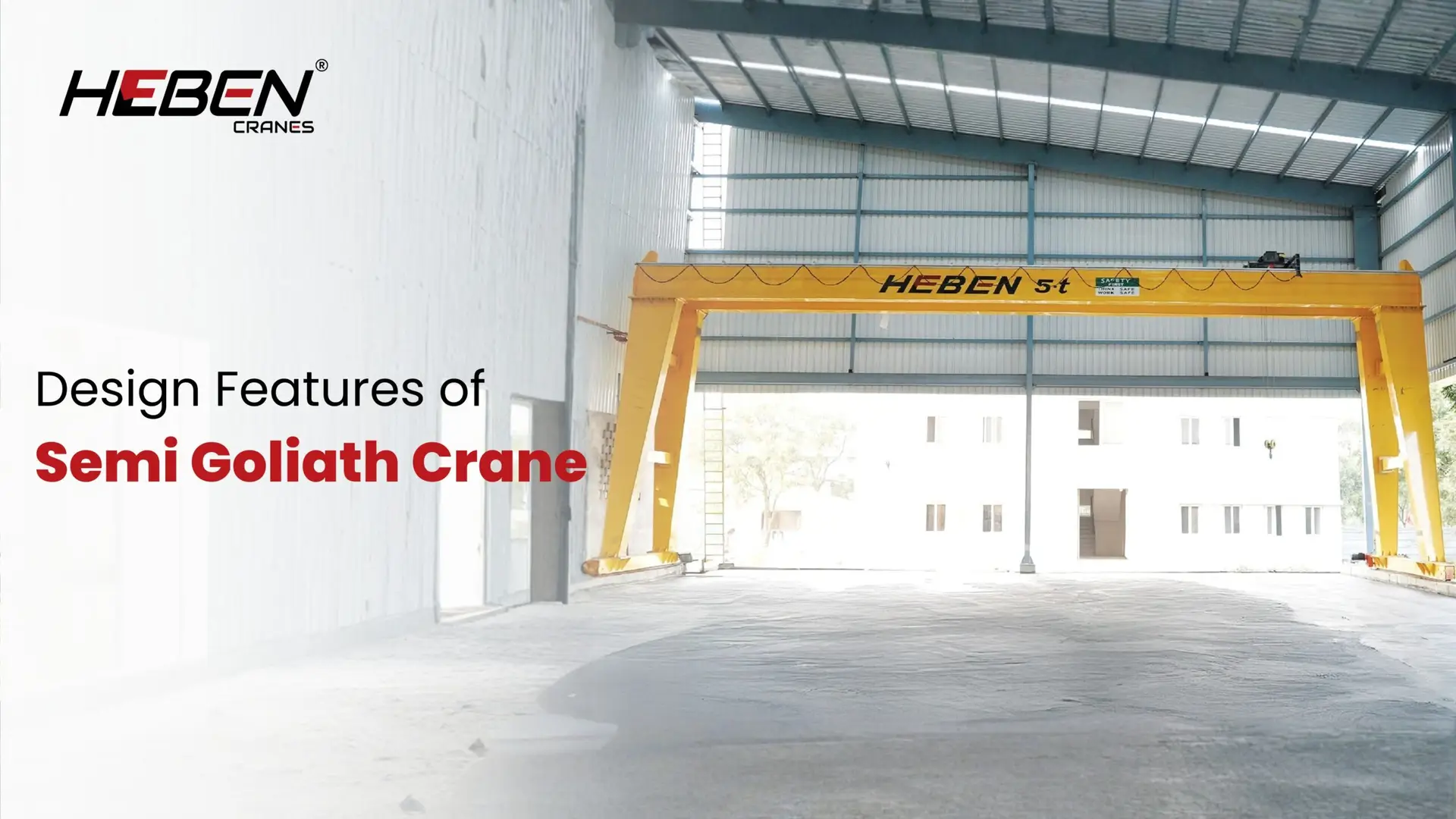
Most facilities that need overhead lifting run into the same wall: one side of the building has structure to support a crane, and the other side doesn’t. A full goliath crane needs ground rails on both ends. A standard overhead crane needs runway beams on both sides. Neither fits a building with only one supported edge.
A semi goliath crane was built to solve exactly that mismatch. One end runs on a ground-level rail, the other end travels on an elevated runway, and the crane bridges the gap between what a full gantry needs and what your building already has.
We design and build these systems, and the design choices behind them matter more than most buyers realize before they sign a purchase order. This post breaks down the structural features that define a semi goliath crane, the material and safety decisions behind them, and how to read a spec sheet so you buy the right configuration the first time.
What Is a Semi Goliath Crane
A semi goliath crane (also called a semi-gantry or semi-portal crane) combines two support methods in one structure. One end carriage rides on a ground-mounted rail, the same way a full goliath crane’s legs do. The other end carriage rides on an elevated runway beam, the same way a standard overhead crane’s end trucks do.
That hybrid arrangement means you don’t need a second leg, a second foundation, or a second ground rail. You use whatever elevated structure your building already has on one side and add a ground rail only where you need it.
Core Design Features
Asymmetric support structure
The defining feature is the mismatch itself. One side takes support from the floor, the other from an elevated beam. This lets the crane serve a bay where only one side has adequate building structure, without forcing a full gantry frame into a space that can’t fit one.
Girder configuration
Semi goliath cranes come in two girder arrangements:
- Single girder — one beam carries the hoist and trolley. Lighter, faster to install, suited to light and moderate loads up to roughly 15 to 20 tons.
- Double girder — two parallel beams share the load. Higher capacity, greater rigidity, and less deflection under heavy or long-span loads, often rated up to 40 tons or more.
Girder cross-section
Within either configuration, the girder itself is built one of two ways:
- Box girder — a closed rectangular section that resists twisting under off-center loads. This is the standard choice for heavier-duty applications because it holds its shape better as load and span increase.
- Truss girder — an open framework of triangulated beams. It trades some rigidity for a meaningful weight reduction, which matters when the elevated end of the crane is bearing on structure with a defined load limit.
End carriages and rail system
The two ends of the crane do different jobs. The ground-level end carriage rolls on wheels along a floor-mounted rail or, in rail-less configurations, on polyurethane wheels that need no rail at all. The high-level end carriage rides on the elevated runway and typically carries the drive motors, since it’s the end doing the structural “reaching.”
Hoist and trolley system
The trolley moves the hoist laterally along the girder, giving the crane its working range across the bay. Electric wire rope hoists handle most industrial loads; pendant, push-button, or radio remote controls give the operator direct positioning control.
Rail-less floor option
Skipping the ground rail entirely is possible in lighter-duty configurations. Polyurethane wheels let the ground-level end travel without a fixed track, which clears the floor of a rail line that would otherwise interrupt forklift paths and foot traffic.
Materials and Construction
Girders and end carriages are built from structural or alloy steel, chosen for strength-to-weight ratio and predictable behavior under repeated loading. Heat treatment brings the steel to the right hardness-toughness balance before fabrication. After assembly, components get a two-coat prime and a final finish coat — standard practice for equipment expected to run for over a decade in an industrial environment.
Safety Features
Every semi goliath crane we build carries the same baseline safety package, regardless of tonnage:
- Overload protection that stops lifting beyond rated capacity
- Emergency stop buttons at the pendant and control panel
- Limit switches that prevent over-travel and end-of-rail collisions
- Obstacle detection on the travel path
- Lift-off prevention to keep the elevated end carriage seated on its runway
Outdoor and high-traffic configurations often add rotating beacons, giving ground crew a visual warning before the crane moves into a shared work area.
Capacity Span and Lift Specifications
Single girder semi goliath cranes typically run 1 to 15 tons, with spans up to 20 to 30 meters. Double girder versions extend that to 40 tons and beyond, with lift heights past 12 meters depending on the elevated runway’s height. The real ceiling on any of these numbers comes down to what the elevated-side structure can actually carry — that’s the figure a spec sheet can’t answer without a site assessment.
Design Variants for Different Environments
Indoor configurations
Built for controlled environments — factories, assembly lines, tool rooms — where the elevated runway is typically part of the existing building frame.
Outdoor configurations
Weatherproofed hoists and reinforced structural members handle rain, wind, and temperature swings without added maintenance.
Hazardous environment configurations
Facilities working with flammable or explosive materials — refineries, chemical plants — need explosion-proof electrical components, spark-resistant materials, and enhanced ventilation built into the crane from the start.
Semi Goliath vs Full Goliath Key Differences
A full goliath crane needs two ground rails and two full-height legs. A semi goliath needs one ground rail and one elevated runway connection. That single difference changes three things: installation cost drops since you’re building one leg instead of two, floor space stays clearer on the elevated side with no leg occupying it, and total lift capacity usually lands lower than a full goliath’s, since one end’s capacity is capped by existing structure rather than a dedicated foundation.
FAQs
Can a semi goliath crane be added to a building that already has an overhead crane? Yes — this is one of the most common use cases. The semi goliath runs at a lower level, serving a specific work cell while the existing overhead crane covers the full bay.
Does the elevated end need a dedicated runway beam, or can it use existing structure? It can use existing structure if the load rating supports it. A site assessment confirms whether the current beam can carry the added weight or needs reinforcement first.
What’s the real advantage of a rail-less ground end? It keeps the floor clear of a track line — useful in bays where forklifts, pallet jacks, or foot traffic cross the crane’s ground-side path regularly.
How much lower is the capacity compared to a full goliath crane? It depends on what the elevated structure can bear. Most semi goliath installs top out lower than a full goliath simply because building structure has stricter limits than a dedicated ground foundation.
Conclusion
A semi goliath crane isn’t a scaled-down goliath crane — it’s a specific answer to a specific structural constraint. Getting the girder type, cross-section, and safety package right depends on what your building can actually support on the elevated side. Talk to us before you finalize a spec, and we’ll tell you what fits.
At Heben Cranes, we engineer semi goliath systems around your building’s real structural capacity, not a generic tonnage chart. Our promise: a crane that integrates with what you already have, built with torsion-resistant girders and standard obstacle detection on every unit. Contact us for a site assessment and a configuration built for your bay.