
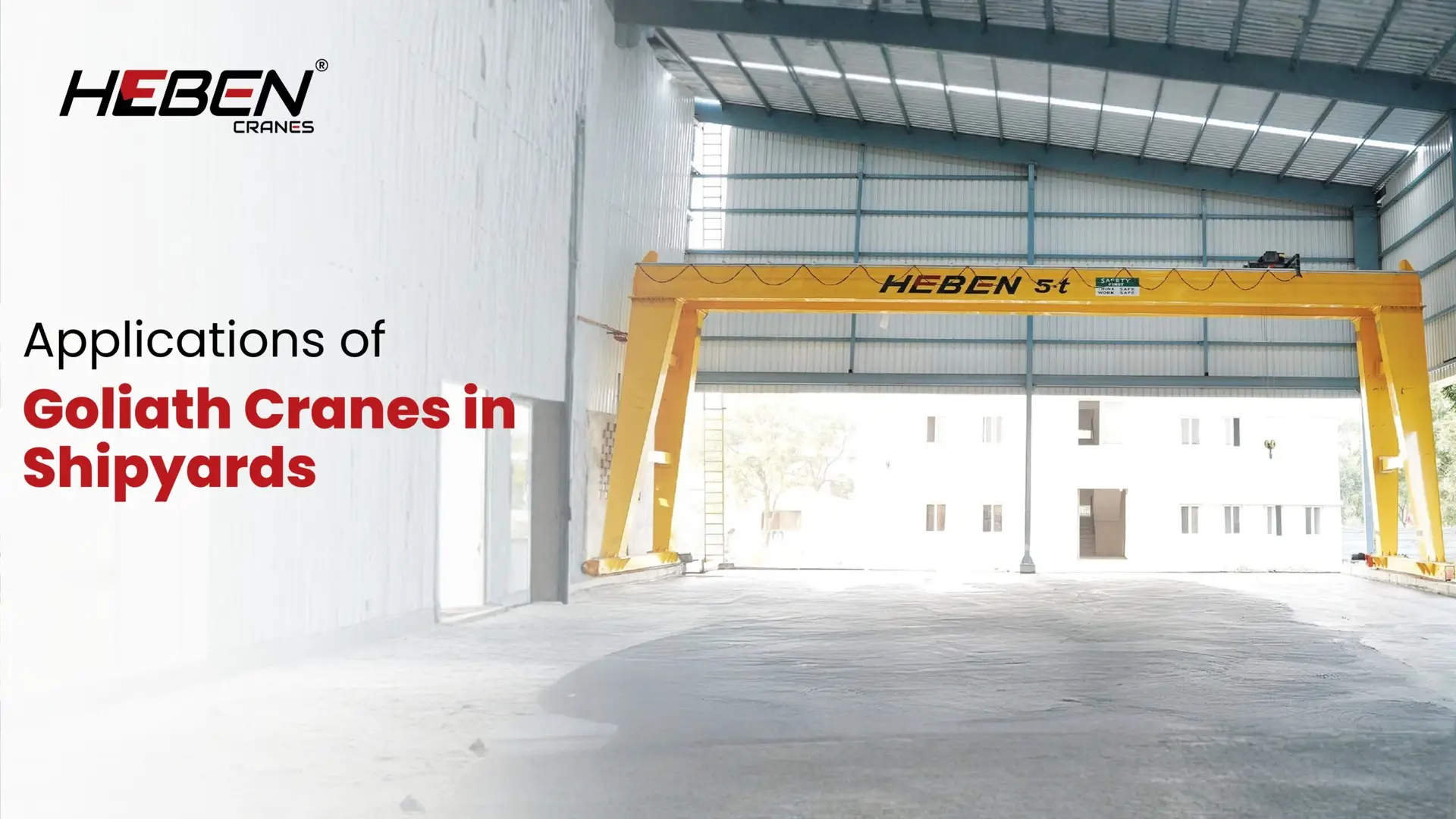
Most buyers evaluating gantry cranes start by comparing tonnage and price, and end up missing the variable that actually determines whether the crane holds up: the shape of the legs. A straight vertical leg and an angled A-frame leg can carry the same rated load on paper, yet behave completely differently under real working stress — wind, off-center loads, sudden stops. That difference isn’t cosmetic. It’s structural engineering doing quiet, unglamorous work every time the crane lifts.
This guide breaks down what an A-frame gantry crane actually gets you: how the geometry handles load and lateral force, what it does to your foundation costs, how it holds up on installation and maintenance timelines, and where it fits against other frame designs. If you’re weighing a gantry crane purchase and want to understand the “why” behind the spec sheet rather than just the numbers on it, this is built for that.
Structural Stability
An A-frame gantry crane gets its strength from geometry, not just material. The two legs lean inward and meet at the top, forming a triangle — and triangles don’t bend the way rectangles do.
Here’s the part that surprises most first-time buyers: a straight vertical leg resists load mainly through bending strength, which steel is only moderately good at. An angled leg converts much of that same force into axial compression instead — a straight push-and-pull force along the length of the leg, which steel handles far more efficiently. Put simply, the A-frame doesn’t fight the load. It redirects it into the direction steel is naturally strongest.
This matters most in a few specific scenarios:
- Heavy, concentrated loads that would cause a straight-leg crane to flex or sway
- High-cycle operations where repeated stress adds up over years, not just single lifts
- Environments with wind exposure — ports, open yards, coastal sites — where lateral push is a constant, not an occasional event
Foundation Requirements
A wider base does more than add stability up top. It spreads load diagonally downward across a larger footprint at ground level, which changes what your foundation actually needs to do.
Straight-leg cranes concentrate force into a smaller area, which often calls for deeper, more reinforced footings to compensate. A-frame legs spread that same force out, easing the load-bearing demand on any single point. For a buyer working with marginal soil conditions or an existing slab that wasn’t built with a crane in mind, that difference can mean the gap between a straightforward install and a full foundation redesign.
Installation
A-frame gantry cranes tend to go up faster, and it’s not just a marketing line — it comes down to part count. Fewer structural components means fewer connections to align, bolt, and verify before the crane is cleared for use.
Compare this to T-frame or four-legged portal designs, which typically call for additional bracing and a longer alignment process. For a facility trying to get a crane operational without shutting down production for an extended stretch, that shorter install window has real value attached to it.
What a faster install actually saves you
- Less time with the work area closed off or restricted
- Fewer contractor hours billed on-site
- Earlier revenue from the equipment the crane is meant to support
Maintenance
Simpler structures don’t just install faster — they stay easier to service for the life of the crane. Fewer welds, fewer connection points, and fewer places for wear to hide all add up to a shorter troubleshooting list when something needs attention.
That translates into two concrete advantages:
- Faster diagnosis. A technician working on a simpler frame spends less time isolating where a problem originates.
- Lower long-term labor cost. Every inspection and repair takes less time when there’s less structure to check.
Cost
The savings compound rather than sitting in one line item. Lower material complexity brings down the initial build cost. A lighter foundation requirement cuts civil construction spending before the crane even ships. Faster installation reduces labor hours. None of these are dramatic on their own — together, they add up to a meaningfully lower total cost of ownership than a buyer comparing sticker prices alone would expect.
Mobility
A-frame designs aren’t locked into one physical configuration, which is part of why they show up across such a wide range of facilities.
- Mobile units roll on casters or wheels, letting a crew reposition the crane as the job changes.
- Adjustable-height legs let the same crane lower for storage or transport and extend back up for use.
- Aluminum variants trade some load capacity for a frame light enough to move by hand — useful for mobile maintenance crews and tight indoor spaces.
- Battery-powered options remove the dependency on a nearby power source entirely, which matters on outdoor or remote sites.
Versatility and Applications
The A-frame format scales from light-duty workshop use up to heavy industrial service, which is unusual for a single structural design.
- Single girder A-frame — one main beam, ideal for smaller spans and capacities in machine shops and light fabrication.
- Double girder A-frame — two main girders for heavier loads and longer spans, common in shipbuilding and steel fabrication.
- Steel vs. aluminum — steel for maximum strength and continuous heavy-duty use, aluminum for portability and corrosion resistance.
You’ll find A-frame gantry cranes doing real work in shipyards, container ports, precast concrete plants, steel fabrication shops, and general maintenance bays — a spread of use cases that a single-purpose crane design typically can’t cover.
FAQs
Is an A-frame gantry crane stronger than a T-frame crane? “Stronger” depends on the application. A-frame designs handle vertical load and lateral force efficiently through their triangular geometry, while T-frame cranes offer different lateral stability characteristics suited to certain precision-handling tasks. For heavy, uniform loads, A-frame is generally the more efficient structural choice.
Do A-frame cranes need less foundation work? In most cases, yes. The wider base spreads load across a larger area, which often reduces the depth and reinforcement your foundation needs compared to a straight-leg design carrying the same rated capacity.
Can an A-frame gantry crane be mobile? Yes. Mobile A-frame cranes run on casters or wheels for repositioning within a facility, and adjustable-height versions can be lowered for storage or transport between sites.
What’s the difference between single and double girder A-frame cranes? Single girder units use one main beam and suit smaller spans and lighter capacities. Double girder units add a second beam to handle heavier loads and longer spans, which is why they show up more often in shipbuilding and heavy fabrication.
Conclusion
An A-frame gantry crane earns its advantages from its shape before it ever touches material cost or installation speed. That geometry is what turns into a lighter foundation bill, a shorter install window, and a lower-maintenance structure over the life of the equipment.
Heben Cranes designs and builds A-frame gantry cranes engineered around exactly this principle — structural efficiency that lowers your total cost, not just your sticker price. If you’re sizing up a gantry crane for your facility, talk to our team about a configuration built for your load, your space, and your budget.