
What is a Jib Crane? Complete Guide
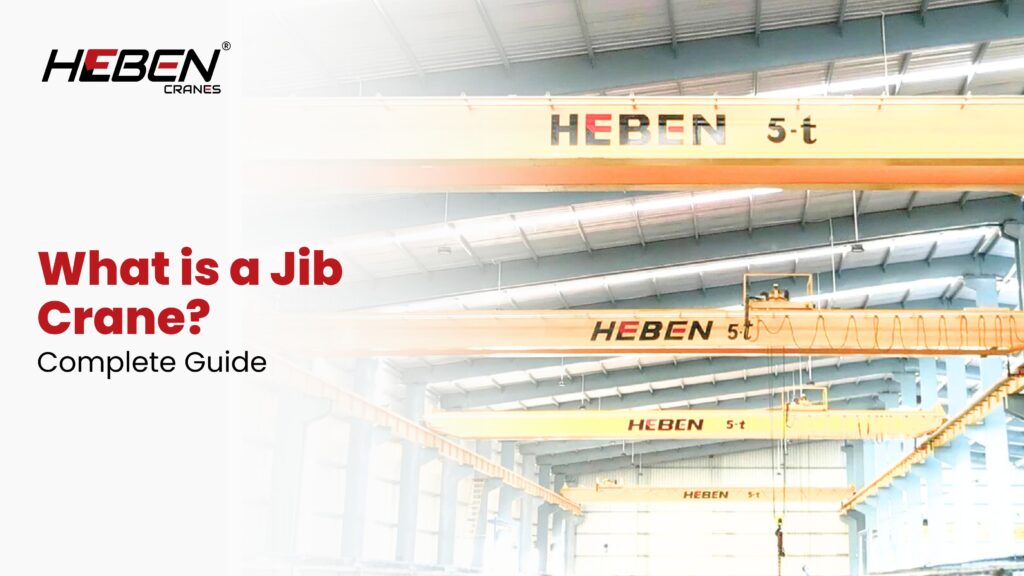
Overhead cranes cover full-bay lifting, but they don’t solve the problem most facilities face daily: short-range, repetitive lifting at a single workstation. Workers improvise with manual handling, forklifts in tight spaces, or shared overhead crane time—each option slower, riskier, or more expensive than the task requires. Jib cranes exist precisely for this gap. A single unit mounts at one workstation, covers a defined radius, and handles loads from 250kg to several tons with full operator control. This guide covers what jib cranes are, how they work, the main types, key design features, practical benefits, common applications, selection factors, and installation basics. What Is a Jib Crane? A jib crane is a fixed lifting device with a horizontal boom extending from a vertical support structure. A hoist and trolley run along the boom. The boom rotates around its mounting point to cover a defined arc or full circle. Load movement happens within this radius—not across a full bay. The name comes from the nautical term for an angled spar on a ship’s mast. Industrial jib cranes carry the same geometry: an arm projecting outward from a vertical anchor point, with lifting equipment at the end. The design has been standard in workshops and port facilities for over a century. Typical capacity ranges from 250kg to 15 tons. Most industrial applications fall between 500kg and 5 tons. Boom lengths from 2 to 10 metres define the working radius. How a Jib Crane Works The boom extends horizontally from a mast or wall bracket. Rotation occurs around the vertical mounting axis. The hoist travels along the boom on a trolley, providing radial movement. Combined, these two motions cover every point within the coverage arc. Electric hoists provide powered vertical movement and, in some configurations, powered trolley travel and boom rotation. Manual versions use hand-pushed boom rotation and chain block hoists. The control method—manual, electric, or pneumatic—matches the application’s cycle frequency and precision requirements. The coverage footprint is the key operational feature. A 5-metre boom with 270° rotation covers approximately 35 square metres of floor area from a single mounting point. An overhead crane covering the same area costs three to five times more in total installed infrastructure. Types of Jib Cranes Each type suits a different mounting condition and workspace: Freestanding (pillar-mounted): Floor-anchored mast, 360° rotation, no building structure required Wall-mounted: Attached to building column or wall, up to 180° rotation, lower foundation cost Mast-type: Similar to freestanding but with top and bottom bracket supports from building structure Articulating (knuckle): Two-arm design for tight spaces and work around obstructions Portable: Wheeled base for temporary use at varied locations, lighter capacities The contrarian insight: facilities often install one overhead crane to handle workstation lifting, then add jib cranes later once they see the productivity difference. The reverse sequence—specifying jib cranes from the start at known fixed-position lifting locations—costs less and solves the problem more directly. Key Design Features Rotation range defines coverage. Wall-mounted designs cover up to 180°. Freestanding and mast-type designs cover up to 360°. The difference determines whether the crane can serve one side of a workstation or wrap fully around it. Structural support requirements differ by type. Freestanding cranes require a dedicated floor foundation carrying both vertical load and overturning moment. Wall-mounted cranes transfer bending forces into the building column or wall—structural assessment is mandatory before mounting. Hoist options span manual chain blocks, electric wire rope hoists, and electric chain hoists. The right choice depends on lift frequency, precision need, and operator ergonomics. High-cycle applications justify electric hoists. Occasional lifts suit manual chain blocks at lower cost. Benefits Cycle time at the workstation drops when the operator controls the lifting resource directly. No waiting for a shared overhead crane. No repositioning a forklift. One operator handles material flow independently. Ergonomics improve measurably. Repetitive manual lifts above 25kg carry significant musculoskeletal injury risk across a shift. Jib cranes eliminate manual handling at the weights where injury risk is highest—typically 50kg and above in production environments. Maintenance demands are low. The mechanical system is simple: a fixed boom, a trolley, and a hoist. Few moving parts means fewer failure points. Routine inspection and lubrication are the primary maintenance tasks. Applications The common thread across applications is this: short-range, repetitive lifting at a defined location. The specific task varies by industry, but the geometry is the same. Machine shops: loading workpieces onto CNC machines, moving fixtures and tooling Assembly lines: positioning components during build sequences Warehouses: loading bays, mezzanine transfers, conveyor infeed points Fabrication yards: welding stations, press and punch machine loading Maintenance workshops: equipment disassembly, heavy component movement to workbenches Food and processing: hygienic stainless-steel variants for ingredient handling Selection Factors Capacity and boom length come first. Specify maximum load including rigging, then add a 20% buffer. Boom length sets the working radius—measure actual reach needed, not an approximation. Mounting type follows from the building. Freestanding suits open floor areas with no suitable wall structure. Wall-mounted suits perimeter workstations with verified column or wall capacity. Mast-type suits locations near building steelwork at two height levels. Rotation requirement determines coverage. A workstation against a wall needs 180°. A central machine station benefits from 270–360°. Over-specifying rotation adds cost without benefit. Environmental conditions matter for specification. Indoor clean environments suit standard finishes. Washdown or outdoor applications need stainless construction or galvanised steel with sealed electrical components. Installation and Safety Foundation design for freestanding cranes requires geotechnical input. The overturning moment at the base column is the governing load—often 3–5 times the rated lift capacity in bending terms. Under-specified foundations fail progressively and are expensive to correct. Rotation clearance verification prevents collision. Map the full arc of the boom at maximum radius and check for equipment, columns, and overhead obstructions. This check happens at design stage, not after installation. Safety requirements include end stops preventing boom over-rotation, hoist limit switches for upper and lower travel, and load capacity labelling. Regular inspection covers boom structure, mounting connections, hoist function, and trolley wheel condition. Frequently Asked Questions
Top Industries That Benefit from Jib Crane Installation
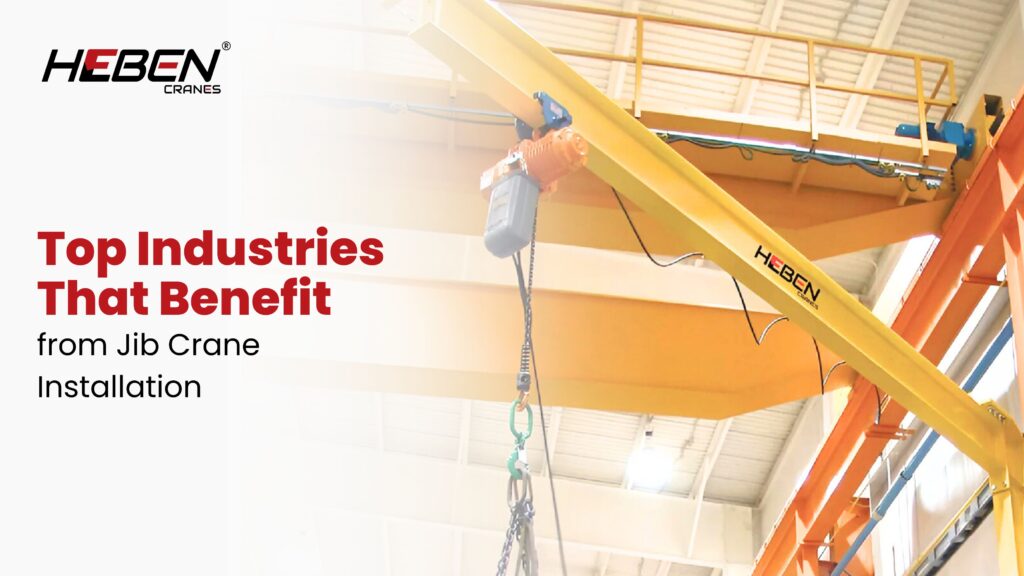
Facilities install overhead cranes for wide-area coverage, then discover 40% of daily lifts happen within a 3-5 meter radius at individual workstations. Overhead cranes don’t solve this. Workers improvise with forklifts, manual handling, or awkward rigging—creating bottlenecks, injuries, and slow cycle times. Jib cranes solve localized lifting precisely. A single pillar-mounted or wall-mounted unit covers one workstation, one machine, one loading bay—with full 180-360° rotation and capacities from 250kg to 5 tons. This guide covers the industries where jib cranes deliver the clearest operational improvement, the specific applications driving that value, and the selection factors matching crane type to task. Manufacturing and Assembly Lines Assembly operations produce the clearest jib crane case. Components move between stations repeatedly. Each move is short, specific, and time-critical. A jib crane mounted at each station handles this without competing for shared overhead crane time. Welding bays use jib cranes to position heavy sub-assemblies for flat or positional welding. The operator rotates the arm, positions the load, and locks it in place. Jig and fixture handling follows the same pattern. Cycle times drop when operators control their own lifting resource rather than waiting for a shared crane. The contrarian insight: most plants install one overhead crane covering the full floor, then discover workstation congestion from crane sharing. Adding jib cranes at high-frequency stations costs less than a second overhead crane and solves the bottleneck more directly. Warehousing and Logistics Loading bays present a specific lifting problem. Loads arrive and depart at fixed points. Coverage radius is small. Speed matters. A wall-mounted jib crane at each bay handles goods movement without forklift congestion in tight dock areas. Conveyor feed stations use jib cranes to transfer heavy bags, drums, and boxes from floor level to conveyor height. The short, repetitive nature of this task suits jib crane geometry exactly. Operators handle the lift in seconds rather than repositioning handling equipment. Mezzanine loading points benefit from column-mounted jib cranes serving both floor and upper levels. One unit covers the vertical transfer zone. No overhead crane access is needed at these locations. Automotive and Aerospace Engine assembly requires precise component positioning over close tolerances. Jib cranes mounted at engine build stations handle block and head positioning, gearbox mating, and ancillary component installation. The operator controls movement directly, placing components within millimetres. Body shop operations use jib cranes for panel handling, door fitting, and sub-frame positioning. These are short-range, high-frequency lifts at fixed workstations. The alternative—manual handling of 50-200kg panels—creates ergonomic injuries and quality problems from surface contact damage. Aerospace component handling demands both capacity and precision. Turbine blades, actuator assemblies, and avionics packages weigh 20-300kg. Jib cranes with fine-speed hoists handle these components without the shock loading risk of manual movement. Construction and Fabrication Yards Fabrication shops use jib cranes at cutting tables, press brakes, and welding positions. Plate and section steel weighs 80-500kg per piece. Manual handling at these weights creates injury risk and slow production. A jib crane at each machine removes both problems. Outdoor construction sites use pillar-mounted or portable jib cranes for rebar cage assembly, precast element handling, and formwork positioning. The freestanding pillar design requires no building attachment, making it suitable for open site locations. Steel service centres handle cut-to-length sections and rolled product with jib cranes at slitting and shearing lines. The crane serves the machine directly. Material flow from process to stacking position covers 3-6 meters—exactly the range where jib cranes outperform all alternatives. Power and Energy Sector Transformer installations require precise positioning in confined electrical switchrooms. Overhead cranes can’t always access these locations. A wall-mounted jib crane inside the switchroom handles transformer positioning during installation and maintenance replacement. Turbine maintenance bays use jib cranes for blade removal, bearing replacement, and ancillary equipment handling. Maintenance cycles repeat at fixed intervals. A permanent jib crane installation at each maintenance bay eliminates mobile crane hire for every service event. Generator and motor repair facilities handle rotors, stators, and end shields weighing 100-2,000kg. Jib cranes at repair benches handle these components through disassembly, inspection, and reassembly sequences. The fixed-position crane serves the workstation throughout each repair cycle. Machine Shops and Maintenance Facilities CNC machining centres require workpiece loading and unloading for every job. Parts weigh 20-500kg. A jib crane mounted at each machine handles this independently. Machine operators don’t wait for overhead crane availability. Cycle time is determined by machining, not material handling. Typical Machine Shop Applications Workpiece loading onto CNC turning, milling, and grinding machines Fixture and tooling movement between storage and machine Finished part transfer from machine to inspection table Heavy chuck and collet handling at lathe positions Maintenance workshops use jib cranes for equipment disassembly and rebuild. Pump casings, gearbox housings, and motor frames move between floor and workbench positions repeatedly during overhaul. A jib crane rated 500kg-2 tons covers most maintenance workshop lifting requirements. Food and Beverage Processing Ingredient handling in food production involves bags, drums, and intermediate bulk containers weighing 25-1,000kg. Jib cranes at mixing and batching stations lift and tip these containers directly into process vessels. The alternative—manual bag handling—creates musculoskeletal injury and contamination risk simultaneously. Hygienic design variants use stainless steel construction and sealed bearings for washdown environments. Food-safe coating systems meet FDA and HACCP requirements. These features add cost but eliminate contamination risk that standard crane finishes can’t address. Packaging line infeed stations use jib cranes to load bulk materials onto conveyors. The short transfer distance and fixed position suit jib crane geometry directly. Installation at each infeed point removes manual handling from a task performed hundreds of times per shift. Shipbuilding and Marine Repair yards use wall-mounted jib cranes along dry dock walls for tooling, equipment, and small component handling. The crane reaches over the vessel side. Marine service technicians work independently without competing for yard overhead crane time. Engine room access is confined and awkward. Jib cranes positioned at engine room hatches lower and raise tools, replacement parts, and removed components through the access opening. The controlled movement reduces damage to both equipment and
Types of Jib Cranes: Industrial Guide

Most factories solve workstation lifting the wrong way. They route every pick through the main overhead crane. The EOT crane moves a large assembly. Meanwhile, a machinist waits to load a 400 kg fixture. A welder needs a component from the rack. An assembler needs a part shifted half a meter. The main crane handles one job at a time. Everyone else waits. A jib crane at each workstation breaks this dependency entirely. This guide covers every major jib crane type — design, rotation, capacity, and application — so you can select the right configuration for each location in your facility. What Jib Cranes Do A jib crane consists of a vertical support, a horizontal boom, and a hoist that travels along the boom. The boom rotates around the support, creating a fixed circular lifting zone. Each crane serves one workstation independently. Capacities range from 125 kg to 15 tonnes. Boom lengths run from 2 meters to 15 meters. Rotation angles vary from 180 degrees on wall-mounted types to full 360 degrees on floor-mounted types. The core advantage is decentralization. Jib cranes give each station its own lifting capacity without competing for the main crane. Pillar Mounted Jib Cranes A pillar jib crane stands on an independent steel column fixed to a concrete foundation. The boom rotates 360 degrees around the column. This covers all four quadrants around the mast — effectively serving multiple adjacent workstations. Capacities reach up to 10 tonnes with boom lengths of 3 to 12 meters. The foundation carries all structural loads independently. Building columns and roof structure are not involved. Pillar jibs are the most structurally reliable type for medium to heavy loads. Their load path — mast to baseplate to foundation — is direct, predictable, and easy to engineer. Wall Mounted Jib Cranes A wall-mounted jib crane fixes to a building wall, structural column, or bracket. The boom rotates 180 to 270 degrees, depending on the mounting angle. No floor space is occupied. No foundation is required beyond the existing column or wall. Capacities for wall jibs typically stay under 2 to 5 tonnes with booms up to 8 meters. The mounting point must carry the full bending moment of the boom under rated load. Older industrial buildings with undersized columns fail this check more often than buyers expect. The practical rule: wall jibs suit light loads on strong columns. When capacity exceeds 2 tonnes or boom length exceeds 6 meters, a structural assessment is mandatory before installation. Free Standing Jib Cranes A free standing jib crane uses a self-supporting mast without wall or roof attachment. The mast bolts to a floor base plate or embedded sleeve. The boom gives full 360-degree coverage. Capacities reach up to 15 tonnes with booms extending to 12 meters or more. Free standing jibs work indoors and outdoors. They suit loading docks, outdoor yards, and open bays where no building structure exists nearby. The installation is flexible. The crane positions anywhere a concrete pad can be poured. This makes free standing jibs the preferred choice for new facility layouts and outdoor handling areas. Articulating Jib Cranes An articulating jib crane uses two boom segments — an inner arm and an outer arm — each rotating independently. The outer arm rotates 360 degrees. The inner arm adds a second rotation axis. Together, they reach into corners, around obstacles, and into confined machine openings that a straight boom cannot access. Capacities stay light — typically under 1 tonne with combined reach up to 5 meters. Articulating jibs suit precision assembly, instrument handling, and machine loading where the load path requires two-axis maneuvering. The unexpected insight: 70% of articulating jib applications are not about reach — they’re about avoiding collisions with machine guards, fixtures, and adjacent equipment that a rigid boom would hit on every cycle. Mast Type Jib Cranes A mast type jib crane is supported at the base by the floor and at the top by the building’s overhead structure. The top tie removes the overturning moment from the foundation. This reduces foundation size and cost compared to a fully free standing mast. Capacities reach up to 10 tonnes with boom lengths of 3 to 12 meters. The overhead tie point must be structurally verified. But the load is primarily vertical tension, not bending — making it easier to integrate with existing roof purlins and rafters than an underhung crane runway. Mast jibs suit facilities where floor space is limited and the roof structure can carry vertical tie loads without major reinforcement. Portable and Mobile Jib Cranes A portable jib crane uses a ballasted base or wheeled chassis for relocation. It serves temporary lifting needs — maintenance access, site installation, equipment repositioning. Capacities stay below 1 to 2 tonnes. Mobile jibs give 360-degree rotation and require no permanent fixing. They are not substitutes for fixed workstation cranes in production environments. Frequent relocation creates repositioning time and reduces the productivity gain that fixed jibs deliver on a per-shift basis. Key Features Across All Jib Types Regardless of type, every jib crane includes these core features: Hoist options: electric chain hoist, wire rope hoist, or manual chain fall Rotation mechanisms: manual push-pull, motorized with brake, or lockable fixed positions Safety devices: overload protection, limit switches for hoist travel, rotation stops Special executions: low headroom units for restricted bays, corrosion-resistant coatings for outdoor or coastal environments, flameproof and ATEX certified versions for hazardous areas How to Select the Right Jib Crane Follow these four steps to match the crane type to the application: Define load and reach: confirm maximum lift weight, boom radius required, and hook height needed at the workstation Assess the building: check floor strength for foundation, column capacity for wall mounting, roof structure for tie loads Match duty cycle: count lifts per shift and estimate daily operating hours; this determines hoist duty class and rotation mechanism type Plan for installation and expansion: confirm site access for foundation work, allow clearance for boom rotation, and check interference with overhead
Top Jib Cranes Supplier in Chennai
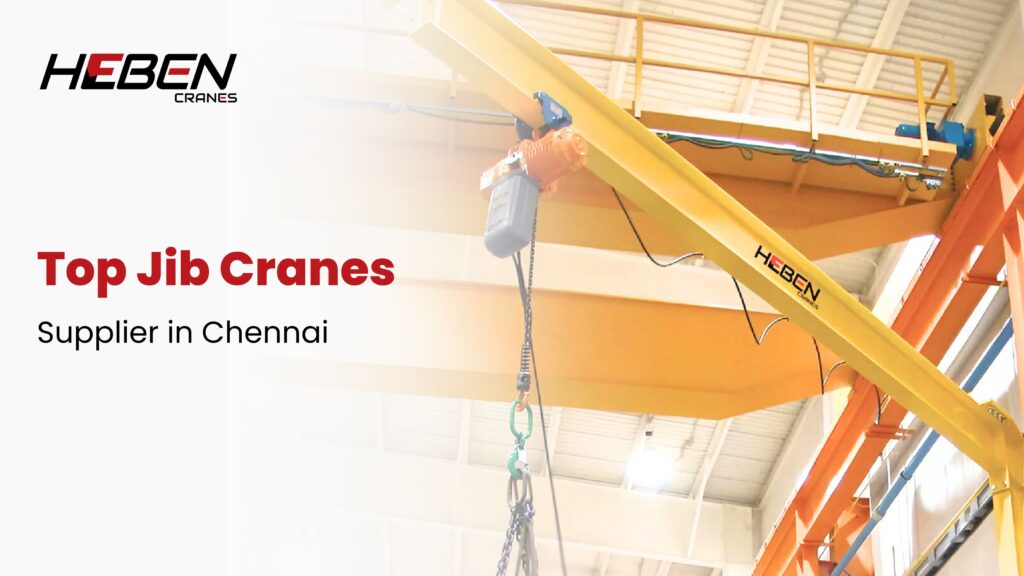
Chennai workshops run main overhead cranes at full capacity. The EOT crane moves large assemblies across the bay. But smaller jobs wait. A machinist needs to load a 500 kg fixture onto a CNC bed. The welder needs a tool from storage. The assembly team needs a component from the staging area. They wait for the main crane. Or they lift manually. Both options cost time, create bottlenecks, and increase injury risk. A jib crane solves this by giving each workstation its own lifting capacity, independent of the main system. This guide explains how to select a Chennai supplier who understands the technical, structural, and operational requirements of jib crane installations. What Jib Cranes Do in Industrial Workstations A jib crane consists of a vertical mast, a horizontal boom, and a hoist that travels along the boom. The boom rotates around the mast. This creates a circular lifting zone at each workstation. Pillar-mounted jib cranes stand on the floor with a foundation. They rotate 360 degrees. Wall-mounted jib cranes bolt to existing columns or structural walls. They rotate 180 to 200 degrees. Both types eliminate the need to wait for the main crane. Studies show workstation cranes increase productivity by 27-28% compared to manual handling or traditional I-beam systems. The time savings come from faster load positioning, reduced travel distance, and continuous availability. Why Chennai Factories Install Jib Cranes Chennai’s automotive component shops, machine tool units, and fabrication workshops operate in bays where the main EOT crane serves multiple stations. A single crane cannot handle simultaneous lifting at five or six workstations. Jib cranes decentralize the lifting. Each machining center gets its own crane. Each welding bay gets its own crane. Each packing station gets its own crane. The main overhead crane handles large transfers between zones. The jib cranes handle repetitive, localized tasks. This separation increases throughput. It also reduces operator fatigue and musculoskeletal injuries from manual lifting. Chennai’s labor laws and safety audits now penalize repetitive manual handling of loads above 20 kg. Jib cranes eliminate compliance risk. The Hidden Problem with Cheap Jib Crane Suppliers Most buyers focus on boom length and capacity. They ignore the mast design, foundation calculations, and rotation mechanism quality. A 2-tonne jib crane looks identical whether it’s built to 1,000 lift cycles or 10,000 lift cycles. Undersized bearings fail within six months. Poorly welded mast joints crack under repeated slewing. Electric hoists without overload protection burn out when operators exceed rated capacity. These failures stop production at the exact workstation the crane was meant to serve. Chennai suppliers who import catalogue jib cranes cannot modify boom length, rotation angle, or hoist specifications. If your column spacing is 4.8 meters and the catalogue offers 4 meters or 5 meters, you either waste reach or create interference. Custom engineering matters. Pillar-Mounted vs Wall-Mounted: The Choice Most Get Wrong Buyers assume wall-mounted cranes save money because they skip the foundation. This is true only if your building columns can handle the loads. A 2-tonne jib crane with a 4-meter boom generates significant bending moment at the wall bracket. Chennai’s older industrial sheds use 200 mm x 200 mm columns. They cannot support a 2-tonne wall jib without reinforcement. You’ll spend on column strengthening what you saved on the foundation. Pillar-mounted jib cranes are structurally independent. They require a small concrete pad but can be placed anywhere in the bay. They offer 360-degree rotation, which covers four workstations in a square layout. Wall-mounted cranes offer 180 degrees, covering only two stations. Choose wall-mounted for light loads (under 500 kg), short booms (under 3 meters), and wall-adjacent workstations. Choose pillar-mounted for heavier loads, longer reach, and multi-station coverage. Technical Specifications That Separate Quality Suppliers Capacity ranges in Chennai installations run from 125 kg to 5,000 kg. Most machine shops need 500 kg to 2,000 kg. Foundries and heavy fabrication need 3,000 kg to 5,000 kg. Boom length determines the work radius. Standard lengths are 3, 4, 5, and 6 meters. Custom lengths matter when existing columns, machines, or storage racks define the workspace geometry. Rotation and Slewing Mechanism Manual slewing works for infrequent lifts (under 20 per shift). Motorized slewing is essential for high-frequency operations (over 50 lifts per shift). Ball bearing slewing rings reduce friction and extend service life. Plain bearings wear quickly under heavy use. Limit switches prevent over-rotation and cable damage. This feature is mandatory for motorized jibs. Many cheap suppliers skip it to cut costs. Hoist Selection Electric chain hoists suit Chennai’s typical 500 kg to 2,000 kg range. Wire rope hoists handle heavier loads and longer lifting heights. The hoist must match the jib’s duty class. A heavy-duty jib with a light-duty hoist creates a mismatch that shortens component life. Installation and Structural Considerations Pillar jib cranes need foundation design. The supplier must provide anchor bolt layout, concrete grade specification, and curing time before erection. Skipping the structural drawing leads to misalignment and vibration. Wall-mounted jibs need column load verification. The supplier should visit the site, measure the column section, check the existing foundation, and calculate the bracket fixation. Drilling into columns without structural analysis can compromise building safety. Electrical routing matters. Pendant cables must reach the operator’s position without creating trip hazards. Festoon systems keep cables organized on long booms. Radio remote controls eliminate cable wear but add cost. After-Sales Service in Chennai’s Industrial Zones Jib cranes operate daily. Bearings need greasing every 500 cycles. Hoist brakes need inspection every 3,000 lifts. Wire ropes need replacement based on visible wear. A supplier with service teams in Chennai’s Ambattur, Guindy, or Sriperumbudur industrial areas can respond within hours. Suppliers based outside Tamil Nadu cannot. Downtime at a CNC workstation costs more per hour than the service call. Spare parts availability determines long-term reliability. Hoists, trolleys, and electrical panels should be standard Indian makes. Imported components create lead times of 6-8 weeks when they fail. How Heben Cranes Delivers for Chennai Buyers? Heben designs pillar and wall-mounted jib cranes from 250 kg
Top Jib Crane Supplier India 2025

India’s industrial sector is surging toward new heights in 2025, driven by rapid expansion in manufacturing, infrastructure, and logistics. In this dynamic environment, the demand for agile, space-saving, and efficient material handling solutions is at an all-time high. Jib cranes—renowned for their versatility and compact design—have become an essential asset across workshops, warehouses, and production lines. Among the leading providers, Heben Technovation Pvt. Ltd. stands out as the top jib crane supplier in India, setting benchmarks in engineering excellence, customization, and customer-centric service. What Is a Jib Crane? A jib crane is a type of lifting device characterized by a horizontal arm (the jib or boom) that supports a hoist, which can move along the arm. The jib is typically mounted on a wall or a freestanding pillar, allowing for a wide range of motion—often up to 360 degrees. This design makes jib cranes ideal for localized lifting, loading, and material transfer tasks, especially in areas where space is limited or where overhead cranes are impractical. Key Features Space Efficiency: Perfect for tight spaces and workstations. Versatile Mounting: Options include wall-mounted, floor-mounted, and column-mounted configurations. Flexible Operation: Offers manual or motorized rotation and lifting. Customizable Capacity: Typically available in capacities from 0.5 tons to 10 tons, with tailored boom lengths and heights. The Indian Market for Jib Cranes in 2025 The Indian jib crane market is experiencing robust growth, fueled by investments in smart manufacturing, warehousing, and infrastructure. As industries embrace automation and lean production, jib cranes are increasingly valued for their ability to streamline workflows, reduce manual handling, and enhance safety. Market Drivers Make in India and Smart Cities: Government initiatives are spurring the adoption of advanced material handling equipment. Automation and Industry 4.0: Integration of IoT and smart controls is making jib cranes more intelligent and efficient. Diverse Applications: From automotive assembly lines to port facilities, jib cranes are being deployed across a wide spectrum of industries. Why Heben Technovation Pvt. Ltd. Leads the Market Engineering Excellence Heben Technovation is synonymous with quality and innovation. Each jib crane is engineered with high-grade materials and precision manufacturing techniques, ensuring durability, reliability, and smooth operation even in demanding industrial environments. Robust Construction: Welded box sections and reinforced pivots for maximum strength. Precision Bearings: Ensures effortless rotation and minimal maintenance. Quality Hoists: Compatible with both electric and manual hoists, offering flexibility for every application. Customization and Flexibility No two facilities are identical, and Heben Technovation recognizes the need for tailored solutions. Their jib cranes are available in a wide range of configurations: Freestanding Jib Cranes: Ideal for open workspaces, offering 360-degree rotation and high lifting capacities. Wall-Mounted Jib Cranes: Space-saving design for workstations and production lines. Articulating Jib Cranes: For complex movement patterns, providing extended reach and maneuverability. Every crane can be customized for boom length, height, rotation angle, and lifting capacity, ensuring a perfect fit for your operational needs. Advanced Features Motorized Rotation: Smooth, precise movement for heavy or repetitive tasks. Variable Speed Drives: Enhanced control and safety during lifting and lowering. Integrated Safety Systems: Overload protection, emergency stop, and limit switches as standard. Smart Controls: Optional IoT integration for remote monitoring and predictive maintenance. Space and Workflow Optimization Heben’s jib cranes are designed to enhance productivity by bringing the lifting solution directly to the point of use. This reduces unnecessary movement, minimizes manual handling, and optimizes workflow efficiency—key benefits in high-throughput environments. Applications Across Industries Heben Technovation’s jib cranes are trusted by leading companies in sectors such as: Automotive: Efficient handling of components along assembly lines and maintenance bays. Manufacturing: Streamlining material transfer between workstations, machines, and storage. Warehousing: Loading and unloading goods, especially in confined spaces. Construction: Supporting lifting and positioning of materials on-site. Ports and Logistics: Assisting in cargo handling and container management. Steel and Metal Fabrication: Precise movement of heavy plates, profiles, and assemblies. Customer-Centric Approach Heben Technovation is more than just a supplier—it’s a partner in your operational success. Their customer-first philosophy is reflected in: 48-Hour Resolution Commitment: Rapid response to service requests, minimizing downtime. 24/7 Technical Support: Around-the-clock assistance from a dedicated team of specialists. Comprehensive After-Sales Service: From installation and commissioning to maintenance and spare parts, Heben provides end-to-end support throughout your crane’s lifecycle. Safety and Compliance Safety is non-negotiable in material handling. Heben’s jib cranes are engineered with: Overload Protection: Prevents lifting beyond rated capacity. Emergency Braking: Ensures immediate stopping in case of anomalies. Limit Switches: Prevents over-travel and accidental collisions. Operator Training: Comprehensive programs to ensure safe and efficient crane operation. All cranes are designed and manufactured in compliance with international standards, ensuring peace of mind and regulatory compliance. Innovation and Future-Readiness Heben Technovation stays ahead of the curve by investing in research and development. Their jib cranes incorporate the latest advancements in automation, energy efficiency, and smart diagnostics, ensuring your investment is future-ready. IoT Integration: Enables real-time monitoring, predictive maintenance, and data-driven decision-making. Energy-Efficient Drives: Reduce operational costs and environmental impact. Modular Design: Allows for easy upgrades and integration with existing systems. Proven Track Record Heben Technovation has a rich history of delivering jib cranes to major projects across India, earning a reputation for reliability, quality, and customer service. Their cranes are trusted by industry leaders in automotive, steel, logistics, and manufacturing, making them the preferred choice for businesses seeking to elevate their material handling capabilities. Why Choose Heben Technovation Pvt. Ltd. in 2025? Unmatched Engineering Quality: Precision design, robust construction, and rigorous testing. Tailored Solutions: Customization for every industry and application. Advanced Safety and Efficiency: Cutting-edge features for safe, reliable, and cost-effective operation. Exceptional Support: 48-hour resolution, 24/7 assistance, and comprehensive after-sales service. Future-Ready Technology: Automation, IoT, and energy-efficient systems for tomorrow’s challenges. Conclusion: Elevate Your Operations with Heben Technovation As India’s industries continue to expand and modernize, the need for efficient, flexible, and reliable lifting solutions has never been greater. Heben Technovation Pvt. Ltd. leads the way as the top jib crane supplier in India for 2025, offering engineering excellence, customization, and unwavering support. Whether you’re upgrading