
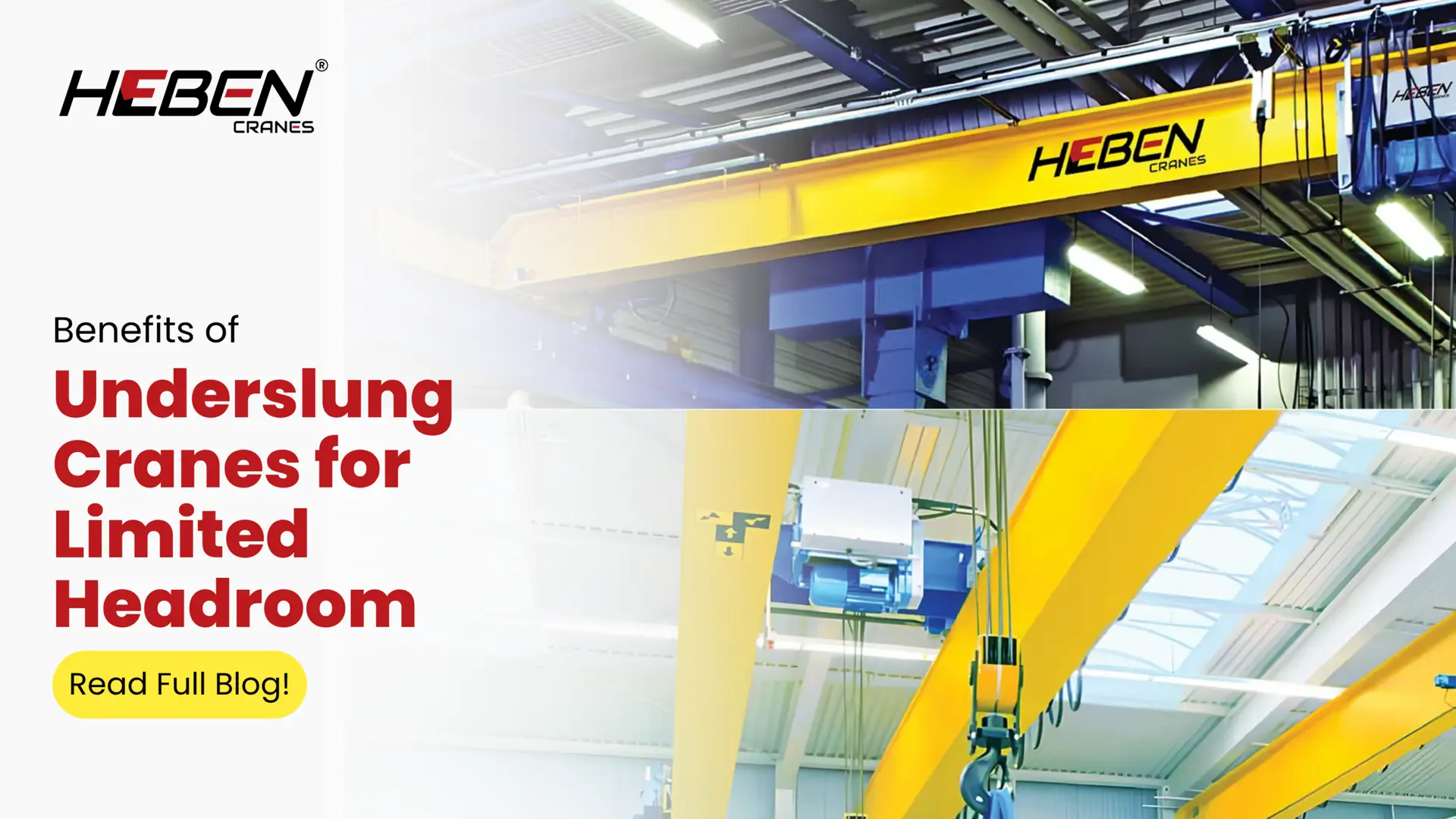
A low ceiling shouldn’t rule out mechanized lifting, but most facility managers assume it does. They keep pushing pallets by hand, or renting forklifts that can’t reach a mezzanine, because a traditional overhead crane needs 16 to 20 feet of clearance to work. That number gets treated as a hard wall. It isn’t.
An underslung crane hangs from the roof structure instead of riding on top of it, and that single design shift changes what “limited headroom” actually limits. A five-ton underslung system can run in as little as 8 to 10 feet of clearance — half of what a comparable top-running crane demands. We’ve engineered and installed these systems across warehouses, assembly lines, and retrofit projects where a low roofline seemed like a permanent constraint.
This post walks through what an underslung crane is, how it solves the headroom problem mechanically, the concrete benefits it delivers, where it fits best, and what to check before you install one.
What Is an Underslung Crane?
An underslung crane (also called an under-running or suspension crane) runs along the bottom flange of a runway beam instead of on top of it. The runway beam bolts directly to your existing roof trusses or ceiling structure. There’s no need to add support columns or a separate runway support system — the building’s own frame does the work.
How It Solves the Headroom Problem
Picture a top-running crane: the trolley and hoist sit between the girders, and that stack of girder-plus-hoist eats into your usable ceiling height. An underslung crane flips that arrangement. The hoist hangs below the beam instead of between two beams, so the extra height the mechanism needs stays below your working area instead of consuming it.
That’s why a 12-foot ceiling that looked incompatible with automated lifting can suddenly take a 5-ton crane with room to spare. The math isn’t about squeezing a smaller crane into a small space — it’s about relocating where the extra inches get spent.
Key Benefits of Underslung Cranes
Maximized headroom and hook height
Because the load path pulls down from the roof rather than pressing down through columns, you keep more of your vertical space usable for lifting instead of losing it to structure.
Floor space stays clear
No support columns means nothing breaking up your floor plan. Aisles stay open, forklifts move freely, and you can rearrange racking or workstations without working around crane legs.
Faster, cheaper installation
Since the crane attaches to structure you already have, there’s no need to pour foundations or erect support columns. Installation runs 30 to 70 percent cheaper than a top-running system, with the crane operational in days rather than weeks.
Flexible track layouts
The rail system can include curves, switches, and interlocks, letting the crane move between bays or around obstacles instead of running in a single straight line.
Lighter load on your building
Underslung systems weigh less than top-running equivalents, which matters when you’re retrofitting an older building that was never engineered to carry a heavy crane on top of its columns.
Smooth, precise handling
Pendant, push-button, or radio-remote controls give operators fine control over positioning, which matters for delicate loads or tight tolerances during assembly.
Lower ongoing maintenance
Fewer moving parts bear the structural load compared to a top-running system, which translates into less wear and a smaller maintenance bill over the life of the equipment.
Built-in safety features
Overload protection, limit switches, and emergency stop buttons come standard, and because the crane hangs rather than sits on the floor, you also clear tripping hazards from the work area below.
Where Underslung Cranes Work Best
Underslung cranes are built for light-to-medium loads — most single-girder systems top out between 10 and 16 tons. They’re the right call in:
- Warehousing and distribution centers
- Assembly lines and light manufacturing
- Textile, food and beverage, and pharmaceutical facilities
- Retrofit projects in decades-old buildings that lack headroom for a top-running system
If you’re regularly lifting above 20 tons or running continuous heavy-duty cycles, that’s a different conversation — one where a top-running crane’s higher capacity and reach make more sense.
Underslung vs. Top-Running: The Real Trade-Off
The decision usually comes down to one question: what does your building actually support?
- Choose underslung if headroom is tight, you need fast installation, your building’s roof structure can bear the suspended load, or you’re working with intermittent, light-to-medium lifting needs.
- Choose top-running if you need capacity above 20 tons, run continuous high-tonnage operations, or have the clearance and structural budget to support it.
Here’s the part most spec sheets skip: if your building can’t support one large top-running crane, two smaller underslung cranes working different bays can often match the total lifting capacity — without triggering a structural reinforcement project.
What to Check Before You Install
- Roof and truss capacity. The structure needs to carry the crane’s dead weight plus your maximum load, with margin.
- Available vertical clearance. Measure floor-to-roof height at the lowest point in the bay, not just the peak.
- Span and suspension points. Longer spans or heavier loads need multiple suspension points, not a single-point hang.
- Existing obstructions. Map racking, ductwork, or fixed machinery in the travel path before finalizing the layout.
Maintenance That Keeps It Running
Underslung systems need more frequent inspection of the suspension hardware than top-running cranes do, since the entire crane weight rests on ceiling attachment points. A workable schedule looks like:
- Daily control system checks
- Semi-monthly wire rope and track inspection
- Monthly checks on safety devices, motors, brackets, and bolts
- Annual comprehensive inspection by a qualified technician
Done consistently, a well-built underslung crane runs reliably for 15 to 25 years.
FAQs
Can I upgrade to a top-running crane later if I need more capacity? Technically yes, but it usually means removing the underslung system, adding runway support columns, and possibly reinforcing the roof structure — a project that often costs as much as the original installation. It’s worth sizing your underslung crane with some growth margin up front.
What’s the maximum load an underslung crane can handle? Most single-girder underslung cranes are rated between 1 and 16 tons. Double-girder configurations can go higher, but at that point the cost and complexity start to close the gap with a top-running system.
Does an underslung crane work in an older building? Often, yes — that’s one of its strongest use cases. As long as the roof trusses or ceiling beams can carry the added load, you avoid the foundation and column work a top-running retrofit would require.
How much clearance do I actually need? A 5-ton underslung crane typically needs 8 to 10 feet of clearance, compared with 16 to 20 feet for an equivalent top-running crane. Exact numbers depend on hoist size and beam depth, which is why a site assessment matters.
Get Your Facility Assessed
A low ceiling is a solvable engineering problem, not a dead end. The next step is a site assessment that tells you exactly what your building can support and what crane fits it.
At Heben Cranes, we design and install underslung crane systems for exactly this situation — facilities where headroom is tight and floor space matters. Our promise is straightforward: a crane engineered to your actual building, not a generic spec sheet. Contact us for a site assessment and get a clear answer on what your space can handle.