Most factories don’t have a clean, open floor plan. They have columns in the wrong places, a machine line down one wall, and a roof that was never built to carry a full overhead crane runway. That’s the exact situation a semi goliath crane was built to solve, and it’s why so many plant managers end up choosing one without ever seriously considering a full gantry or full overhead system.
This piece breaks down what a semi goliath crane actually is, how its hybrid structure works, and why it keeps showing up as the right fit for factory floors specifically — not shipyards, not open yards, factories. You’ll get the benefits that matter for a factory setting, the applications where this crane earns its keep, and the specs and site factors worth checking before you commit. If you’re comparing lifting options for a plant with limited floor space or an existing crane already in use, this should settle most of the open questions.
What Is A Semi Goliath Crane
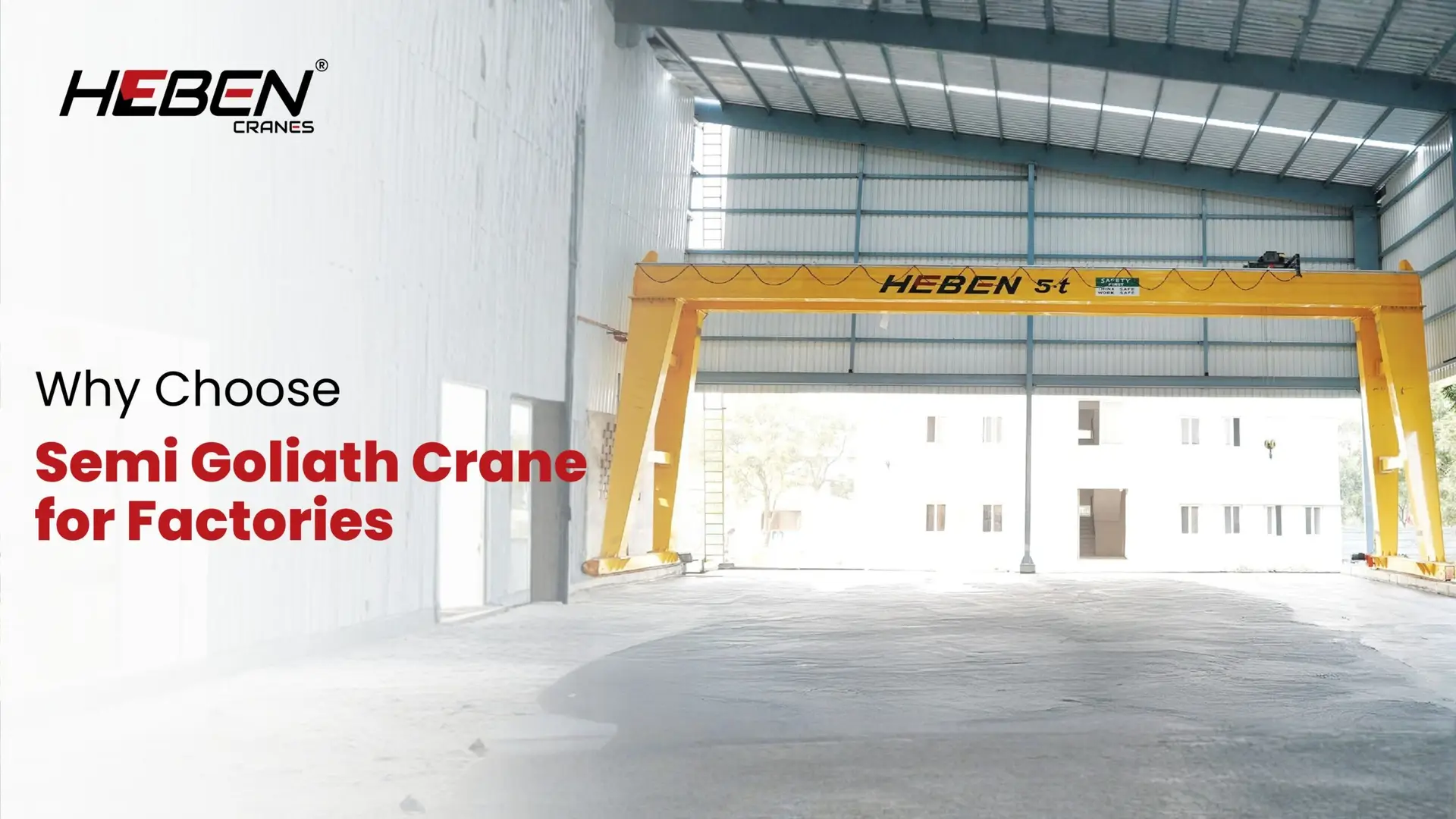
A semi goliath crane runs one leg on a ground-level rail and supports the other end of the bridge girder on an elevated runway, usually fixed to a wall or building column. That’s the entire concept in one sentence, and it’s also the reason this crane needs less than half the infrastructure a full system does.
A full goliath (gantry) crane needs ground rails running the entire span. A full overhead (EOT) crane needs an elevated runway on both sides. A semi goliath crane splits the difference — one side down, one side up — which is exactly why it fits into buildings that were never designed with cranes in mind.
How It Works
The bridge girder carries the hoist and trolley, same as any overhead crane. What changes is how each end gets supported.
- One end sits on a vertical leg that travels along a ground-mounted rail
- The other end rides an end truck along an elevated runway beam, mounted to a column or wall
- Single girder configurations handle lighter loads with a simpler, more compact structure
- Double girder configurations handle heavier loads and longer spans with added stability
Some versions skip the floor rail entirely, running on polyurethane tyre wheels instead. That removes a trip hazard from the floor and lets the crane operate on a standard factory floor rated for forklift-level loads.
Benefits For Factory Floors
Here’s where the case for a semi goliath crane gets concrete. Every point below is a direct comparison against the alternative — a full gantry or full overhead installation.
Space and structure
- Only one side needs ground rails, freeing up floor space the other type would consume
- The elevated side ties into columns you already have, so you’re not building new structural steel across the whole bay
- Works in narrow, congested layouts where a full crane simply won’t clear existing machinery
Cost and installation speed
- Lower steel and civil work requirement translates directly into lower upfront cost
- Less groundwork means shorter installation timelines and less production downtime during setup
- Fewer structural modifications reduce the risk of unexpected site costs mid-project
Fits around what you already run
- Can operate underneath or alongside an existing overhead crane, giving you a second hook without a second full system
- Ideal for adding coverage to one side of a bay while the existing crane handles the rest of the floor
- Suited to moderate lifting volumes that don’t justify a full permanent crane investment
One pattern that surprises a lot of buyers: plants that already own an overhead crane are often the ones that end up buying a semi goliath, not plants starting from zero. The second crane fills a gap the first one can’t reach, and it does it for a fraction of what a second full system would cost.
Where It Makes The Most Sense
A semi goliath crane isn’t a universal answer — it’s a strong fit for specific factory conditions:
- Manufacturing units and assembly lines where the machine layout leaves a narrow, defined lifting zone
- Fabrication shops and workshops with columns already positioned along one wall
- Warehouses and logistics floors needing coverage in one section without touching the rest of the layout
- Steel plants or production cells where a full-length runway would cross paths with existing equipment
If your lifting need spans the entire building width evenly, a full overhead crane still makes more sense. The semi goliath earns its place when the lifting zone runs along one side or a defined section.
Specifications worth checking
- Load capacity, typically 1 to 100+ tons depending on single or double girder design
- Span length, generally 5 to 50 meters, or custom-built to your bay
- Duty class, matched against IS or ISO standards for how many lifts you run per shift
- Control setup — variable frequency drives and radio remote are now standard requests, not upgrades
Factors To Evaluate Before You Commit
- Load requirements: size for your heaviest regular lift, not your average one, and leave headroom for future volume
- Floor and ceiling clearance: confirm the elevated runway side has the column strength and height to support your span
- Indoor vs. outdoor exposure: outdoor installations need corrosion protection and weatherproofing the indoor version doesn’t
- Duty class match: a crane rated below your actual shift intensity wears out early; one rated well above it costs more than you need
FAQs
Can a semi goliath crane run alongside an overhead crane I already have? Yes. This is one of its most common uses — it provides localized hook coverage for one section of the floor while your existing overhead crane continues serving the rest of the bay.
Is a semi goliath crane cheaper than a full overhead crane? Generally yes, because only one side needs elevated runway structure instead of two. The exact savings depend on your span and site conditions, but the reduced steel and civil work is the main driver.
Does it need a floor rail? Not always. Rail-less versions run on polyurethane tyre wheels directly on the factory floor, which removes the trip hazard and works on floors rated for forklift traffic.
What’s the biggest mistake buyers make when sizing one? Sizing to current load and current duty cycle only. Facilities that skip the future-capacity check often find themselves replacing the crane within a few years instead of upgrading a properly sized one.
Conclusion
A semi goliath crane earns its place in a factory by fitting the building you already have, not the building you’d need for a full crane system. If your floor has columns in the wrong place, an existing crane that needs backup, or a lifting zone confined to one side of the bay, this is the option worth pricing out first.
Heben Cranes designs semi goliath cranes around your actual floor layout, load pattern, and existing structure, so you get coverage exactly where you need it without paying for infrastructure you don’t. Talk to our team for a site assessment and a straight recommendation on whether a semi goliath crane fits your factory.