Ask most people what stalls a shipbuilding schedule, and they’ll blame steel delays or labor shortages. Ask a shipyard operations manager, and they’ll point to the crane. A hull section ready to move but with no crane free to move it sits idle, and every idle hour ripples through the rest of the build. Goliath cranes exist to close that gap.
We build and supply Goliath cranes for heavy industrial lifting, and shipyards are where these machines do their most demanding work. This piece covers where Goliath cranes fit into a shipyard’s operations, what types get used and why, the capacity and safety specs that matter, and what to check before you commit to one. By the end, you’ll know whether a Goliath crane solves your bottleneck — and which configuration to ask for.
What Is a Goliath Crane?
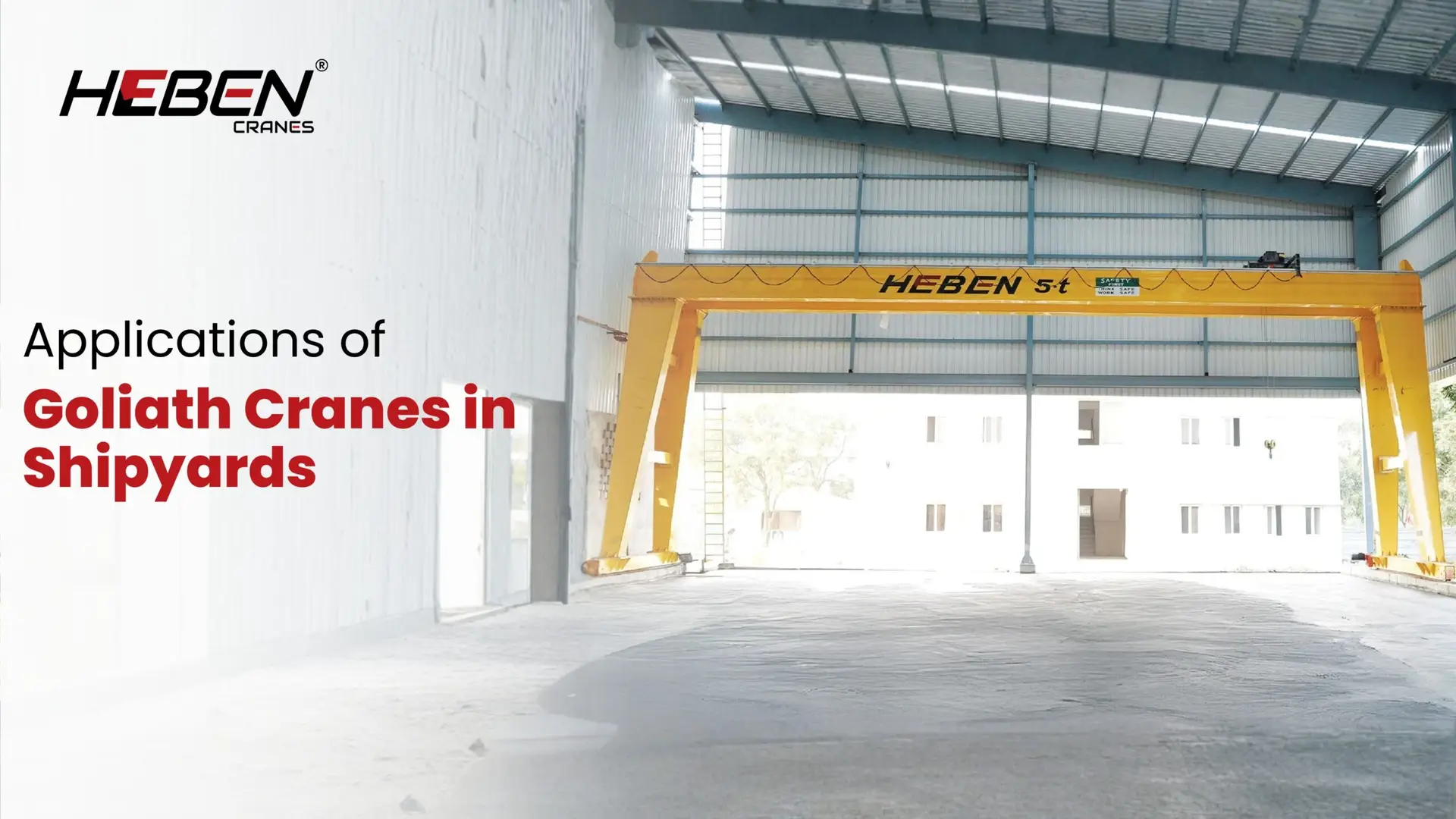
A Goliath crane is a freestanding, bridge-type crane that runs on ground-level rails instead of hanging from a building structure. Two vertical legs support a horizontal girder, which carries the hoist and trolley across the span. That independence from overhead building support is the entire reason shipyards use it — a dry dock doesn’t have a ceiling to hang a crane from, and pouring the foundations for elevated runway columns across a dock that size would cost far more than the crane itself.
Key Applications in Shipyards
Goliath cranes handle several distinct jobs inside a shipyard, not just one generic “lifting” function.
- Hull block and section lifting — moving prefabricated hull sections into place during modular ship assembly, where blocks built separately are joined into a single vessel.
- Dry dock positioning — placing and aligning blocks with the precision welding and fastening require.
- Ship launching — repositioning completed sections and assemblies as a vessel nears launch.
- Loading and unloading — moving heavy equipment, engines, and materials on and off vessels during outfitting.
- Maintenance and repair support — handling components during dry-docking, when a ship is lifted out of the water for inspection or overhaul.
- Machinery and deck installation — placing engines, generators, and deck equipment that are too heavy for standard rigging.
- Mold and formwork handling — moving the molds and formwork used to fabricate hull components before assembly.
Each task puts different demands on the crane — precision matters more for block alignment, raw capacity matters more for engine installation. That’s why most shipyards run more than one Goliath crane, each sized for a specific job.
Types of Goliath Cranes Used in Shipyards
Single girder Goliath cranes
One main beam, suited to lighter, more frequent lifts — moving smaller components, tools, or fittings rather than full hull sections.
Double girder Goliath cranes
Two parallel girders let the hoist and trolley run on top rather than underneath, adding stability and pushing capacity well beyond a single girder design. This is the configuration behind most hull block lifts.
Rail-mounted vs. rubber-tyred
Rail-mounted cranes run on fixed tracks and suit repetitive, predictable paths along a dry dock. Rubber-tyred versions trade some load stability for the ability to reposition across a less fixed yard layout.
Semi-Goliath cranes
These operate beneath or alongside existing overhead crane systems rather than fully independently — useful when retrofitting Goliath capacity into a yard that already has overhead cranes installed.
Capacity, Span, and Lift Height
Shipyard Goliath cranes cover an unusually wide range compared to other industries, because the loads themselves vary so much:
- Capacity — from roughly 20 tons for lighter single girder units up to 1,000+ tons for mega-block handling on large commercial shipyards.
- Span — sized to the width of the dry dock itself, since the crane needs to travel its full length.
- Lift height — set by the height of the hull sections and the clearance needed above the dock floor.
Yards often size a crane to their largest theoretical lift, then run it for years at a fraction of that capacity on everyday jobs. That’s not waste — it’s the same logic as building a bridge to hold more than daily traffic. But it means capacity alone is a poor way to compare two cranes; duty cycle and lift frequency matter just as much.
Advantages of Using Goliath Cranes in Shipyards
- No dependency on building structure — the crane stands on its own legs, which matters since dry docks are open-air.
- Lower installation cost — no elevated runway steelwork or support columns to engineer.
- Full dock coverage — one crane travels the entire dock length rather than serving one fixed bay.
- Built for marine exposure — corrosion-resistant coatings and sealed components hold up against salt air and weather.
- Precision positioning — critical when aligning multi-ton hull sections to millimeter welding tolerances.
Safety Features
Modern Goliath cranes used in shipyards carry several safety systems as standard, not as optional add-ons:
- Anti-collision systems that prevent two cranes on the same rail from making contact.
- Load limiters and overload protection that stop a lift before it exceeds rated capacity.
- Emergency stop mechanisms accessible from the operator station.
- Tandem, or master-slave, control — two cranes lifting one oversized section under a single operator, which removes the coordination risk of two separate operators working the same load.
That last point matters more than it sounds. Coordinating two independent operators lifting one hull block is a genuine failure point — timing mismatches during a synchronized lift are how loads get dropped or twisted. One control station removes that entire category of error.
Notable Shipyard Goliath Crane Installations
Scale is easier to grasp with real numbers. The twin Goliath cranes at the Harland & Wolff shipyard in Belfast each lift up to 840 tonnes to a height of 70 metres, spanning 140 metres to serve one of the largest dry docks in the world. A shipyard in the Russian Far East later installed a 1,200-tonne Goliath crane built for large-block construction, standing 120 metres tall with a 189-metre span. A Japanese shipbuilder took delivery of a matching second 1,200-ton crane specifically to run two units in parallel across one dock. These aren’t outliers — they’re the scale a modern commercial shipyard actually requires.
How to Choose the Right Goliath Crane for a Shipyard
- Match capacity to your heaviest realistic block or section, not your average lift — then add a margin for rigging and attachment weight.
- Measure your dry dock’s full width and length to confirm required span and travel distance.
- Check clearance above the dock floor against your tallest hull sections to confirm lift height.
- Confirm corrosion protection specs are rated for your specific coastal or marine environment.
- Decide between single crane and tandem configuration based on whether your largest sections exceed one crane’s rated capacity.
FAQs
Can a Goliath crane operate in coastal environments without major modification? Yes, provided it’s specified with corrosion-resistant coatings and sealed electrical components from the start. Retrofitting weatherproofing after installation costs considerably more than specifying it upfront.
What’s the difference between a Goliath crane and a standard overhead crane in a shipyard? A Goliath crane is self-supporting on ground-level rails, while an overhead crane depends on a building structure. Since dry docks are open-air, Goliath cranes are the only practical option for that environment.
Do shipyards typically need more than one Goliath crane? Most yards running modular construction operate at least two — one sized for heavy hull blocks and one for lighter, more frequent lifts. Larger yards add tandem-capable pairs for their biggest sections.
Conclusion
Goliath cranes handle the heaviest, most precise lifting work in a shipyard — hull blocks, dry dock positioning, launching, and maintenance — because no other crane design can span a dry dock without building support. Getting capacity, span, and safety configuration right at the specification stage is what determines whether the crane becomes a bottleneck or removes one.
About Heben Technovation
Heben Technovation designs and builds Goliath cranes engineered around your yard’s actual lift profile — from single crane setups to tandem configurations built for hull block assembly. If a Goliath crane is on your equipment list for this year, contact Heben Technovation for a consultation built around your dock’s real specifications.