Some facilities need overhead crane coverage but can’t justify a full Goliath crane. The site has one solid building wall on one side and an open yard or narrow aisle on the other. A full EOT crane needs a building runway on both sides. A full Goliath crane needs ground rails on both sides. Neither fits. A semi Goliath crane solves this by using one ground-level rail on the open side and the existing building wall or column as the elevated support on the other. This guide covers how semi Goliath cranes are built, what they lift, and where they outperform both EOT and full Goliath configurations.
What a Semi Goliath Crane Is
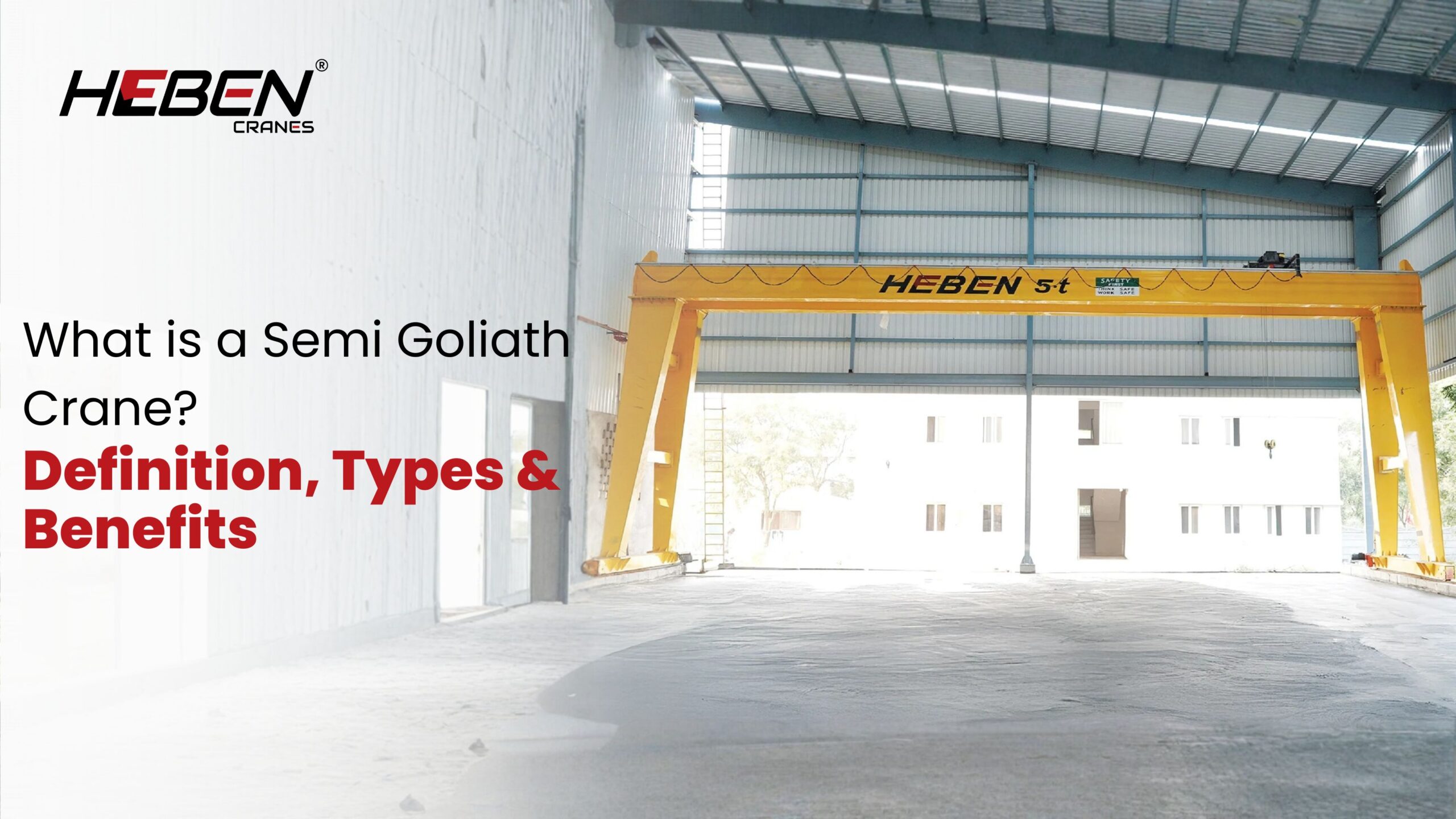
A semi Goliath crane is a hybrid lifting system. One end of the bridge girder runs on a ground-level rail track via a single structural leg. The other end runs on an elevated runway beam fixed to the building wall or column.
This arrangement combines the freestanding ground travel of a Goliath crane with the wall-mounted elevated travel of an EOT crane. The result is a crane that covers areas where a full symmetrical system — ground or elevated on both sides — is structurally or spatially impossible.
Capacities range from 1 tonne to 32 tonnes and beyond, with spans up to 32 meters. The configuration suits both indoor bays and outdoor sites with partial building cover.
How It Works
The ground leg is a structural steel frame. It carries one end of the bridge girder and travels on a rail embedded in or fixed to a concrete pad. The elevated end carriage travels on a wall-mounted runway beam, using the building’s existing structural columns as load-bearing points.
The bridge girder spans between these two supports. A hoist and trolley travel along the bridge, providing the vertical lift and lateral coverage across the full span. Both ends move in synchrony along their respective rails during long travel.
The critical point: the building wall or column on the elevated side must carry vertical wheel loads plus lateral thrust forces from crane travel and acceleration. A structural check is mandatory before any installation.
Single Girder vs Double Girder
Single Girder Semi Goliath
Single girder cranes use one bridge beam between the ground leg and the elevated carriage. They handle 1 to 16 tonnes with spans up to 20 meters. The hoist trolley runs on the bottom flange of the girder.
Lower structural weight reduces ground rail loads and wall bracket forces. This makes single girder cranes easier to retrofit into existing facilities without major civil works. They suit light fabrication yards, tool stores, and covered outdoor bays.
Double Girder Semi Goliath
Double girder cranes use two parallel bridge beams with a crab mechanism on top. They handle 3 to 32+ tonnes with spans up to 32 meters. The crab travels on rails on top of the girders, giving maximum hook height.
The twin-beam structure adds rigidity under heavy loads and allows maintenance platforms on the bridge. Double girder semi Goliath cranes suit heavy fabrication, construction material yards, and industrial plants where single girder deflection limits would be exceeded.
Key Design Features
Every semi Goliath crane includes these structural elements:
- Ground leg and base: welded steel frame, sized for span, capacity, and dynamic travel loads
- Ground rail and foundation: embedded crane rail on a concrete pad; alignment tolerance within ±3 mm over full length
- Elevated runway beam: wall or column-mounted steel section, bracket-fixed at each column
- Bridge girder: single or double beam spanning between ground leg and elevated carriage
- Hoist and trolley: wire rope hoist for heavier lifts, chain hoist for lighter applications; both with overload protection
- Drive system: VFD-controlled motors on all motions for smooth start, stop, and speed regulation
Advantages Over Full Goliath and EOT Cranes
The most overlooked advantage is installation cost. A full Goliath crane needs two ground rail systems with complete foundations on both sides. A semi Goliath needs one ground rail and uses the existing building structure on the other side. Foundation and civil works cost drops by 40–60% compared to a full Goliath on the same span.
Against an EOT crane, the semi Goliath wins on coverage. An EOT crane needs elevated runway beams on both sides, which requires a complete building enclosure. A semi Goliath works where only one building wall exists — a half-covered yard, a narrow bay adjacent to an open area, or a facility in stages of expansion.
Key advantages in summary:
- Single ground rail: one foundation pad instead of two; lower civil cost
- Uses existing building: elevated end leverages current columns; no new runway structure
- Clear floor on one side: ground leg stays on one rail line; aisle stays open on the other
- Relocatable: ground rail section can be lifted and repositioned; less permanent than EOT
- Indoor and outdoor use: functions in covered bays, open yards, and partial-shelter sites
Typical Applications
Semi Goliath cranes appear consistently in a defined set of site conditions:
- Fabrication yards with one covered side: structural steel, pressure vessel, and pipe fabrication where one wall exists
- Construction material storage yards: precast yards and stone processing where building cover is partial
- Workshops with adjacent outdoor areas: machine shops that extend into an uncovered yard for material staging
- Narrow industrial bays: plants where floor space restricts a full two-leg Goliath system
- Phased facility construction: cranes installed before the building is fully enclosed, serving both stages
Installation and Site Requirements
Installation follows four sequential stages:
- Structural verification: confirm column section and bracket capacity for elevated runway; calculate ground rail foundation loads
- Civil works: pour concrete pad for ground rail; install wall brackets and elevated runway beam
- Crane erection: mobile crane lifts ground leg, bridge girder sections, and elevated end carriage into position; align both rails within tolerance
- Commissioning: no-load travel trials, 125% rated load test, limit switch calibration, brake verification, and electrical check
Rail alignment between the ground and elevated rails is the most critical installation step. Height difference between the two rail levels must match the bridge geometry exactly. A level error above 5 mm creates structural stress in the bridge and uneven wheel loading on both end carriages.
Safety and Compliance
Standard safety provisions for semi Goliath cranes include:
- Overload protection: load limiter set at 110% of rated capacity
- Hoist limit switches: up/down travel stops on the hoist drum
- Long-travel and cross-travel end stops: physical buffers at both runway ends
- Dual brakes: independent braking on hoist, cross-travel, and long-travel motions
- Anti-collision systems: required when two cranes share any part of the runway
- Wind load design: for outdoor installations, structural calculations include site wind speed data
IS and FEM standards govern structural design, load testing, and operational compliance. Statutory load testing at 125% rated capacity is mandatory before commissioning and at defined inspection intervals.
FAQs
Can a semi Goliath crane be converted to a full Goliath later?
Yes, in most cases. If the bridge girder and ground leg are designed with the future conversion in mind, a second leg and ground rail can be added later. The original bridge girder and hoist remain in use. Planning for this at the design stage avoids unnecessary re-engineering costs later.
What wall or column strength is needed for the elevated runway?
The elevated end carriage transfers vertical wheel loads plus 20–25% lateral thrust into the wall bracket and column. For a 10-tonne crane on a 15-meter span, this creates significant column bending that standard 200 mm industrial columns may not carry without reinforcement. A structural engineer must verify this before procurement.
How does a semi Goliath compare in cost to two jib cranes covering the same area?
A semi Goliath covers a continuous area with one system. Multiple jib cranes cover discrete zones with separate hoists, controls, and maintenance requirements. For areas exceeding 20 meters in length, a semi Goliath delivers lower total ownership cost and simpler maintenance scheduling than four or more individual jib cranes.
Is a semi Goliath crane suitable for outdoor use?
Yes. The ground leg and bridge must use marine-grade or industrial-grade corrosion protection. Electrical enclosures need IP65 rating as a minimum. VFD panels require additional thermal management in high-ambient outdoor environments. Wind load calculations must use the actual site wind speed, not a generic value.
Conclusion
A semi Goliath crane fills a specific gap: facilities that need continuous overhead coverage but cannot install a full Goliath or EOT system due to site constraints, structural limitations, or cost. One ground rail, one elevated runway, and one engineered bridge deliver full crane function across the entire coverage zone.
Contact Heben Cranes today for a semi Goliath crane assessment based on your site dimensions, wall structure, and capacity requirements.
Heben Cranes designs and supplies single and double girder semi Goliath cranes from 1 to 32 tonnes with custom spans, site-specific structural analysis, and complete installation support. Every project includes elevated runway verification, ground rail foundation design, and duty-class matching to your actual shift and lifting patterns. Reach out to our engineering team for a technical consultation and quotation tailored to your facility