
Introduction
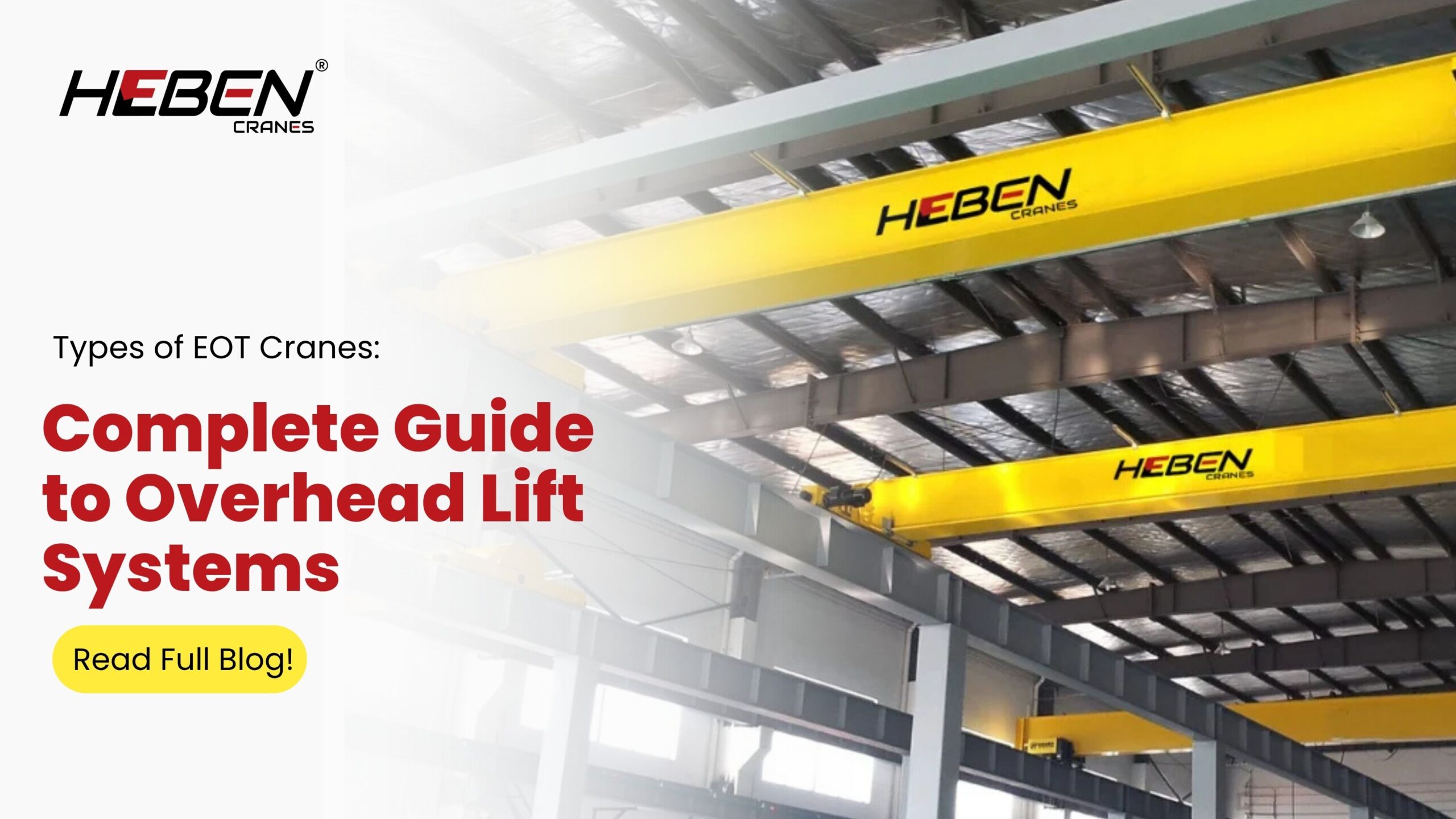
Your facility needs an overhead crane, but the configuration options are wider than most buyers expect. Choosing the wrong type means structural modifications you didn’t plan for, capacity limits that stop production, or headroom problems discovered only after installation. EOT (Electric Overhead Travelling) cranes cover a full range of configurations — from single girder workshop units to heavy double girder systems for steel plants. This guide breaks down each type, its specifications, application range, and the selection logic that matches crane configuration to your load patterns, bay dimensions, and duty requirements.
Single Girder EOT Cranes
Single girder cranes use one bridge beam with the hoist trolley running along the bottom flange. The design is compact and cost-effective for light to medium duty applications. End carriages at both beam ends travel on runway beams mounted to building columns.
Capacity ranges from 0.5 to 20 tons, with spans covering 5 to 30 meters. Duty classes A3 to A4 suit 2–4 hours of daily intermittent operation. Runway beams are lighter and column reinforcement is minimal compared to double girder alternatives, which reduces total project cost.
Double Girder EOT Cranes
Double girder cranes use two parallel bridge girders with the hoist trolley traveling on rails mounted between them. The hoist sits between girder tops rather than hanging below a single beam, which increases hook-to-floor distance significantly.
Capacity spans 5 to 250+ tons with bridge spans up to 60 meters. Duty classes A5 to A7 serve continuous heavy operation in steel plants, automotive facilities, and power plants. The structural rigidity distributes loads evenly across runway beams, reducing wheel loads and extending rail life.
Here’s the counterintuitive reality: facilities often over-invest in double girder cranes for loads under 20 tons. A correctly specified single girder system costs 30–40% less and handles the same operational requirement without excess structural overhead.
Underslung EOT Cranes
Underslung cranes suspend the bridge from the bottom flange of runway beams rather than riding on top. The hoist hangs below the bridge, which hangs below the runway. The entire crane occupies the lower portion of the building.
Capacity limits sit at 1–10 tons for single girder underslung systems, with double girder versions reaching 20 tons. Spans typically range from 3 to 15 meters. Many installations use existing roof structure, avoiding new column work and dramatically reducing installation cost and timeline.
Underslung cranes recover 1–2 meters of hook travel that top-running systems lose to structural depth. In a 4.5-meter ceiling building, this difference determines whether the crane is operationally useful or structurally limited.
Gantry and Semi-Gantry EOT Cranes
Gantry cranes use legs that travel on ground rails instead of building-mounted runways. The bridge spans between these self-supporting legs. Full gantry cranes operate completely independent of building structure — suitable for outdoor yards and facilities without roof support.
Semi-gantry cranes run one leg on a ground rail while the other side travels on a building runway. Capacity ranges from 1 to 50 tons across spans up to 35 meters. This configuration suits facilities with partial structural support on one bay side.
Gantry cranes cost 20–35% more than equivalent EOT systems where adequate building structure already exists. Choose gantry for outdoor yards or buildings with inadequate columns — not as a default alternative to top-running EOT.
Jib Cranes
Jib cranes mount to a wall, pillar, or freestanding column and rotate through a horizontal arc. Wall-mounted versions fix to building columns. Pillar-mounted types use independent freestanding columns with engineered foundations.
Capacity ranges from 0.5 to 10 tons with outreach up to 10 meters. Rotation spans 180–360 degrees depending on mounting type. Jib cranes suit workstation lifting where loads move through fixed arcs rather than across full bay lengths.
Multiple jib cranes create coverage patterns that linear EOT systems can’t match cost-effectively in assembly-intensive workshops. They function best as complements to main EOT systems, not replacements.
Key Components Across All Types
Every EOT configuration shares a common set of functional components:
- Bridge girder(s): Main structural span carrying trolley and load
- End carriages: Contain wheels, drive motors, and brakes for runway travel
- Hoist and trolley: Vertical lifting and lateral cross-travel
- Control system: Pendant push buttons, radio remote, or cabin operation
- Safety devices: Overload protection, limit switches, emergency stops, anti-collision systems
- Electrical panel: Motor controls, variable frequency drives, circuit protection
Wire rope hoists suit heavy continuous lifts. Chain hoists work for lighter precision applications. Duty class ratings define operating intensity across all configurations.
How to Select the Right EOT Crane Type
Step 1: Calculate Load and Duty
Document maximum load, typical operating load, and lifts per shift. Calculate duty class from actual frequency data, not assumed maximum. Duty class mismatch causes 60% of premature failures — it’s the most underweighted specification in most buying decisions.
Step 2: Measure Bay Constraints
Measure clear span between runway support columns and available headroom. Single girder suits spans up to 30 meters. Double girder extends to 60 meters. For headroom under 5 meters with loads below 10 tons, underslung is the practical answer.
Step 3: Assess Building Structure
Confirm column and roof beam capacity for your crane type. Top-running EOT cranes require dedicated runway beams with column reinforcement. Underslung cranes transfer loads through existing roof structure — structural verification is mandatory before specifying.
Step 4: Choose Control and Safety Specifications
Select operation method based on operator visibility and cycle complexity. Pendant controls suit simple repetitive tasks. Radio remotes improve positioning accuracy when operators move with the load. Cabin control applies to high-volume continuous operations.
Step 5: Plan for Service and Expansion
Specify future capacity scenarios before ordering. Double girder systems accommodate hoist upgrades. Single girder cranes rarely convert to higher capacity without complete replacement. Build service access and maintenance platform provisions into the design, not as afterthoughts.
Frequently Asked Questions
What’s the practical capacity limit for single girder EOT cranes?
The standard ceiling is 20 tons. Beyond this, deflection and structural demands make double girder configurations more economical. Some manufacturers quote 25 tons, but runway and column costs at that capacity make double girder the better value.
When does underslung make sense over top-running EOT?
When ceiling height is under 5 meters and loads stay below 10 tons. Underslung systems recover 1–2 meters of hook travel that top-running structures consume. For heavier loads, the suspension engineering complexity exceeds the headroom benefit.
Do multiple lighter cranes outperform a single heavy crane?
Often, yes. Multiple single girder or underslung units on shared runways deliver better multi-zone material flow than one heavy crane covering the same area. Crane count and configuration should derive from operational flow patterns, not just peak load.
How do duty classes differ between crane types?
All crane types carry duty class ratings from A3 to A7. A3 suits intermittent light use; A7 handles near-continuous heavy operation. The same capacity crane in different duty classes costs differently and uses different motors, brakes, and structural sections. Always match duty class to actual cycle data.
Conclusion
EOT crane type follows from load, span, headroom, and duty — not from industry convention. Single girder handles light workshops. Double girder scales for heavy industry. Underslung recovers headroom. Gantry operates without building support. Jib cranes serve fixed workstations. Specify each dimension correctly and the configuration becomes clear.
Heben Cranes manufactures all EOT crane configurations — single girder, double girder, underslung, gantry, and jib — engineered precisely to your bay dimensions, load patterns, and duty requirements. We assess your building structure, calculate duty class from real cycle data, and deliver certified load-tested systems with full installation and service support. Contact our engineering team today for a site survey and detailed proposal.