
Introduction
Choosing the wrong underslung crane manufacturer costs you twice—once in money, once in downtime. Maharashtra’s industrial facilities rely on underslung cranes for low-headroom applications, yet many buyers select suppliers based on price alone, only to face delayed deliveries, substandard quality, or vanished after-sales support. The truth? A manufacturer’s fabrication capability, service infrastructure, and proposal transparency determine whether your crane operates reliably for 15-20 years or becomes a maintenance burden within 3-5 years. This guide separates qualified suppliers from problematic ones by examining manufacturing depth, regional expertise, service commitments, and the questions that reveal true capability.
Understanding Underslung Crane Design
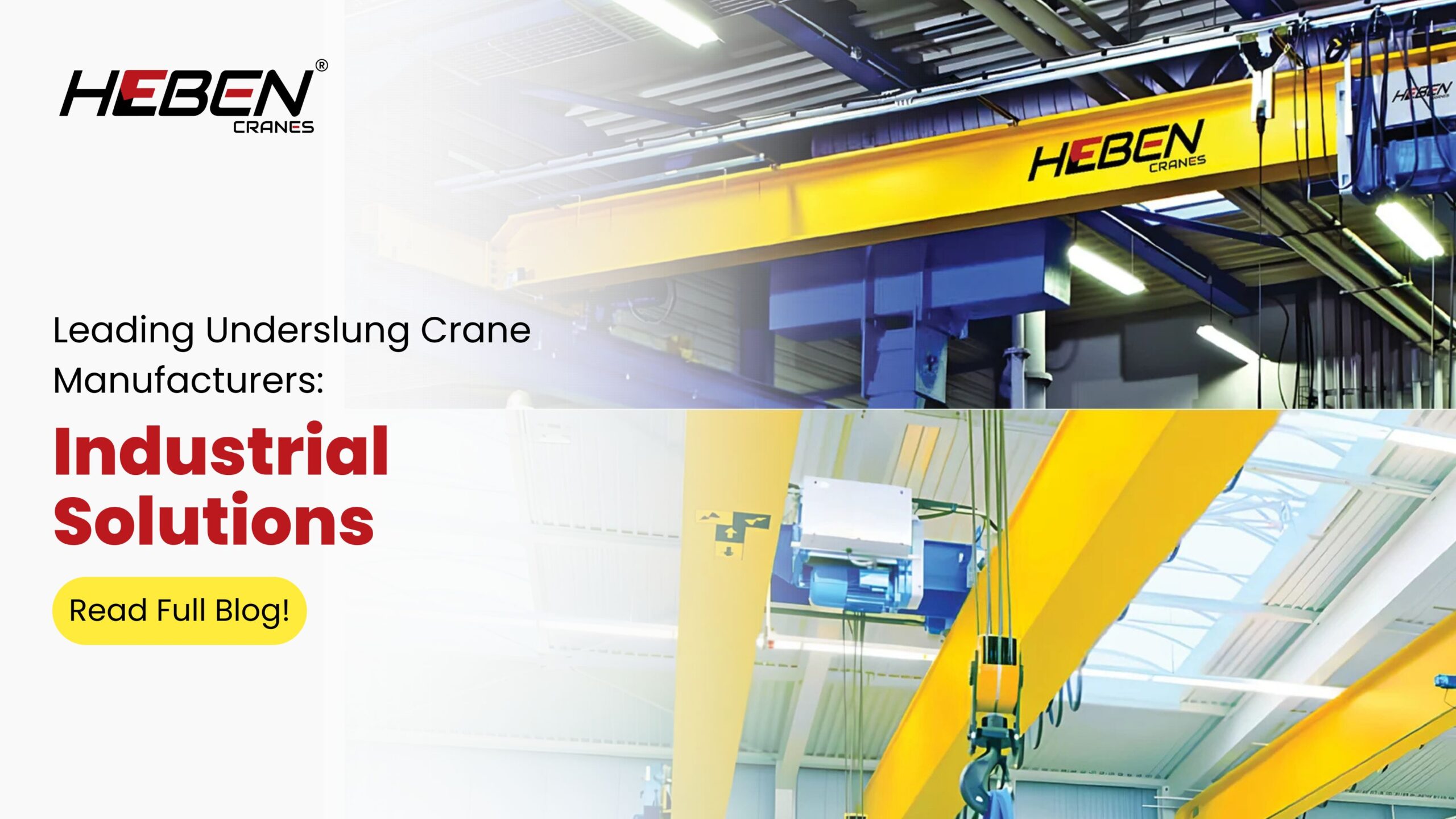
An underslung crane suspends from the bottom flange of runway beams instead of sitting on top, reversing the load path compared to top-running systems. This configuration suits facilities with 3-4 meters of headroom where traditional cranes cannot fit. The trolley travels along the underside of the bridge girder, with the hoist hanging below.
Typical applications include light manufacturing assembly lines, warehousing storage retrieval, and retrofit projects where building structure cannot support top-running loads. Capacities range from 1 to 12.5 tons, with spans reaching 22.5 meters—though most installations stay under 15 meters for optimal structural efficiency.
Here’s the counterintuitive reality: underslung systems often cost 40-60% less to install than equivalent top-running cranes, not because of cheaper components, but because they skip runway beam installation and structural reinforcement. The savings come from faster assembly and utilizing existing building beams as runways.
Criteria for Leading Manufacturers
Manufacturing Capability vs. Trading Operations
Leading manufacturers operate in-house fabrication facilities with certified welders, CNC cutting equipment, and load testing rigs. Trading companies merely broker products, controlling neither quality nor delivery timelines. Request a facility visit to observe welding quality and stage-wise production—genuine manufacturers welcome this; brokers make excuses.
Compliance and Certification Benchmarks
Indian Standard IS 3177 governs crane design and manufacturing. Top suppliers provide material traceability certificates, IS 3177 compliance verification, and third-party test reports from agencies like Lloyd’s or Bureau Veritas. ISO 9001 certification indicates systematic quality management—non-negotiable for industrial suppliers.
Customization for Building Constraints
Standard catalogue products rarely match facility requirements perfectly. Leading manufacturers engineer solutions for specific span lengths, lifting heights, and existing beam configurations. They assess whether your ceiling beams can support suspension loads without reinforcement—a critical step many skip.
Regional Manufacturer Landscape in India
Pune Industrial Corridor
Pune dominates automotive component manufacturing and precision engineering. Suppliers here specialize in higher duty cycles, integration with automated lines, and clean-room compatible variants for pharmaceuticals. The concentration of automotive plants drives demand for variable frequency drives and soft-start systems.
Mumbai and MMR
Mumbai suppliers serve port logistics, textile mills, and light manufacturing. Emphasis falls on compact designs for space-constrained facilities and rapid delivery to meet port operation schedules. Thane and Navi Mumbai host numerous fabrication units offering both standard and custom configurations.
Ahmedabad and Gujarat Belt
Ahmedabad serves as a hub for chemical, engineering, and textile industries. Suppliers here excel in corrosion-resistant coatings for chemical environments and explosion-proof configurations for hazardous areas. The region’s export-oriented manufacturers often maintain global-standard quality practices.
Chennai and South India
Chennai suppliers focus on heavy engineering, railways, and automotive sectors. Strengths include large-span expertise and experience with foundation engineering for outdoor installations. National players with pan-India service networks operate from these regions.
Features of Top Underslung Crane Systems
Structural Efficiency
Top systems use Grade IS 2062 structural steel, stress-relieved after welding to prevent residual stresses that cause premature failure under cyclic loading. Girder dimensions optimize weight-to-strength ratio—oversized girders waste material; undersized ones deflect excessively.
Hoisting and Control Quality
European-standard hoists (0.5-5 ton capacity) or robust Indian-made units for heavier loads determine long-term reliability. Control systems featuring Schneider or Siemens components with proper IP ratings reduce electrical failure rates significantly. Overload protection and emergency stops are non-negotiable safety features.
Headroom Optimization
True underslung design minimizes additional height beyond the hoist itself. The trolley runs on the bottom flange of the girder, keeping the crane profile low. Facilities gain 150-250mm of effective lifting height compared to top-running alternatives in the same building envelope.
Wire Rope vs. Chain Hoist Selection
Wire rope hoists suit 1-ton+ capacities and longer lift heights with higher speeds. Chain hoists excel in compact applications under 5 tons with lower lift heights—common in maintenance bays and workshops. The choice affects both initial cost and long-term maintenance patterns.
Services Offered by Leading Suppliers
Engineering and Design Depth
Qualified suppliers conduct structural assessments before quoting—not just accepting your capacity and span at face value. They verify whether existing beams can support suspension loads, propose reinforcements if needed, and provide load calculations for foundation design where ground rails are required.
Installation and Commissioning Excellence
Installation teams include structural engineers who verify building support adequacy, not just riggers who bolt equipment in place. Commissioning involves operator training, safety protocol development, and complete documentation handover—suppliers treating these as optional extras create operational gaps.
After-Sales Support Infrastructure
Regional service infrastructure determines recovery speed from breakdowns. Top suppliers maintain local spare parts inventory for critical components—brake pads, limit switches, wire ropes—and guarantee 24-48 hour emergency response. Annual maintenance contracts prevent slow degradation that leads to sudden failures.
How to Choose the Right Manufacturer
Essential Verification Checklist
- Request proof of in-house fabrication (facility visit invitation)
- Verify IS 3177 compliance and material traceability documents
- Confirm regional service presence with response time commitments
- Review warranty terms: structural (24 months), mechanical (12 months), electrical (12 months)
- Ask for three recent client references in your industry with facility visit options
Critical Questions to Pose
- “Can you show me your load testing procedure and certification documents?”
- “What specific checks do you perform on suspension points during installation?”
- “How do you handle cases where existing beams require reinforcement?”
- “What’s your spare parts commitment period for this crane model?”
- “Who performs the annual comprehensive inspection—your team or third party?”
Red Flags That Signal Problems
Suspiciously low quotes (30% below market) usually mean substituted materials or hidden installation exclusions. Vague delivery commitments without manufacturing schedules suggest outsourced production the supplier cannot control. Reluctance to provide client references indicates quality concerns.
Conclusion
Manufacturer selection determines whether your underslung crane delivers 15-20 years of reliable service or becomes a liability within 3-5 years. Manufacturing capability, compliance records, service infrastructure, and transparent proposal terms separate qualified suppliers from problematic ones. The right partner engineers solutions for your specific building constraints, provides verifiable quality documentation, and maintains regional support for the crane’s full lifecycle.
Contact us for a facility assessment and detailed proposal that addresses your specific headroom, capacity, and structural constraints.
Heben Cranes manufactures underslung overhead crane systems from 1 to 12.5 tons with complete in-house fabrication, IS 3177 compliance verification, and engineered solutions tailored to your facility’s ceiling beam structure and load patterns. Our engineering team conducts structural assessments to verify suspension feasibility, designs systems that integrate with your existing building features, and manages installation with minimal production disruption. We provide comprehensive operator training, maintenance documentation, and regional service infrastructure for scheduled maintenance and emergency support. Every crane includes load testing certificates, material traceability documents, and multi-year warranties on structural, mechanical, and electrical components. Visit hebencranes.com to discuss your underslung crane requirements and schedule a consultation with our Maharashtra-based team