
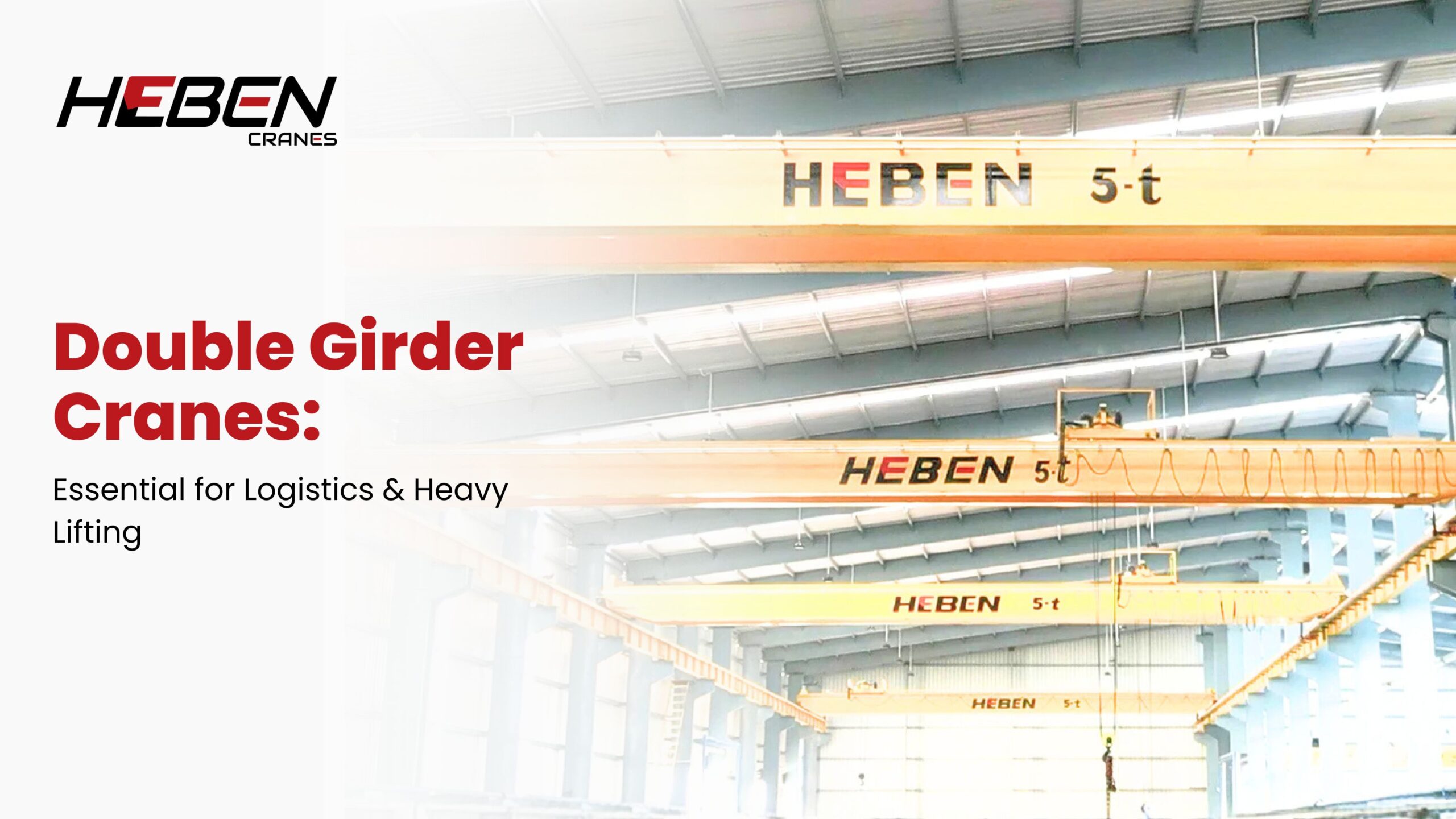
Facilities handling loads exceeding 15-20 tons face a critical decision point where single girder cranes reach practical limitations. Operations that push undersized equipment beyond design capacity experience 2-3 times normal wear rates, frequent breakdowns, and replacement within 8-10 years instead of designed 20-25 year lifespans. Double girder cranes eliminate these compromises through superior structural capacity, maximum hook height, and heavy-duty construction designed for intensive operations. This guide examines why double girder configurations become essential, their structural advantages, capacity ranges, applications in logistics and heavy industry, key features, and selection criteria ensuring optimal long-term value.
Structural Design and Core Advantages
Double girder cranes use two parallel main girders supporting the trolley and hoist system riding atop the bridge. This fundamental design difference from single girder cranes—where the hoist hangs beneath a single beam—creates multiple performance advantages that justify premium investment.
Load distribution across dual girders provides superior stability handling heavy capacities and wide spans without excessive deflection. The parallel beam structure creates a rigid platform supporting intensive duty cycles that would overstress single girder designs.
Maximum hook height results from hoist positioning atop bridge girders rather than hanging beneath. This design gains 3-6 feet additional lifting height compared to equivalent single girder installations—critical advantage in facilities with limited vertical clearance.
Maintenance walkways integrate directly into the bridge structure, providing safe technician access to wheels, drives, electrical components, and hoist mechanisms. Single girder designs require suspended scaffolding or lift equipment for service access, extending downtime and increasing labor costs.

Capacity and Span Capabilities
Double girder cranes start at 10-15 ton capacities where single girder designs reach practical limits and scale to 500+ tons for specialized heavy industrial applications. The dual beam structure enables this scalability without geometric constraints limiting single girder configurations.
Span lengths exceeding 65-70 feet become economical with double girder construction. Single girder cranes struggle with spans beyond 60 feet due to deflection and material availability limitations, while double girder designs routinely cover 100-150 foot spans effectively.
Duty classifications A6 through A8 suit double girder structural capacity for heavy to severe service conditions. These ratings handle 20-40+ lifting cycles hourly across multi-shift operations—operational intensity that degrades lighter-duty equipment prematurely.
Typical Capacity Ranges by Application
- 10-25 tons: General manufacturing, fabrication shops upgrading from single girder limitations
- 25-75 tons: Steel processing, heavy equipment assembly, logistics centers
- 75-200 tons: Steel mills, shipyards, power plants, infrastructure construction
- 200-500+ tons: Specialized applications including ship assembly, offshore platforms, heavy forging
Logistics and Warehouse Applications
Modern distribution centers use double girder cranes for high-volume material handling where capacity, precision, and cycle speed determine throughput. Container handling, bulk pallet movement, and heavy equipment positioning benefit from superior stability and control.
Automated storage and retrieval systems integrate double girder cranes with inventory management software, enabling lights-out operations in 24/7 facilities. The robust construction withstands continuous operation that would quickly fatigue lighter equipment.
Cross-docking operations require rapid load transfers between incoming and outgoing transport. Double girder crane speed capabilities—often 10-20% faster than single girder equivalents—directly impact facility throughput and operational efficiency.
The contrarian insight most logistics managers miss: two 15-ton single girder cranes cost less initially than one 30-ton double girder unit but require twice the runway infrastructure, electrical systems, and maintenance labor. Total ownership costs often favor single higher-capacity installations over multiple smaller units.

Heavy Industrial Applications
Steel mills rely on double girder cranes handling molten metal ladles, coil processing, and structural component movement. Specialized designs accommodate extreme temperatures, corrosive environments, and loads exceeding 200 tons routinely.
Shipbuilding yards use double girder gantry configurations positioning hull sections, engine assemblies, and outfitting components with millimeter precision. Tandem hoist systems combine multiple units for ultra-heavy lifts exceeding single-hoist capacity limits.
Automotive manufacturing depends on double girder precision moving body panels, engine blocks, and assembly components through production sequences. Integration with factory automation systems enables synchronized material flow supporting just-in-time manufacturing principles.
Power plant construction and maintenance requires heavy lifting capability for turbine installation, generator positioning, and component replacement during scheduled outages. Double girder crane reliability during critical maintenance windows prevents expensive delays extending plant downtime.
Essential Features and Technology
Variable frequency drives provide precise speed control, smooth acceleration reducing structural stress, and energy savings offsetting 15-20% higher equipment costs within 3-5 years of intensive operation. Modern VFD systems enable soft starts, controlled stops, and multiple preset speed ranges.
Anti-sway technology improves load positioning accuracy and cycle speed by damping oscillation during travel. Facilities handling tall loads or requiring precise placement benefit significantly from electronic sway control systems.
Remote monitoring capabilities track operating hours, cycle counts, load weights, and component condition enabling predictive maintenance. Data-driven intervention scheduling reduces unplanned downtime 40-60% compared to reactive maintenance approaches.
Safety Systems Integration
- Overload protection preventing dangerous lifts exceeding rated capacity
- Redundant braking systems ensuring controlled stops if primary system fails
- Collision avoidance for multiple crane installations sharing runways
- Emergency stop systems with redundant controls accessible from multiple locations
Why Double Girder Becomes Essential?
Single girder cranes reach practical limits around 15-20 tons capacity and 60-65 foot spans. Operations regularly approaching these thresholds should specify double girder configurations avoiding performance compromises and premature equipment replacement.
Headroom optimization matters when facilities maximize vertical space utilization. The 3-6 feet additional hook height from double girder design often determines whether operations can function effectively in existing structures versus requiring expensive building modifications.
Heavy-duty cycle operations demanding A6-A8 classifications need double girder structural capacity. Forcing single girder equipment into intensive duty applications accelerates fatigue damage, component wear, and structural deterioration requiring major overhauls at 50-60% of designed service life.
Long-term value favors double girder investments despite 30-40% higher initial costs when total ownership analysis includes maintenance frequency, component longevity, energy efficiency, and operational capability over 20-25 year equipment lifespans.

Frequently Asked Questions
Q: At what capacity should buyers choose double girder over single girder cranes?
A: Double girder becomes the practical choice when capacity requirements regularly exceed 15 tons, spans exceed 65 feet, or operations demand A6+ duty classifications. Facilities approaching these thresholds should specify double girder configurations avoiding performance limitations and ensuring adequate capacity for operational growth without premature replacement needs.
Q: How much additional hook height do double girder cranes provide?
A: Double girder designs typically gain 3-6 feet additional hook height compared to equivalent single girder installations because the hoist runs atop bridge girders rather than hanging beneath. This advantage proves critical in facilities with limited vertical clearance where maximizing lifting height determines operational capability and eliminates expensive building modifications.
Q: Do double girder cranes require more maintenance than single girder designs?
A: Double girder cranes include more components but integrated maintenance walkways provide superior service access reducing inspection time and maintenance labor costs. Well-designed installations require similar maintenance frequency as single girder equivalents while delivering substantially longer service life under heavy-duty operations through robust construction handling intensive cycle rates.
Q: Can existing single girder runway systems support double girder crane upgrades?
A: Upgrading from single to double girder typically requires complete runway replacement due to different rail configurations, increased loads, and structural capacity demands. Runway beams, supports, and foundations designed for lighter single girder cranes rarely accommodate double girder weight and loading characteristics without major reinforcement or complete reconstruction.
Q: What’s the realistic ROI timeline for double girder crane investments?
A: ROI depends on operational intensity and capacity utilization. High-volume operations running multi-shift schedules typically recover premium double girder investment within 5-7 years through higher throughput, reduced downtime, lower maintenance costs, and avoided replacement expenses. Light-duty applications may struggle justifying the investment versus adequate single girder alternatives.
Conclusion
Double girder cranes deliver essential capacity, stability, and durability for logistics operations and heavy industrial applications where single girder designs reach practical limitations. The structural advantages—superior load distribution, maximum hook height, heavy-duty construction, and maintenance accessibility—justify premium investment through decades of reliable performance under demanding conditions. Facilities handling 15+ ton loads, requiring intensive duty cycles, or needing maximum vertical reach should specify double girder configurations matching long-term operational requirements rather than accepting single girder compromises.
Heben Cranes engineers double girder overhead crane solutions for logistics facilities and heavy industrial operations requiring superior capacity, precision, and reliability. Our configurations span 10 to 500+ ton capacities with duty classifications A5-A8, spans exceeding 100 feet, and customizable features including VFD controls, anti-sway systems, automated operation, and remote monitoring. Each installation includes comprehensive engineering analysis, professional installation supervision, operator training, and complete documentation ensuring regulatory compliance. Beyond competitive equipment pricing, we deliver long-term value through quality construction reducing lifecycle costs, energy-efficient designs lowering operating expenses, and responsive technical support minimizing downtime. Contact Heben Cranes for a detailed facility assessment and expert recommendations ensuring your double girder crane specification matches both current lifting demands and future operational requirements efficiently.