
Introduction
Your facility needs overhead lifting but lacks the building structure to support bridge cranes. Outdoor yards, storage areas, and bay extensions face this challenge when columns can’t handle runway loads or don’t exist at all. Gantry and Goliath cranes solve this by running on ground-level rails with independent leg support. These systems deliver heavy-duty lifting capability without building-mounted infrastructure. This guide covers operational mechanics, crane types, component specifications, capacity ranges, industrial applications, selection criteria, and maintenance requirements to match the right gantry configuration to your material handling patterns and site constraints.
How Gantry and Goliath Cranes Work
Gantry cranes use legs that travel on ground rails instead of building-mounted runways. The bridge structure spans between these legs, with a hoist trolley moving along the girder. This creates three-dimensional positioning: vertical lift through the hoist, lateral movement via trolley travel, and longitudinal coverage through gantry travel along the rails.
The load path runs from ground foundations through legs to the bridge girder, then down to the hoist and hook. This ground-based support eliminates dependence on building columns and roof structure. The crane stands independently, making it suitable for outdoor yards and facilities without adequate overhead support.
Goliath cranes are large-capacity gantry systems, typically double girder designs handling 50-800 tons. The terminology overlaps—what one facility calls a Goliath crane, another terms a heavy-duty gantry. Function and configuration matter more than naming conventions.
Types of Gantry and Goliath Cranes
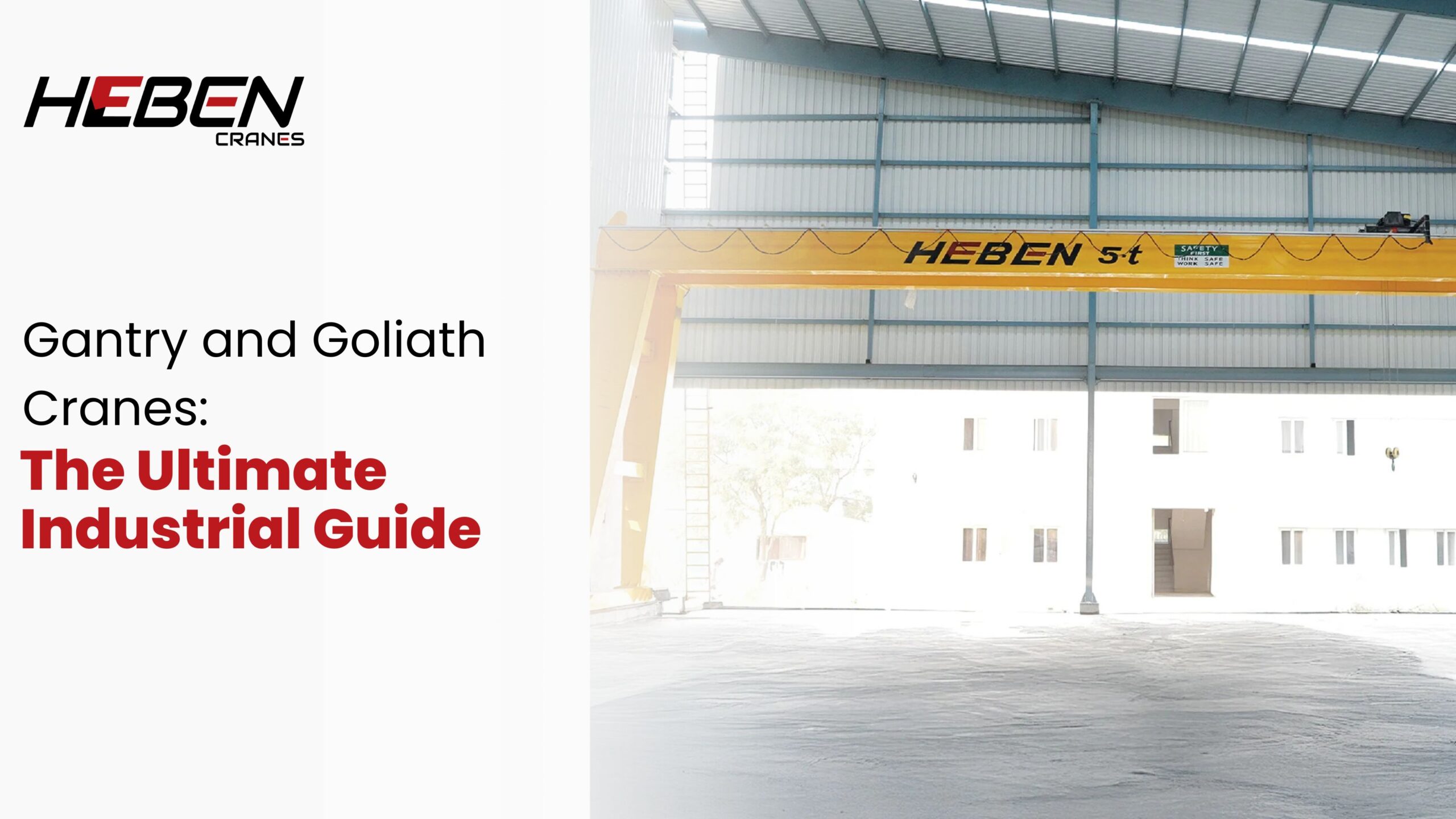
Full gantry cranes have legs on both sides traveling on parallel ground rails. This design works best for outdoor yards, storage areas, and facilities where complete independence from building structure makes sense.
Semi-gantry cranes run one leg on ground rail while the other side travels on an elevated building-mounted runway. This hybrid reduces cost and floor obstruction when partial building support exists. The configuration suits facilities with adequate structure on one side but not the other.
Single girder gantry cranes use one main beam for loads up to 20 tons. Double girder configurations provide the structural capacity for 20-800 ton lifts across longer spans. The choice depends on load requirements and span distance, not preference.
Portable gantry cranes are lightweight aluminum or steel frames on wheels or casters. Capacities range from 500kg to 10 tons with adjustable heights. These units relocate easily between work areas for flexible coverage.
Key Components
The gantry structure consists of vertical legs, horizontal cross beams connecting leg tops, and main girder(s) spanning between. Legs contain drive motors, wheels, and braking systems for travel along rails. Structural design must withstand vertical loads and horizontal forces from acceleration and braking.
Hoisting mechanisms include wire rope hoists for heavy-duty applications and chain hoists for lighter loads. The trolley system mounts to the girder and provides cross-travel motion. Drive systems range from manual chain operation to electric motors with variable frequency drives.
End trucks house the wheel assemblies, bearings, and drive components. These units transfer crane weight and operational loads to the rails. Wheel design affects tracking performance and maintenance requirements.
Control systems vary from pendant push buttons to radio remotes to full operator cabins. Safety devices include travel limit switches, overload protection, emergency stops, and anti-collision systems for multi-crane environments.
Technical Specifications
Capacity brackets segment into light (1-10 tons), medium (10-50 tons), and heavy (50-800 tons) ranges. Each bracket implies different structural engineering, foundation requirements, and component specifications. Load capacity alone doesn’t define proper selection—duty cycle and lift frequency matter equally.
Span lengths range from 5 meters for portable units to 50+ meters for large Goliath installations. Lifting height varies from 3 meters in compact applications to 30+ meters in shipyards and heavy industry.
Operating speeds include gantry travel at 20-50 m/min, trolley travel at 15-40 m/min, and hoist speeds from 3-15 m/min. Higher speeds improve productivity but increase structural loads and power requirements.
Duty classes from A3 to A8 indicate operating intensity. Outdoor installations need weatherproofing, corrosion-resistant coatings, and wind stability calculations. Power supply typically uses three-phase systems with appropriate electrical protection.
Applications Across Industries
Manufacturing facilities use gantry cranes in assembly areas, machine shops, and loading docks where building modifications aren’t feasible. The ground-based design adapts to existing layouts without structural intervention.
Steel yards, shipbuilding facilities, and ports rely on heavy Goliath cranes for outdoor material handling. Container terminals use massive gantry systems for ship-to-shore operations and yard stacking. These environments need all-weather operation and spans that building structures can’t support.
Precast concrete plants, infrastructure projects, and heavy machinery manufacturers choose gantry systems when loads and spans exceed practical limits for forklifts or mobile cranes. Warehouses and logistics operations use them for high-bay storage and loading dock coverage.
Advantages and Limitations
Independence from building structure is the primary advantage. Gantry cranes work where overhead cranes can’t—outdoor yards, temporary sites, and facilities with inadequate roof support. They relocate more easily than building-mounted systems, though large rail-mounted units still require significant infrastructure.
Heavy load capacity and wide coverage area suit applications with substantial material movement. Double girder Goliath cranes handle hundreds of tons across spans that would require prohibitively expensive building structure.
Here’s the uncomfortable truth: gantry cranes cost 20-35% more than equivalent overhead cranes when adequate building structure already exists. The legs, wheels, and ground rail system add expense. Choose gantry configurations because site conditions demand them, not for operational preference alone.
Foundation and rail requirements create permanent infrastructure. Poor rail alignment causes premature wear and tracking problems. Ground conditions affect foundation design and project cost significantly.
Selection Guide
Step 1: Document Load Requirements
Map maximum weight, typical load range, and lift frequency across shifts. Include safety margins and growth projections. Specify outdoor exposure and environmental conditions that affect design.
Step 2: Assess Site Constraints
Measure available span, required lifting height, and ground conditions. Check soil bearing capacity for foundation design. Identify space for rail installation and future extensions.
Step 3: Choose Configuration Type
Select full gantry when both sides need ground support. Pick semi-gantry when one side has building structure. Decide single versus double girder based on capacity and span requirements.
Step 4: Specify Controls and Safety
Choose operation method based on visibility needs and cycle complexity. Specify environmental protection for outdoor use. Include anti-collision systems for multiple crane installations.
Step 5: Plan Installation and Lifecycle
Design foundations and rail alignment to proper tolerances. Plan maintenance access and spare parts stocking. Calculate total ownership cost including energy, maintenance, and eventual replacement.
Frequently Asked Questions
Q: When does a gantry crane cost less than an overhead crane?
A: Never, if adequate building structure already exists. Gantry systems add leg structure, wheels, and ground rails that overhead cranes don’t need. Choose gantry configurations when site conditions demand them—outdoor operation, inadequate building support, or temporary installations where permanent runway modification isn’t justified.
Q: Can gantry cranes be relocated after installation?
A: Portable units move easily between locations. Large rail-mounted systems can relocate by extending rails or moving to new sites, though this requires significant effort. Plan for relocation during initial design if future movement is likely. Fixed installations with engineered foundations suit permanent operations.
Q: What’s the practical capacity limit for gantry cranes?
A: Heavy-duty Goliath cranes reach 800+ tons for specialized shipyard and heavy industry applications. Most industrial gantry systems fall between 5-100 tons. Beyond 200 tons, engineering complexity and foundation requirements increase substantially. Load, span, and duty cycle together determine practical limits.
Q: How much foundation work do gantry cranes require?
A: Portable units under 5 tons work on level concrete floors. Permanent installations need engineered concrete foundations designed for wheel loads and soil conditions. Large Goliath cranes require substantial foundation work comparable to building column foundations. Rail alignment within 3-5mm tolerances across the entire span prevents tracking problems and premature wear.
Conclusion
Gantry and Goliath cranes deliver overhead lifting capability without building-mounted infrastructure. They suit outdoor yards, facilities with inadequate roof support, and applications where operational flexibility justifies higher initial cost. Match crane type and capacity to actual load patterns, site constraints, and long-term operational requirements rather than optimizing for installation convenience alone.
Heben Cranes engineers and manufactures gantry and Goliath crane systems for ground-supported material handling across diverse industrial applications. We design full gantry, semi-gantry, and heavy-duty Goliath configurations matched to your load capacity, site conditions, and operational requirements. Our engineering team conducts site surveys, validates ground conditions, calculates foundation requirements, and specifies crane configurations that balance installation cost with long-term performance and reliability. We provide complete solutions from design through installation, commissioning, operator training, and ongoing maintenance support. Ready to discuss your gantry crane project with technical depth and practical site-specific recommendations? Contact our engineering team for a comprehensive site assessment and detailed proposal.