
Most crane buying goes wrong in the first conversation. A plant head says “we need a 10-tonne crane,” three suppliers quote a 10-tonne crane, and the cheapest one wins. Two years later the gearbox is running hot, the hook cannot reach the last two metres of the bay, and nobody can say why. The crane was never the problem. The specification was. This guide walks you through what to settle before you take a quote: load, duty class, span, lift height, building fit, electrics, and the questions that tell you whether you are buying from an engineer or a fabricator.
What an EOT Crane Actually Is
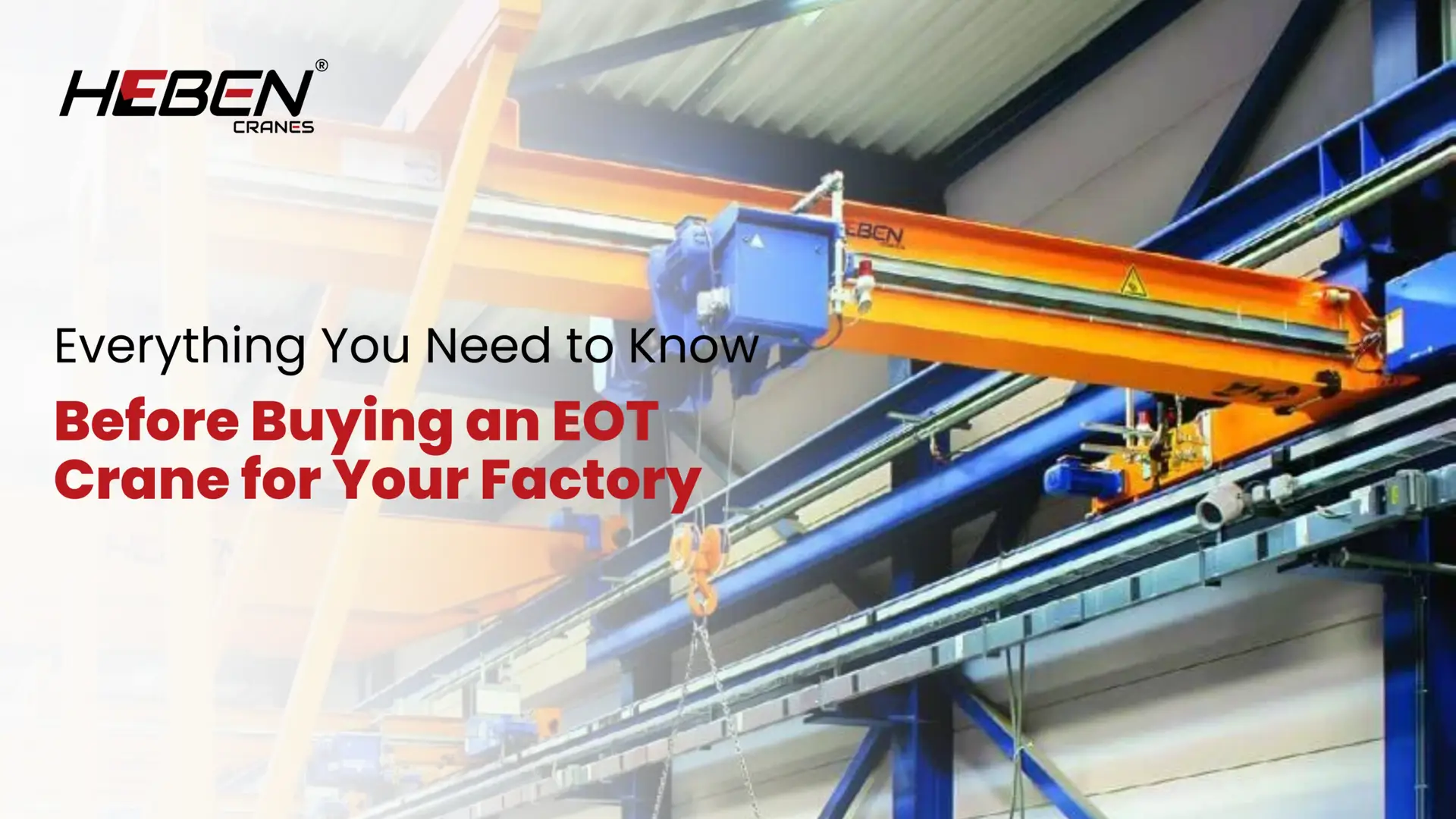
EOT stands for electric overhead travelling. The bridge runs along runway beams down the length of your bay, the trolley and hoist run across the bridge, and the hook goes up and down. Three motions, three drives, one coverage area — the full rectangle under the runway.
How the three motions work
Long travel moves the bridge along the bay. Cross travel moves the hoist across the span. Hoisting raises and lowers the load. Each motion has its own motor, brake, and speed rating, and each one can be specified independently. A crane that lifts fast but crawls along the bay is a common and avoidable mismatch.
EOT vs gantry vs jib — a quick placement
Gantry cranes carry their own legs and run on floor rails, which suits yards and open sheds. Jib cranes cover a circle around one pillar and serve a single machine. An EOT crane uses your building’s structure and covers the whole bay, which is why it remains the default for fabrication, machining, foundry, and press shops.
The Types You Will Be Choosing Between
Single girder and double girder
Single girder cranes use one bridge beam with an underhung hoist. They are lighter, cheaper, and need less headroom. Double girder cranes carry the hoist on top of two beams, which buys you higher lift, longer span, and heavier duty.
Top running and underslung
Top running cranes sit on rails above the runway beams and carry the most load. Underslung cranes hang from the bottom flange of the roof structure and free up floor space, at the cost of capacity and reach.
Manual, semi-EOT, and fully electric
- Manual (HOT): chain-operated, under 5 tonnes, occasional use
- Semi-EOT: powered hoist, manual travel — a false economy above about 3 tonnes of daily use
- Fully electric: all three motions powered, pendant or radio control
Start With the Load, Not the Crane
Heaviest load, not average load
Specify for the heaviest item you will ever lift, then check how often you lift it. A press shop moving 2-tonne dies all day and one 8-tonne mould twice a year needs an 8-tonne crane with a duty class set by the 2-tonne cycle — not the other way round.
Lifting tackle counts as payload
Here is the number that catches people out. Spreader beams, C-hooks, magnets, slings, and grabs come out of your rated capacity. A 5-tonne crane with a 600 kg lifting beam is a 4.4-tonne crane. On heavy fabrication jobs we have seen tackle eat 15–20% of rated capacity before the workpiece is even attached.
Why the safety margin is not padding
Rated capacity assumes a controlled, vertical, centred lift. Real lifts are none of those things. Loads swing, slings go off-centre, and operators snatch. Standards build in a factor for this, and buying a crane sized exactly to your maximum load spends that factor on day one.
Duty Class — The Spec Most Buyers Skip
How duty classes are decided
Duty class is a function of two things: how many hours the crane runs and how heavy the average load is against the rated load. Indian buyers work to IS 3177 classes (Class I to Class IV); European specs use FEM/ISO groups (M3 to M8). A 10-tonne Class II crane and a 10-tonne Class IV crane lift the same weight and are not remotely the same machine.
What under-classing costs you in year three
The duty class sets wheel diameter, gearbox rating, brake sizing, rope factor of safety, and girder fatigue life. Under-class a crane and nothing fails on commissioning day. It fails at month thirty, as rope wear, brake fade, and wheel flange scoring, in a bay that cannot stop. The saving on the purchase order is usually recovered by the second unplanned shutdown.
Span, Lift Height, and Building Fit
Measuring span correctly
Span is centre-to-centre of the runway rails, not wall to wall and not column face to column face. Measure at three points along the bay — buildings are rarely square, and a 40 mm variation across a 20 m span is normal and needs designing in.
Headroom, hook approach, and dead zones
Two numbers decide whether your crane is usable:
- Headroom — the vertical distance from the rail top to the lowest roof obstruction. This caps your hoist type and lift height.
- Hook approach — how close the hook can get to each end of the bay and to each side. Every centimetre of poor approach is floor you paid for and cannot serve.
When the building has to change
Sometimes the honest answer is that the shed needs modification: raising a purlin, relocating a duct, or adding corbels. Finding this out during the survey costs a site visit. Finding it out during erection costs a month.
Structure and Foundation Checks
Gantry columns, corbels, and runway beams
The crane is only as good as what carries it. Existing sheds often have columns designed for roof load alone, with no allowance for a moving crane. A structural check on columns, corbels, bracing, and runway beam deflection belongs in the pre-order stage, not the erection stage.
Wheel loads and floor capacity
Your supplier should give you maximum wheel loads in writing — both vertical and lateral — before you finalise. Your civil consultant needs them to sign off foundations. If a supplier cannot produce this quickly, that tells you something about the design work behind the quote.
Electrics, Controls, and Safety Systems
Power feed options
Festoon cable systems are cheap and proven, but they need side clearance and they wear. Conductor bars (DSL) cost more, occupy less space, and survive dusty environments better. In foundries and galvanising lines, DSL usually pays back within a few years on maintenance alone.
VFD vs contactor control
Contactor control gives you two fixed speeds and a hard stop. Variable frequency drives give smooth acceleration, precise spotting, and far less shock loading on the structure. The often-missed benefit: VFD-controlled cranes reduce load swing enough that cycle times drop, because the operator stops fighting the pendulum.
Non-negotiable safety fitments
- Overload limiter with cut-off
- Upper and lower hoist limit switches
- End-travel limit switches and rail stops with buffers
- Emergency stop on pendant and panel
- Anti-collision, if two cranes share a runway
- Rail sweeps and hook safety latch
What Drives the Price
Capacity is not the biggest lever. In practice the spread between a lean quote and a heavy quote on the same tonnage comes from duty class, span, lift height, hoist brand, control type, and power feed. Two 10-tonne cranes can differ by 60% on price and both be correctly engineered — for different factories.
Choosing the Manufacturer, Not Just the Crane
Questions that separate fabricators from engineers
Ask for the girder design calculation, the wheel load statement, and the duty class justification. Ask what happens to camber over ten years. A supplier who answers these from memory is designing cranes. A supplier who says “don’t worry, it is heavy-duty” is welding plate.
Spares, service response, and documentation
Find out where the nearest service engineer is based, what the stated response time is, and whether hoist spares are ex-stock or import-dependent. Ask for the O&M manual, wiring schematics, and load test certificate as deliverables named in the purchase order.
The Installation and Commissioning Timeline
A typical single girder crane runs six to ten weeks from confirmed drawings to commissioning; double girder and heavy-duty units run longer. The step that slips most often is drawing approval on your side. Nominate one person to approve GA drawings and give them a deadline — it is the cheapest schedule protection available.
FAQs
How long does an EOT crane last? A correctly classed crane in a single-shift factory commonly runs 20–25 years on structure, with hoist and drive components replaced along the way. Duty class, not age, determines fatigue life — a Class IV crane worked at Class II conditions ages slowly.
Can I install an EOT crane in an existing shed? Usually yes, but it depends on column capacity, headroom, and whether corbels can be added. A structural survey before ordering is the only way to know. Underslung or freestanding gantry systems are the fallback when the building cannot take runway loads.
Do I need a bigger crane if I might grow? Buy capacity for known needs and design the runway for future ones. Runway structure is expensive to change later; a hoist is comparatively easy to upgrade. Oversizing the crane itself raises wheel loads and cost without helping.
What certification should come with the crane? Load test certificate at 125% of rated capacity, material test certificates for structural steel, hoist and motor test reports, and a full O&M manual with electrical schematics. In most Indian states a competent-person test certificate is also required before use.
Single or double girder for a 10-tonne lift? Both are viable at 10 tonnes. Single girder wins on cost and headroom for spans under about 20 m and moderate duty. Double girder wins when you need maximum lift height, longer span, or continuous heavy cycles.
Conclusion
Get five things right before you sign: true maximum load including tackle, honest duty class, verified span and lift height, a structural check on the building, and a supplier who can defend the design on paper. Everything else is negotiable. If you are within three months of a purchase, get a site survey done now — it is the single highest-value hour in the whole process.
Heben Crane designs, manufactures, and commissions EOT cranes built to the duty your factory actually runs, not the tonnage on the enquiry. Every crane ships with design calculations, wheel load statements, and a load test certificate, and every project starts with a site survey rather than a price list.
Book a free site survey with Heben Crane and get a specification you can put in front of your structural consultant.