
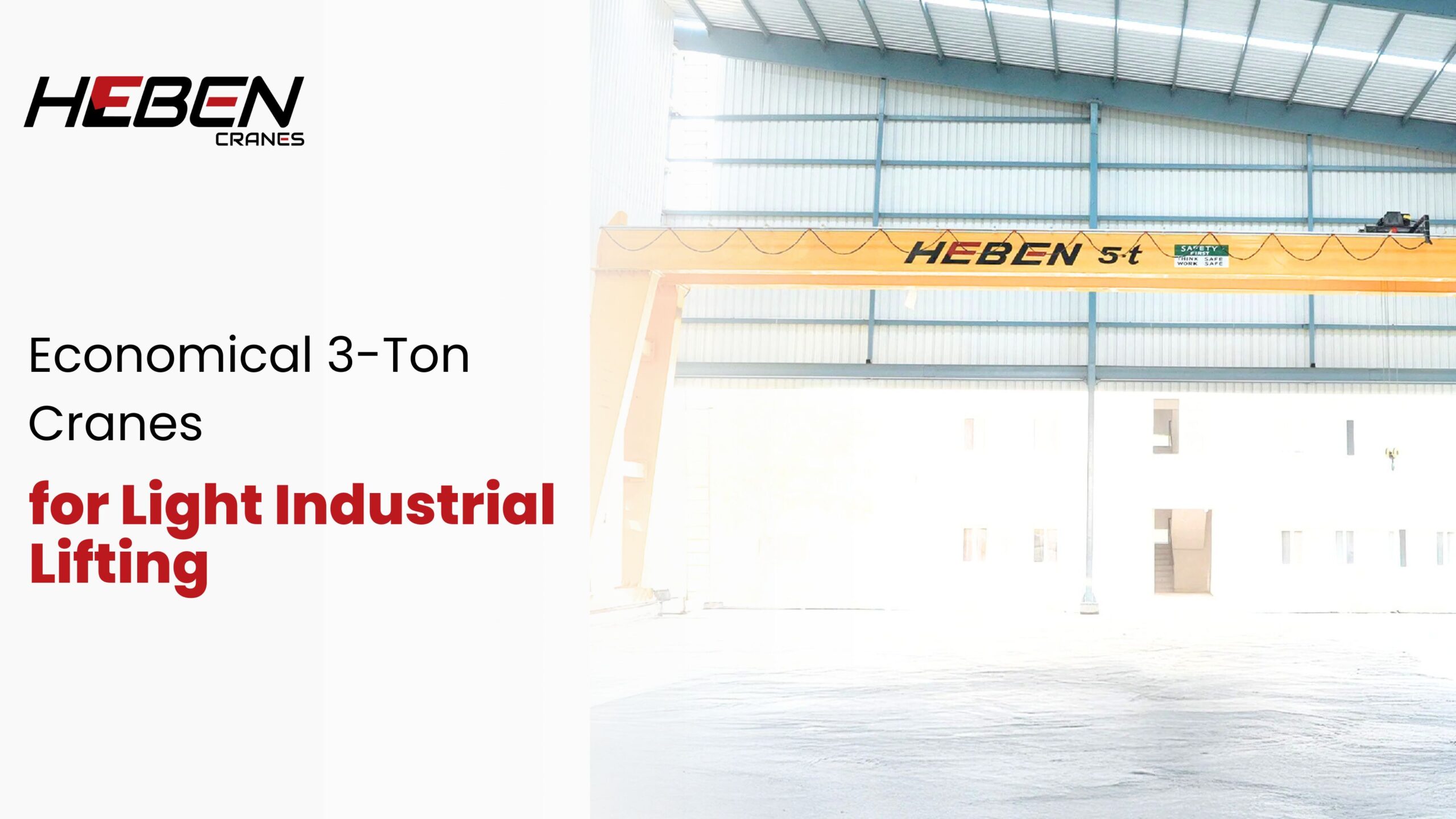
Budget-conscious buyers make a costly mistake when they prioritize the lowest purchase price over total ownership value. Here’s the data that shocks most procurement teams: a 3-ton crane costing 20% less upfront but requiring 40% more maintenance over 10 years actually costs 15-25% more in total expenses than a quality unit with higher initial investment. Light industrial operations need reliable lifting equipment that balances affordability with durability, safety, and serviceability.
This guide examines economical 3-ton crane types, essential features preventing expensive repairs, customization optimizing value, typical applications, cost considerations beyond sticker price, and selection criteria ensuring smart purchasing decisions.
Types of Economical 3-Ton Cranes
Single girder overhead cranes dominate the 3-ton capacity range due to their lightweight structure, reduced material costs, and simpler installation requirements. They handle spans from 7.5 to 31.5 meters with lifting heights reaching 30 meters, covering most light industrial applications.
Low headroom designs optimize vertical space by positioning the hoist mechanism on the bridge side rather than below, gaining 20-30% additional hook height compared to standard configurations. Facilities with ceiling clearance constraints benefit significantly from this design without sacrificing lifting capacity.
Gantry cranes provide portable alternatives when building structures can’t support overhead installation. Three-ton gantry options include fixed position models, semi-gantry designs using one runway beam and building support, and adjustable height units accommodating varied workflows.
Crane Type Selection Guide
- Standard Single Girder: Spans 7.5-31.5m, most economical for typical workshops, A3 duty class for 8-10 hour daily operation
- Low Headroom: Same capacity with 20-30% improved hook height, ideal for space-constrained facilities
- Underhung: Suspension from existing structure, eliminates floor supports, capacity typically limited to lighter ranges
- Portable Gantry: Flexible positioning, no building modification required, trade-off in stability vs mobility
Essential Features for Long-Term Value
Control system selection impacts both initial price and operational efficiency. Pendant controls offer the most economical option for stationary operator positions. Wireless remote controls increase cost 15-20% but improve operator visibility and positioning flexibility. Full cabin controls suit intensive operations requiring extended operator presence but add 30-40% to base price.
Variable frequency drives (VFD) provide precise speed control, smooth acceleration reducing structural stress, and significant energy savings offsetting higher upfront costs. Dual-speed hoists enable both rapid transit at 8m/min and precision positioning at 2m/min.
Safety features separate quality manufacturers from budget vendors cutting corners. Essential inclusions are overload protection preventing dangerous lifts, emergency stop systems with redundant controls, limit switches halting over-travel, and anti-sway technology improving load positioning.
Customization Maximizing Value
Span length and lifting height customization ensures cranes match facility dimensions without over-specification waste. Standard spans range 7.5-31.5 meters, with customization accommodating unusual building layouts or future expansion plans.
Duty class selection affects structural design, component quality, and service life. A3 classification suits light to moderate use totaling 8-10 hours daily with lifting cycles under 25% of rated capacity. A5 duty handles more intensive operations but costs 20-30% more through heavier construction and upgraded components.
Environmental adaptations prevent premature failure in challenging conditions. Dust-proof electrical enclosures protect components in cement or woodworking facilities. Heat-resistant materials and thermal protection suit foundries or high-temperature environments reaching 60°C. Corrosion-resistant coatings extend life in chemical processing or coastal locations.
Power supply compatibility matters more than buyers expect. Verify voltage requirements (220V-660V options available) match facility electrical systems to avoid expensive transformer installations.
Typical Applications and Use Cases
CNC machining workshops benefit from 3-ton cranes handling precision molds weighing 0.8-2.5 tons, stainless steel shafts and titanium components ranging 0.5-2.7 tons, and tool-changing system modules. The combination of accurate positioning and adequate capacity supports efficient material flow without equipment over-sizing.
Concrete production facilities use low headroom 3-ton cranes for cement bags, precast components under 2.7 tons, and production molds. The compact design adapts to limited vertical space while delivering 90% coverage of typical load demands in the sector.
Steel pipe processing operations leverage 3-ton cranes moving 6-meter pipes weighing up to 2.7 tons individually or bundled loads of 1.5-2.8 tons. Remote control operation ensures stability handling long materials, with typical facilities completing 30-50 lifts daily.
Warehousing and logistics applications use 3-ton capacity for inventory management, container handling, and loading operations where mobility and precision matter more than heavy lifting capability.
Cost Considerations Beyond Purchase Price
Initial investment for 3-ton cranes varies significantly by type and features. Standard single girder models range $2,130-$7,680 depending on span, lifting height, and specifications. Low headroom versions add approximately 5% premium. European FEM-standard cranes cost $4,980-$11,050 through enhanced materials and precision manufacturing.
The uncomfortable truth most buyers ignore: purchase price typically represents 40-60% of total ownership cost over a crane’s 20-25 year lifespan. Maintenance frequency, component replacement rates, energy consumption, and downtime expenses determine the remaining 40-60%.
Energy efficiency deserves calculation beyond marketing claims. VFD-equipped cranes consume 30-40% less electricity than resistance-controlled alternatives in typical duty cycles. For operations running 2,000+ hours annually, energy savings recover the 15-20% VFD premium within 3-4 years.
Component quality from reputable manufacturers (motors, gearboxes, electrical controls) reduces maintenance frequency and extends intervals between major overhauls. Cheap alternatives require component replacement 2-3 times more frequently, negating initial savings through labor costs and downtime.
After-Sales Support Value
Installation support determines whether cranes operate reliably from commissioning or require expensive corrections. Professional manufacturers provide detailed assembly guidance, remote technical assistance, and optional on-site supervision ensuring proper setup.
Operator training prevents equipment abuse extending service life and improving safety. Comprehensive programs cover safe operating procedures, pre-shift inspection protocols, load handling techniques, and emergency response.
Maintenance contracts optimize uptime through scheduled inspections, predictive component replacement, priority response for breakdowns, and discounted parts. The investment typically costs 3-5% of crane value annually but reduces unplanned downtime 40-60% compared to reactive maintenance approaches.
Spare parts availability affects both downtime duration and repair costs. Manufacturers maintaining stock and providing rapid shipping minimize production interruptions when components fail. Generic parts from lowest-cost sources often require modification, create compatibility issues, or fail prematurely.
Frequently Asked Questions
Q: What is the realistic lifespan of an economical 3-ton crane in light industrial use?
A: Quality 3-ton cranes operate reliably 20-25 years with proper maintenance in light industrial applications. Duty class A3 designs handling moderate daily use (8-10 hours) reach this lifespan through systematic inspection, scheduled component replacement, and appropriate operational practices. Budget cranes using inferior materials or inadequate structural design may require replacement in 10-15 years despite lower initial investment.
Q: Can 3-ton cranes be upgraded to higher capacities later?
A: No, capacity upgrades aren’t practical because structural design, hoist specifications, and runway support all size specifically for rated load. Attempting capacity increases creates dangerous overload conditions and violates safety certifications. Buyers anticipating growth should specify higher initial capacity with appropriate duty class rather than planning future upgrades.
Q: How do I assess required span and lifting height for my application?
A: Measure building column spacing for maximum practical span, then subtract clearances for crane end trucks and safety margins. Lifting height requires calculating hook travel from floor level to highest pickup point, adding allowance for rigging hardware and load height. Professional crane suppliers provide application engineering assistance optimizing these specifications.
Q: What safety certifications should economical cranes have?
A: Legitimate manufacturers provide CE certification for European markets, ISO 9001 demonstrating quality management systems, and product-specific test certificates including load testing documentation. Regional standards like IS 3177 (India), ASME (North America), or GB/T (China) apply based on installation location. Avoid suppliers unable to provide recognized third-party certification documentation.
Q: Are used or refurbished 3-ton cranes safe and economical choices?
A: Used cranes carry significant risks including unknown maintenance history, component wear difficult to assess, obsolete parts creating service challenges, and liability issues if proper inspection documentation is unavailable. Refurbished units from reputable dealers with comprehensive inspection, component replacement, and warranty coverage can provide value, but savings typically range only 20-30% below new pricing for comparable specifications and support.
Conclusion
Economical 3-ton cranes balance initial affordability with long-term reliability when buyers evaluate total ownership costs rather than purchase price alone. Quality single girder designs with appropriate duty classification, essential safety features, and proper customization serve light industrial applications effectively for 20-25 years. The smart approach prioritizes suppliers offering comprehensive support, proven component quality, and realistic value propositions over bottom-tier pricing masking inferior construction and inadequate service.
Need reliable lifting power without the premium pricing? Heben Cranes delivers economical 3-ton overhead and gantry cranes built for light industrial performance. Choose from single girder, standard, or low headroom designs spanning 7.5–31.5 m, with duty classes A3–A5 and customizable features like VFD control, wireless operation, and environmental protection.
Get quality components, low maintenance, energy efficiency, full documentation, operator training, and a 12–24 month warranty—all backed by responsive technical support.
Contact Heben Cranes today for a tailored 3-ton crane solution that fits your facility, performance goals, and budget.