
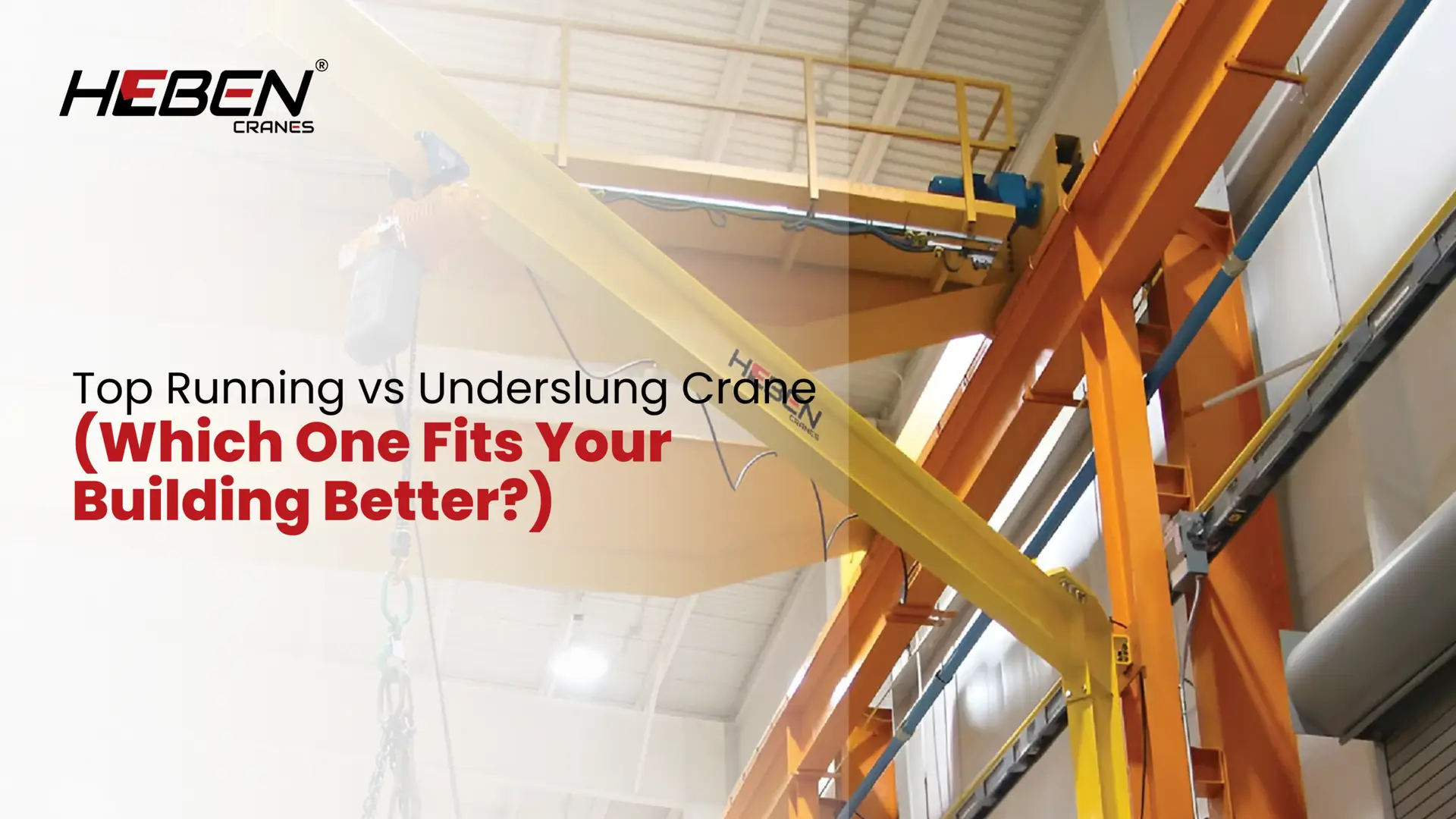
Two factories can order the same 5-tonne crane and need completely different machines — because one has columns built to carry a crane and the other has a roof built to keep rain out. Top running and underslung cranes solve the same handling problem from opposite directions: one rides on top of a runway you build, the other hangs from a structure you already have. Choosing wrongly means either paying for structural work you did not need or discovering, mid-project, that your roof cannot take the load. Here is how the two compare, and how your building decides for you.
The Difference Is Where the Crane Sits
Top running — riding on rails above the runway
A top running crane’s end carriages sit on rails fixed to the top of runway beams, which are carried on corbels off the building columns or on a dedicated freestanding structure. Loads travel down through the columns into the foundations. This is the standard arrangement for medium and heavy industrial cranes.
Underslung — hanging from the bottom flange
An underslung crane’s end trucks grip the bottom flange of the runway beam, so the whole crane hangs beneath it. The runway beam is usually suspended from the roof structure. Loads travel up into the roof trusses and then into the columns.
Quick Comparison Table
| Factor | Top Running | Underslung |
| Typical capacity | 1 t to 500 t+ | Up to 10 t, commonly under 5 t |
| Practical span | Up to 40 m+ | Up to about 20 m |
| Runway support | Columns and corbels | Roof structure or ceiling |
| Headroom required above rail | More | Less |
| Hook height achievable | Higher | Lower |
| Side approach | Moderate | Excellent |
| Floor space used | Columns only | None |
| Can cross into adjacent bays | No | Yes, with interlocks |
| Structural cost | Higher | Lower, if roof can take it |
| Best for | Heavy, continuous duty | Light duty, tight buildings |
What Your Building Says About the Choice
Buildings designed for a crane
If your shed was built with crane columns, corbels, and bracing already in place, top running is straightforward and almost always the better technical answer. The structure is waiting for it, and you get the full capacity and span range without compromise.
Buildings that were not
Warehouses, converted sheds, and light industrial units often have columns sized for roof and wind load only. Adding a top running crane to these means strengthening columns, adding corbels, and sometimes new foundations. Underslung avoids that, provided the roof trusses can carry the crane and load — which requires a structural check, not an assumption.
Freestanding runways as a third option
When neither the columns nor the roof can take the load, a freestanding runway on its own posts and foundations is the answer. It costs more and consumes floor space, but it makes a heavy top running crane possible in a building that could never otherwise carry one — and it can be relocated if you move plant.
Capacity and Span
Where underslung stops being practical
Underslung cranes work by gripping a flange. That flange has finite bending capacity, and the wheel loads concentrate on its edge. Above roughly 10 tonnes, or spans past about 20 m, the beam sections and roof reinforcement required stop making sense. Most underslung installations sit at 5 tonnes or below.
Why top running scales
Top running wheels bear on a rail centred over the beam web — the strongest possible load path. There is no flange bending, no eccentricity, and the runway beam can be as deep as the design requires. This is why every heavy crane in the world is top running.
Headroom and Hook Height
The clearance each design needs
A top running crane occupies the space above the rail, which means it needs vertical room in the roof zone. An underslung crane hangs below the beam, so it needs almost nothing above. In a building with very limited clearance between the truss and your machines, underslung can be the only design that fits.
The trade-off: because the underslung crane hangs lower, its hook also starts lower. You gain installation clearance and lose usable lift.
The side approach advantage of underslung
An underslung crane’s hook can travel much closer to the runway line — often within 200–300 mm, versus a metre or more on a top running crane. In a narrow bay, that recovered strip along both walls can be several percent of your floor area, and it is usually the area where you want your machines.
Coverage, Interlocks, and Multi-Bay Handling
The one thing underslung does that top running cannot
Because an underslung crane hangs from a track rather than sitting on a rail, that track can be switched, curved, and interlocked. With transfer sections, an underslung crane can run out of one bay and into the next, or onto a spur over a loading dock. A top running crane is confined to its runway, permanently.
For multi-bay assembly operations where one hoist should follow the work rather than hand it over, this capability is worth more than the capacity you give up.
Cost — Crane vs Building
Crane cost comparison
At the same capacity and span, the two cranes themselves cost broadly similar amounts. Underslung end trucks are simpler; top running end carriages are heavier. Neither difference dominates.
Structural cost comparison
This is where the decision is actually made. Top running needs corbels, runway beams, column strengthening, and often foundation work. Underslung needs roof reinforcement and hangers. In a building already designed for a crane, top running costs almost nothing extra. In one that was not, it can add a sum comparable to the crane itself.
Where the total flips
The pattern is consistent: below about 5 tonnes in an existing non-crane building, underslung usually wins on total installed cost. Above 10 tonnes, or in any purpose-built shed, top running wins on both cost and capability. Between those points, get both structural assessments before deciding — the answer varies by building, not by rule.
Maintenance, Wear, and Alignment
Flange wear on underslung systems
Underslung wheels run on the beam flange, and over time both wheel and flange wear. Misalignment accelerates it. Beam flanges are part of the building, so replacing a worn one is a bigger job than replacing a rail. Regular alignment checks are not optional on these systems.
Rail alignment on top running systems
Top running cranes need the two rails level, parallel, and at consistent gauge. Buildings settle, and a runway that drifts out of tolerance causes wheel skewing, flange wear, and motor overload. An annual runway survey catches this early and costs a fraction of what a wheel set does.
Decision Framework
Choose top running if…
- Capacity is above 10 tonnes
- Span is above 20 m
- Duty is heavy or continuous
- Your building has crane columns and corbels
- You need maximum hook height
Choose underslung if…
- Capacity is 5 tonnes or below
- Span is under 20 m
- Headroom above the load is very limited
- Your columns cannot take crane loads but the roof can
- You need to move loads between bays or onto spur tracks
- Side approach along the walls matters
Three Building Scenarios
A purpose-built 24 m fabrication bay with corbels, 15-tonne lifts. Top running. The building was designed for it and nothing else reaches that capacity at that span.
A rented 14 m warehouse with a portal frame roof, 3-tonne lifts, no crane columns. Underslung, subject to a roof check. Strengthening columns in a rented building rarely makes commercial sense.
A 20 m shed with weak columns, 12-tonne lifts, two shifts. Neither, as-is. This is a freestanding top running runway — the load is too high for underslung and the existing structure cannot carry a conventional installation.
FAQs
Can I convert an underslung crane to top running later? Not as a crane modification. The end carriages, runway, and supporting structure all change, which effectively means a new installation. Choose based on where your handling needs will be in five years.
Does underslung mean less safe? No. Within its design limits it is fully safe. Risk enters when an underslung crane is fitted to a roof structure that was never assessed for it — which is why the structural check is non-negotiable.
Which is faster to install? Underslung, generally, where the roof structure is adequate. There are no corbels to fabricate and no column work, so installations often complete in days rather than weeks.
Can both types run on the same runway? No. The runway geometry and load path differ completely. One runway, one crane type.
Do underslung cranes need more maintenance? Slightly more attention to alignment and flange condition, because the wheels run on a building element rather than a replaceable rail. The routine work itself is comparable.
Conclusion
The crane does not choose itself — your building does. Get a structural assessment of your columns and your roof before you compare quotes, because that report will point clearly at one answer and save you from paying for the other.
Heben Crane surveys your structure first and specifies the configuration your building can actually carry — top running, underslung, or freestanding — with wheel loads and reactions stated in writing for your structural consultant.
Get a Heben Crane structural survey and find out which configuration your building supports.