
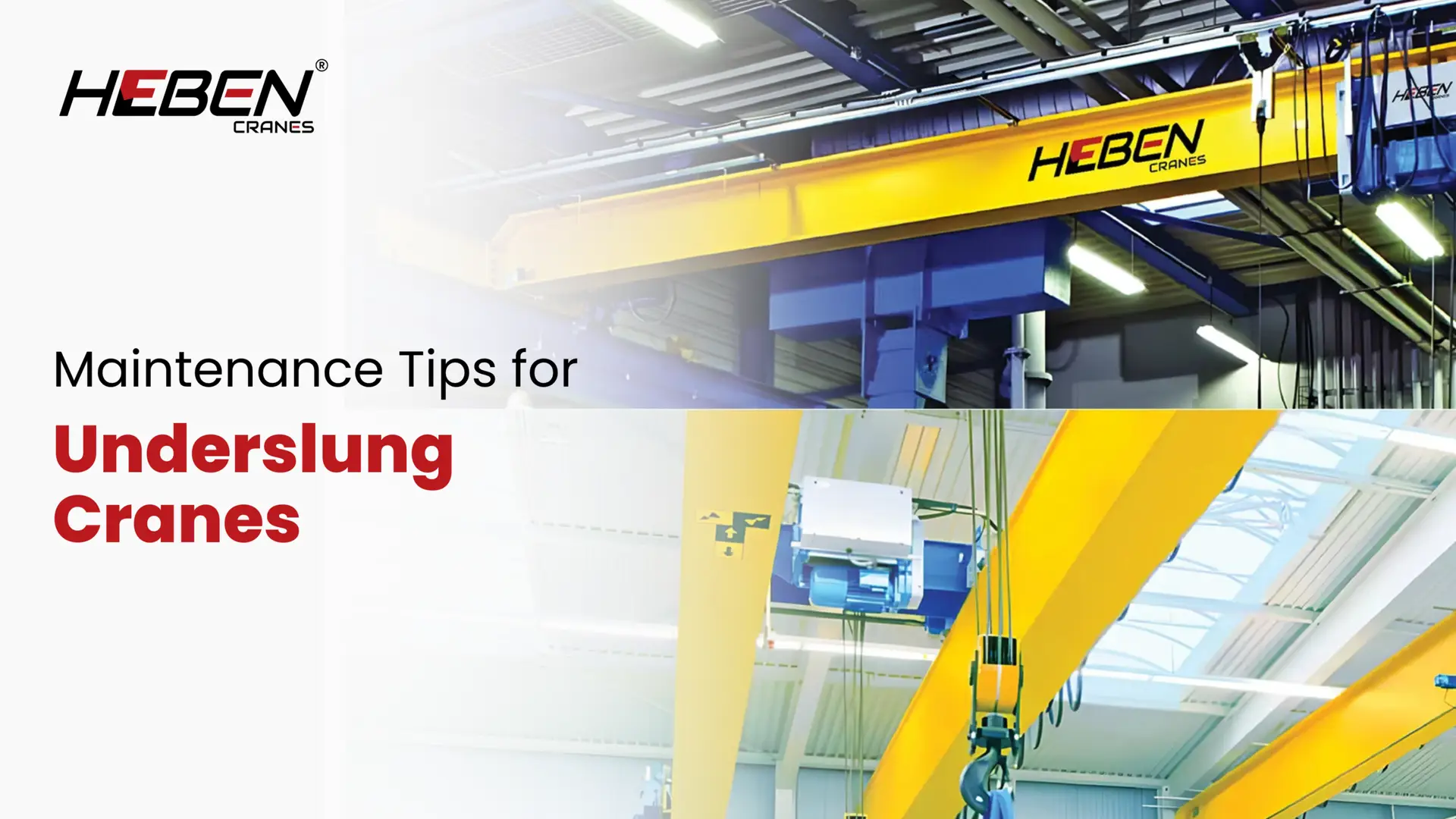
Why Underslung Cranes Wear Differently
Search for underslung crane maintenance and you will get a generic overhead crane checklist. That is a problem, because an underslung crane does not run on a rail. It hangs from the bottom flange of the runway beam, and that single difference changes where the wear happens, how fast it happens, and what you should be measuring. Flange edges wear. Splice joints step. Wheels ride on a surface that was never machined for them. This guide covers the daily, monthly, quarterly and annual routine for underslung cranes, the discard limits worth writing on a form, and the failures that keep repeating.
How an Underslung Crane Works
The load path
The bridge hangs below the runway beams. End trucks carry wheels that ride on the lower flange of those beams, so the load travels through the wheel tread into the flange edge, up the beam web, and into the building structure. Nothing sits on top of anything.
The three parts that take the punishment
- The lower flange of the runway beam. It is a structural surface being used as a running surface. Rolling tolerances on a beam are far looser than on a crane rail.
- The wheels. Smaller than top-running wheels, carrying the same load, contacting a narrower band of steel.
- The splice joints. Wherever two runway beams meet, the flange steps. Every wheel passes over that step thousands of times a year.
Daily Checks Before the First Lift
Give the operator a card with these on it. The whole routine takes five minutes.
- Pendant or radio: every button moves the right motion in the right direction and returns to off when released
- Warning horn and any flashing beacon
- Upper limit switch: raise the empty hook slowly and confirm it stops
- Hook: no cracks, bending, twisting; safety latch closes; hook rotates freely
- Wire rope or load chain: walk the full length and look for kinks, birdcaging, corrosion or twisted links
- Hook drift: release the hoist control with a load on and confirm it does not creep
- Oil leaks under the hoist and gearbox
- Bridge and trolley travel: no unusual noise, no snatching at joints
- Floor area under the runway clear
Anything on this list that fails takes the crane out of service until it is fixed. There is no partial pass.
Weekly and Monthly Maintenance
Wheels and end trucks
Look at the wheel tread where it meets the flange. Underslung wheels wear on one edge first, which shows up as a lip forming on the tread. Check for uneven wear side to side — if one wheel is wearing faster, the bridge is running skewed. Check the end truck mounting bolts for tightness while you are up there.
Runway beam and flange
Walk the runway with a torch. You are looking for shiny wear bands on the flange edge, any downward curl at the flange tip, cracks near the connection to the building steel, and loose or missing hanger bolts. Pay particular attention at splice joints — run a straightedge across the joint and check whether the two flanges are flush. A step of even a couple of millimetres punishes wheels and bearings.
Brakes
Check hoist brake holding with rated load, and check bridge and trolley brakes for stopping distance. Underslung cranes are usually lighter, so a dragging bridge brake shows up as heat and a burning smell before it shows up as poor stopping.
Electrical and controls
Inspect the festoon track and cable trolleys — a cable that catches at one point will chafe through within months. Check the collector shoes if the crane runs on a busbar, tighten panel terminals, and confirm all limit switches still trip at the right position.
Quarterly Maintenance
- Open the hoist gearbox and check oil level and condition; replace if it is dark, gritty or smells burnt
- Check the hoist drum grooves or chain guide for wear
- Measure and record wheel diameters on both sides
- Verify runway alignment and span with a tape and level; correct any drift before it forces wheel replacement
- Inspect all structural welds on the bridge and end trucks
- Test overload protection at the set point
- Check end stops and buffers on both the bridge and the trolley
Annual Inspection and Testing
Once a year, run a full documented inspection by a competent person. That includes structural inspection of the bridge, end trucks and runway; complete electrical testing including earthing and insulation resistance; brake torque verification; and a load test if the crane has been repaired, altered, or if your statutory regime requires one. File the report. It is the document an inspector or an insurer will ask for first.
Wear Limits Worth Measuring
Vague inspection is why cranes fail between inspections. These are numbers you can write on a form.
Wire rope
Under ASME B30.2, running ropes come out of service at 12 randomly distributed broken wires in one rope lay, or 4 broken wires in one strand in one lay. Rope also goes at a diameter reduction exceeding 5% of nominal, or when outer wire wear exceeds one-third of the original outer wire diameter. Measure diameter with a proper rope caliper across the crowns, not with a vernier across the valleys.
Load chain
Measure across a defined number of links, record it, and compare against the same measurement taken when the chain was new and against the manufacturer’s stated discard limit. Elongation is gradual and invisible without a baseline, which is exactly why the baseline measurement matters more than the inspection that follows it.
Hooks
Record throat opening at commissioning. Any increase against that baseline, or any twist out of plane, takes the hook out of service. Do not weld or heat a hook to repair it.
Wheels and flange
Set a wheel replacement threshold as a percentage of original diameter and stick to it. On the runway, replace or repair flange sections where the flange tip has curled or where local wear has cut into the edge.
Lubrication Schedule
- Weekly: hook bearing, rope or chain, festoon trolley wheels
- Monthly: wheel bearings, drum bearings, brake linkages
- Quarterly: gearbox oil check, coupling grease
- Annual: gearbox oil change, full regrease of all sealed points
Use the grade the manufacturer specifies. Mixing grease types is a common cause of bearing failure in cranes that were otherwise well maintained, because incompatible thickeners break down and the grease runs out of the bearing.
Common Failures and What Causes Them
- Wheel flange wear on one side only. The bridge is skewing. Cause is usually runway span drift, a seized wheel, or one drive motor running slower than the other.
- Bridge stalls at the same spot every time. A splice joint step, a sagging beam, or a low spot in the runway. Check the joint with a straightedge.
- Hoist trips on overload with a normal load. Brake dragging, gearbox failing, or the overload sensor drifting out of calibration.
- Festoon cable damage. Cable trolleys binding, or the track fixed out of line with the bridge travel.
- Loose runway hangers. Vibration from a stepped joint works fasteners loose over time. This is the failure that compounds, because a loose hanger makes the step worse, which loosens more fasteners.
Records, Compliance and Spares
Keep a single logbook per crane covering daily check sheets, monthly and quarterly reports, the annual inspection, all repairs, and every part replaced with its date. Two things follow from good records. First, you spot trends — a wheel wearing twice as fast as its partner tells you something before it fails. Second, you can order spares against actual consumption instead of guessing.
Stock the parts with the longest lead time and the highest failure rate: brake linings, collector shoes, festoon trolleys, limit switches, contactors, and one spare wheel set.
FAQs
How often does an underslung crane need professional inspection? Daily visual checks by the operator, monthly and quarterly checks by your maintenance team, and a full documented inspection by a competent person at least once a year. Heavier duty cycles compress all of these.
Can we run an underslung crane on existing building beams? Only after a structural check. The beam has to carry the crane and load in bending, and the lower flange has to take the wheel loads locally without curling. Older buildings often need flange reinforcement or a dedicated runway beam.
Why do underslung crane wheels wear faster than top-running wheels? Smaller diameter, narrower contact band, and a running surface that is a rolled structural flange rather than a machined rail. All three raise contact stress. Good runway alignment is the single biggest thing that extends wheel life.
What causes the crane to drift or run crooked? Runway span variation, unequal wheel diameters, a dragging brake on one side, or drive motors out of sync. Measure span at several points along the runway before assuming it is a drive problem.
Is it worth converting an underslung crane to top-running? Rarely as a retrofit. If capacity or duty has outgrown the crane, a new top-running installation with a proper runway is usually cheaper than modifying an existing underslung system and its building steel.
Conclusion and Next Step
Underslung cranes are simple machines with an unusual wear pattern. Keep the runway flange true, keep the wheels measured, and keep a baseline for every part that degrades slowly. Most underslung failures announce themselves months in advance to anyone who is recording numbers rather than just looking.
About Heben Cranes
Heben Cranes manufactures and services underslung cranes built for the runway they will actually run on — with structural checks, alignment to published tolerances, and a maintenance schedule handed over with the machine.
Book a maintenance audit for your existing underslung crane, or tell us your span and capacity for a new one. Reach us at hebencranes.com.