
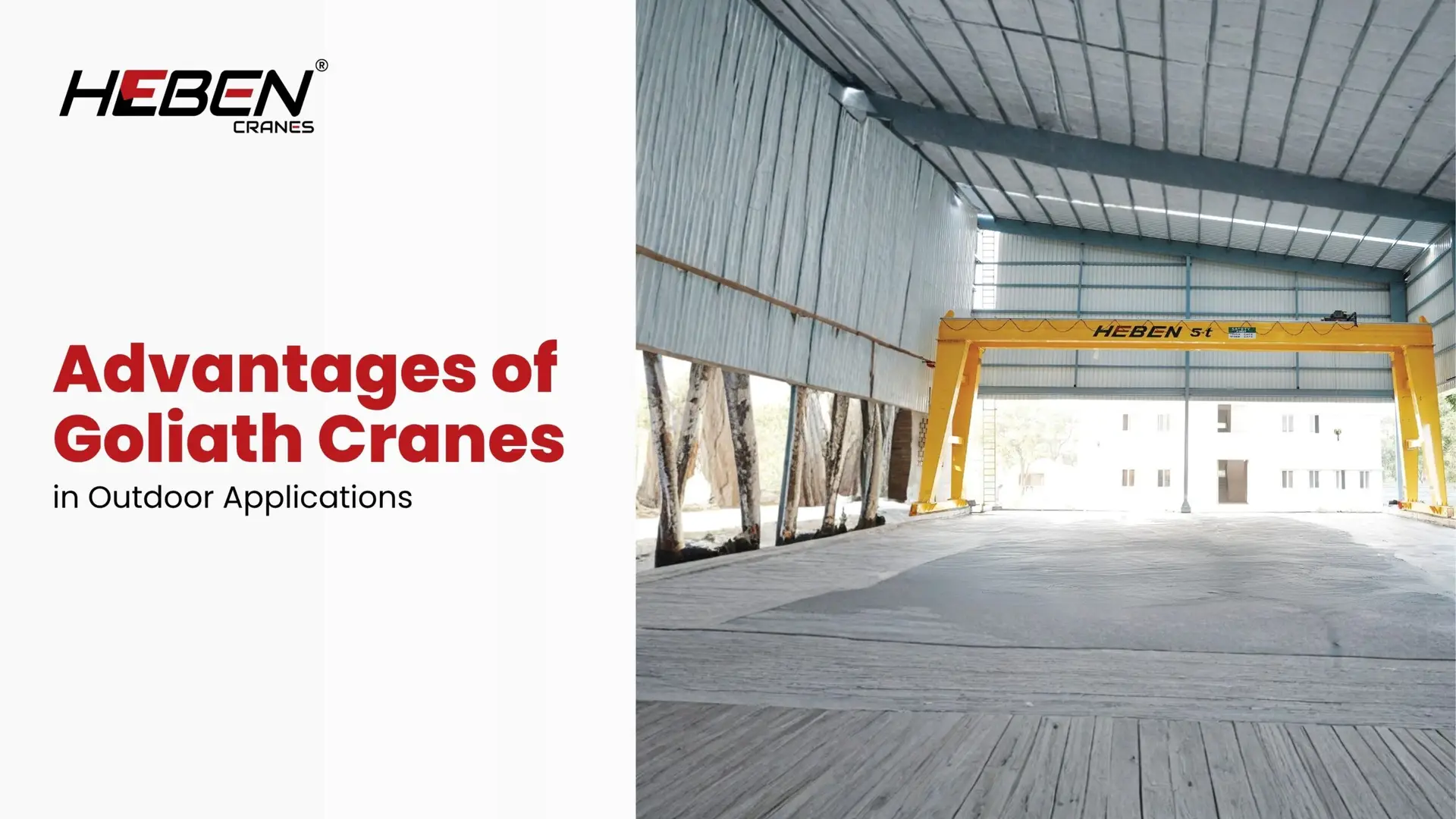
Most heavy lifting equipment is built around the assumption of a building. Overhead cranes need runway beams. Jib cranes need anchor columns. The moment your operation moves outdoors — a precast yard, a rail siding, an open fabrication yard — those assumptions collapse, and you’re left searching for a system that can perform without a roof over it.
Goliath cranes are engineered precisely for that environment. They carry their own support structure on ground-level rails, need no building to lean on, and handle loads that most outdoor alternatives simply cannot manage. This piece covers what makes them well-suited for outdoor use, the configurations available, the operational considerations that matter, and how to select the right one for your yard.
What Is a Goliath Crane?
A Goliath crane — also referred to as a gantry crane — is an overhead crane where the bridge girder is supported by two legs that travel on rails set into the ground. Unlike a conventional EOT crane, it does not depend on a building’s columns or roof trusses for support.
The load path goes directly from the hoist, through the bridge, down the legs, and into the ground rails. That self-contained structure is what makes outdoor deployment practical.
Types of Goliath Cranes
Single Girder Goliath
One bridge beam between two legs. Handles lighter loads, typically up to 20 tonnes. Compact, lower cost, faster to erect.
Double Girder Goliath
Two parallel bridge beams. Handles heavier loads — commonly 20 to 500+ tonnes. The trolley sits between or on top of the girders, giving greater hook height and lifting capacity.
Semi-Gantry
One leg on a ground rail, the other end supported by an elevated runway beam on a wall or column. Useful where space on one side is constrained.
Rail-Mounted vs. Rubber-Tyred
Rail-mounted cranes offer higher precision and stability for fixed yard layouts. Rubber-tyred variants can be repositioned without track infrastructure, making them practical on construction sites or temporary yards.
Core Advantages for Outdoor Use
No Building Required
This is the fundamental advantage. A Goliath crane brings its own structural support. You are not constrained by roof height, bay width, or column spacing. A wide-span Goliath can cover 30, 50, or even 80 metres of open yard — something no indoor overhead crane can replicate.
High Capacity and Wide Spans
Outdoor operations routinely deal with loads that would be impractical indoors: precast concrete beams, steel plate stacks, ship sections, transformer units. Double girder Goliath cranes are designed for exactly this. Spans of 30–80 metres and capacities beyond 200 tonnes are standard in port and fabrication yard applications.
Ground-Level Logistics Integration
Because the crane runs on ground rails, it fits naturally into a yard where trucks, flatbeds, and rail wagons are moving below. Loads can be lifted directly off a delivery vehicle and set down at a precise location — without re-handling. This cuts cycle time significantly in precast and steel yards.
Portability and Modular Assembly
Goliath cranes — particularly single girder variants — can be disassembled, transported, and reassembled at another site. For contractors running multiple project yards, this represents a real capital advantage: one crane, multiple deployments over its service life.
Weather-Rated Construction
Outdoor cranes take on exposure that indoor equipment never faces: rain, dust, salt air, UV, and wind loads. Well-built Goliath cranes are specified with weatherproof enclosures on motors and control panels, hot-dip galvanized or epoxy-coated structural members, and storm anchors that lock the crane to its rail in high-wind conditions. A crane not built to these standards will degrade rapidly in outdoor service.
Lower Civil Investment Than a Building
Here is an insight most plant managers only discover after the fact: installing a Goliath crane in an open yard typically costs significantly less in civil works than erecting a building to house an equivalent overhead crane. The foundation is essentially two parallel rail plinths. That’s it. No columns, no roof, no cladding.
Typical Outdoor Applications
Goliath cranes are deployed wherever outdoor lifting is a recurring, precision requirement:
- Precast concrete yards — beam, slab, and column handling at ground level
- Shipyards and dry docks — hull section assembly, block positioning
- Steel fabrication yards — plate and structural steel movement
- Railway maintenance yards — locomotive and bogie lifting
- Port and container terminals — bulk material and unit load transfer
- Construction project sites — temporary lifting infrastructure for large civil works
- Transformer and power equipment yards — precision placement of high-value, heavy units
Operational Considerations for Outdoor Deployment
Foundation and Rail Installation
The rails must sit on a prepared foundation — typically a reinforced concrete plinth. Ground conditions, load per wheel, and dynamic forces from travel and lifting all feed into the foundation design. This is not an area to cut corners on; rail misalignment under load creates wheel flange wear, structural fatigue, and safety risk.
Power Supply
Options include cable reeling systems (a motorised drum that pays out and retrieves the power cable as the crane travels), conductor bar systems set into the ground, and in remote applications, onboard diesel generator sets. The right choice depends on travel distance, frequency of movement, and site infrastructure.
Storm and Wind Protection
Outdoor cranes in exposed locations need storm anchors — mechanical clamps that lock the crane’s wheels to the rail when it is parked. Wind load calculations should factor into the structural design from the outset, particularly for wide-span double girder units.
Frequently Asked Questions
What is the typical span range for a Goliath crane?
Single girder variants typically run from 6 to 35 metres. Double girder configurations extend to 80 metres and beyond in port and shipyard applications, depending on structural design and load requirements.
Can a Goliath crane operate in coastal or high-humidity environments?
Yes, with the right specification. Coastal deployments require hot-dip galvanizing or marine-grade epoxy coatings on structural steel, IP55 or higher-rated enclosures on electrical components, and stainless fasteners in exposed locations. A crane specified for a dry inland yard will deteriorate quickly at the coast.
How is a Goliath crane controlled outdoors?
Pendant stations work for short-span cranes where the operator can maintain clear sightlines. For larger spans or high-traffic yards, radio remote controls allow the operator to move to the best viewing position. Cabin-mounted operators are used in heavy port and shipyard cranes where continuous operation is required.
What duty class is appropriate for an outdoor Goliath crane?
Duty class depends on lift frequency and load spectrum, not on whether the crane is indoors or outdoors. A precast yard crane running 30–50 lifts per day will need a higher duty class than a transformer handling crane that lifts twice a week. FEM or IS classifications should be applied based on actual operating data, not assumptions.
Conclusion
Goliath cranes solve a specific, real problem: how to move heavy loads with precision in an open outdoor yard, without a building, without re-handling, and without the civil cost of enclosing the operation. When specified correctly — with the right duty class, weather protection, and foundation design — they are among the most durable and cost-effective lifting systems available for outdoor industrial use.
At Heben Cranes, we design and supply Goliath cranes built for your yard dimensions, load profile, and operating environment — not from a catalogue. We carry out site assessments, handle foundation and rail layout design, and support you through commissioning and after-sales service. If your outdoor operation needs a lifting solution engineered to last, contact Heben Cranes and let’s get the specification right from the start.