
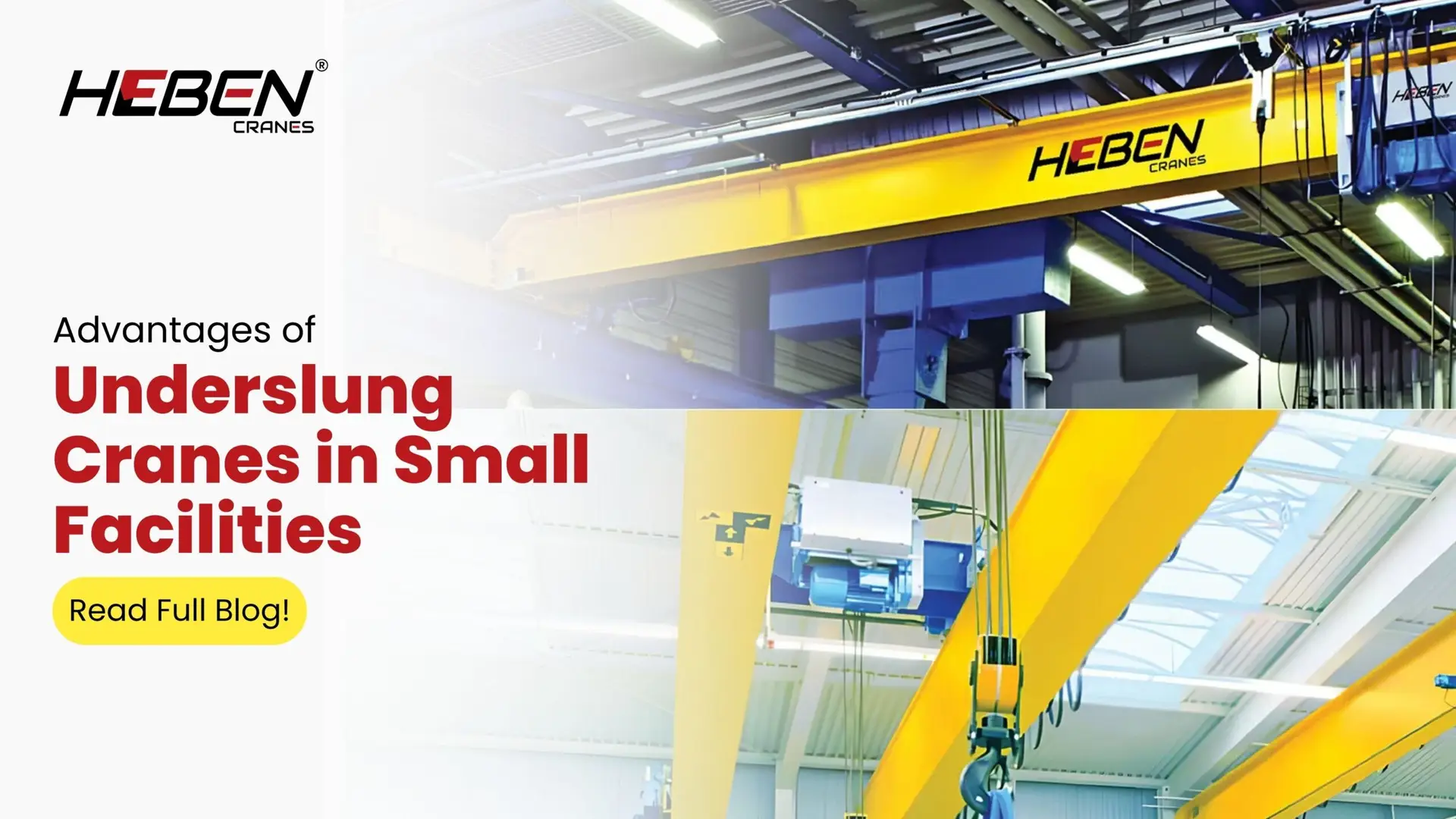
Most small factories don’t have a headroom problem — until they try to install a crane. A standard top-running overhead crane demands 16–20 feet of clearance for a 5-ton lift. Most compact workshops, older warehouses, and light manufacturing units simply don’t have that. The result: facilities either skip mechanized lifting entirely or spend heavily on structural modifications they can’t afford.
Underslung cranes solve this differently. They hang from the underside of existing roof beams — no floor columns, no runway rails on top, no major civil work. A 5-ton underslung unit runs effectively in as little as 8–10 feet of clearance. This piece breaks down exactly how that design advantage plays out across space, cost, installation, safety, and application — so you can make an informed decision before your next facility upgrade.
What Is an Underslung Crane
An underslung crane (also called an underhung crane) is an overhead travelling crane where the bridge and hoist assembly run along the bottom flange of the runway beam rather than on top of it. The runway itself is bolted to the underside of your existing roof structure.
This single design decision cascades into multiple practical gains for small facilities.
Space Optimization
Floor space in a compact facility is productive space. Every column you add to support a crane system is a column that blocks a machine, a pallet, or a workflow path.
Underslung cranes eliminate that trade-off entirely:
- No floor-mounted support columns required
- The full floor area remains open and reconfigurable
- Trolley approach dimensions are minimal, maximizing the usable span across the building’s full width
For facilities running lean operations or shift-based production, that unobstructed floor is a real operational asset.
Low Headroom Advantage
This is where underslung cranes have the clearest edge. A comparable top-running system needs nearly twice the vertical clearance.
- Top-running crane (5 ton): 16–20 ft clearance needed
- Underslung crane (5 ton): 8–10 ft clearance sufficient
Older industrial buildings — built before modern crane systems were standard — almost always fall into that 10–14 ft ceiling range. Underslung cranes were designed specifically for these conditions. The hook reaches higher relative to the crane’s installation point, which means you get more usable lift height out of less building height.
Cost Efficiency
Here’s the part most buyers don’t fully price in at the start: the real cost of a crane system includes structural modifications, not just the crane itself.
Underslung cranes reduce total project cost across multiple lines:
- No separate support structures or custom steel columns
- Existing roof tie beams take the load (with standard structural verification)
- Lower civil and fabrication scope
- Shorter project timeline, which reduces labor costs
Facilities that have installed underslung cranes in place of a planned top-running system have reported total installed cost reductions of 20–35% — primarily because the civil scope shrinks dramatically.
Installation Process
Installation follows a straightforward sequence:
- Site assessment — verify roof beam load capacity and facility dimensions
- Runway installation — runway beams are bolted to the underside of existing structural members
- Bridge and trolley assembly — crane components are assembled at floor level, then lifted into position
- Electrical wiring — pendant controls or radio remote wired in
- Load testing — test lifts at rated capacity and overload margin
- Operator handover — controls walkthrough and safety briefing
The full installation in a small facility typically takes 2–4 days. No concrete pouring, no extended shutdowns.
Safety Features
Underslung cranes carry a full suite of industrial safety systems as standard:
- Overload protection cutoffs
- Emergency stop buttons on pendant and remote
- End-of-travel limit switches (horizontal and vertical)
- Anti-collision sensors on multi-crane runway setups
- Enclosed conductor bars to eliminate exposed live parts
The controls are designed for operators without crane-specific training to reach working proficiency within a shift.
Applications and Industries
Underslung cranes handle 0.25–10 tons and fit a wide range of industries:
- Automotive workshops — engine blocks, gearboxes, axle assemblies
- Textile units — fabric rolls, yarn cones, loom components
- Food and beverage — palletized goods, storage containers, processing equipment
- Printing facilities — paper rolls, printing plate handling
- General manufacturing — assembly line support, jig and fixture movement
- Warehousing — loading bay operations, inventory movement
Any operation involving repetitive, precise horizontal movement of moderate loads is a strong candidate.
FAQ
Can an underslung crane be installed in a building with no existing overhead structure?
No. The crane hangs from existing roof members. If your building lacks structural roof beams capable of supporting the crane and its rated load, a freestanding gantry or jib system would be more appropriate.
What is the maximum capacity available?
Standard underslung cranes go up to 10 tons for single girder configurations. Double girder versions extend that range further, though most small facility applications fall within the 1–5 ton range.
How long does an underslung crane last?
With standard preventive maintenance, service life runs 15–25 years. Modular construction means individual components — hoists, wheels, electrical panels — can be replaced without replacing the full crane.
Is radio remote control available?
Yes. Pendant (wired) and radio remote controls are both standard options. Radio remote is particularly useful in facilities where the operator needs to move alongside the load.
Conclusion
Underslung cranes give small facilities a precise, structurally light, and cost-efficient lifting solution without demanding building modifications. The headroom advantage alone makes them the default choice when ceiling height is limited. Add no-column floor freedom, fast installation, and a 15–25 year lifespan, and the case is straightforward.
If you’re evaluating a crane system for a compact facility, start here.
Heben Cranes engineers and supplies underslung crane systems built for small and medium facilities across manufacturing, warehousing, and assembly applications. Every system is sized, sourced, and supported to fit your building — not the other way around.
Get in touch with the Heben Cranes team to discuss your facility’s requirements and receive a tailored recommendation.