Operations that need heavy lifting in open yards, shipyards, or large construction sites face a core problem: conventional EOT cranes need a building with runway beams. No building means no crane. Some facilities add roof structures just to mount a crane — spending significantly more than the crane itself costs. A Goliath crane eliminates this dependency entirely. It stands on its own legs, runs on ground-level rails, and lifts loads that no building-mounted system can reach. This guide covers the structure, performance specifications, applications, and selection factors for Goliath cranes — so you can determine whether this configuration fits your site.
What a Goliath Crane Is
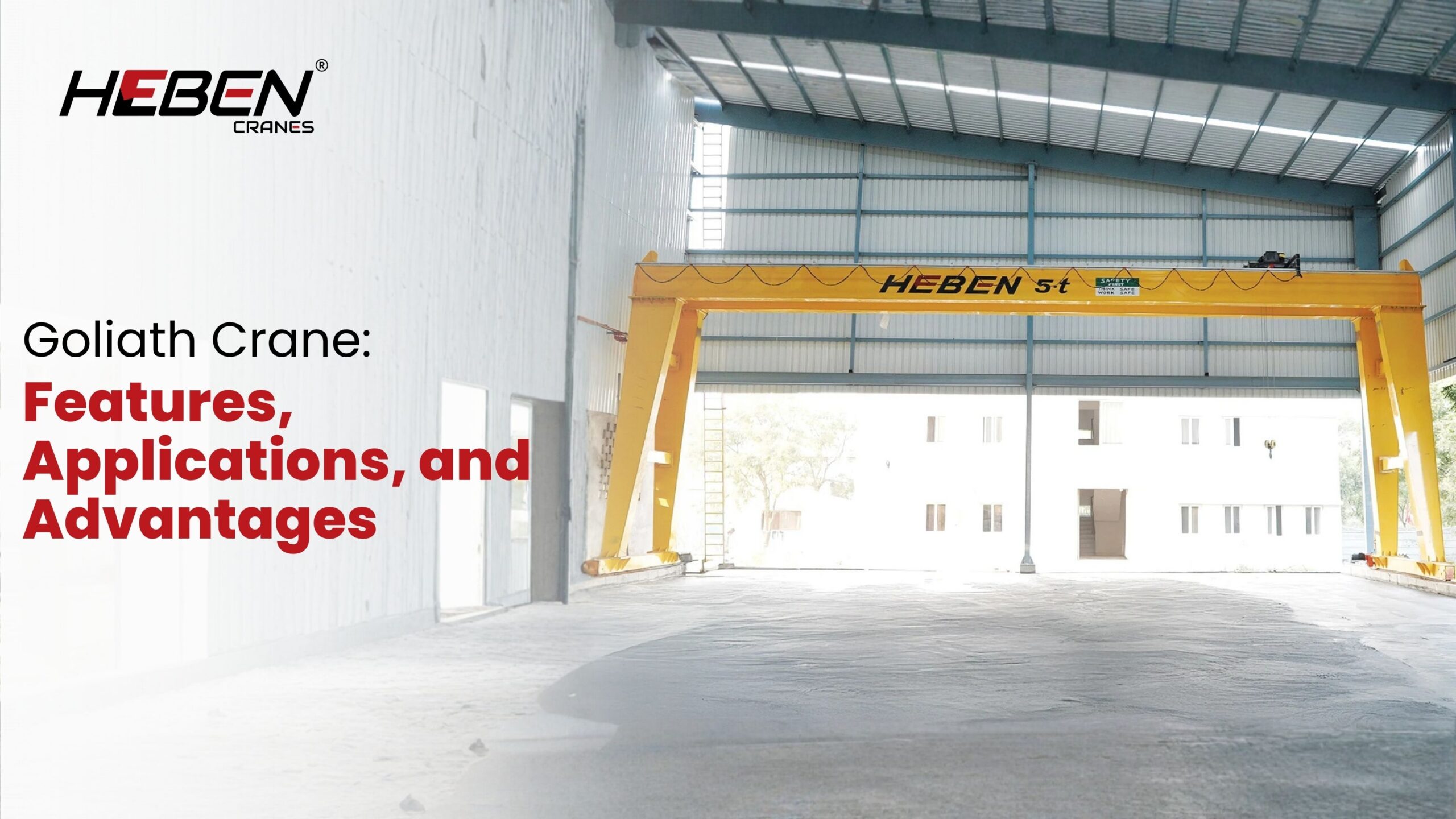
A Goliath crane is a large gantry crane with structural legs that run on ground-level rails. The bridge girder spans between the two legs. A hoist and trolley travel along the bridge, providing coverage across the full span and rail length.
The core distinction from an EOT crane is structural independence. Goliath cranes carry their own loads through the legs to the ground. They don’t transfer forces into a building frame. This makes them the only practical lifting solution for open yards, outdoor sites, and facilities where building construction is not viable.
Capacities start at 5 tonnes and extend beyond 500 tonnes. Spans run from 10 meters to over 50 meters depending on the application.
Structural Features and Configurations
Single Girder vs Double Girder
Single girder Goliath cranes use one bridge beam supported by two legs. They handle 5 to 50 tonnes at spans up to 30 meters. Lower structural weight, simpler erection, and lower cost make them suitable for steel stockyards, precast segment yards, and light outdoor handling.
Double girder Goliath cranes use two parallel bridge beams with a crab mechanism on top. They handle 50 to 500+ tonnes with spans reaching 50 meters. The twin-beam design gives maximum hook height, higher structural rigidity, and platforms for maintenance access.
Leg and Rail System
Leg designs are either A-frame or box section:
- A-frame legs distribute loads across a wider base; suited for standard and heavy duty
- Box section legs suit ultra-heavy duty and process-critical applications with greater rigidity
Ground rails are embedded in concrete foundations. Rail gauge, levelness, and expansion joint spacing must be engineered for span, load, and temperature range. Poor rail alignment is the primary cause of wheel wear, bearing overload, and uneven leg loading on Goliath cranes.
Lifting Capacities and Performance Specs
Goliath cranes are specified across four motion parameters:
- Hoist speed: typically 1–8 m/min, lower for heavier lifts
- Cross-travel speed: 5–20 m/min for trolley movement
- Long-travel speed: 10–40 m/min for crane movement along rails
- Duty class: A3 (light outdoor use) to A7 (continuous heavy process duty)
Most buyers under-specify duty class on outdoor Goliath cranes. A crane in a steel yard running three shifts needs A6 or A7. An A4 crane in the same application fails within 18–24 months as gearbox and brake components wear through their rated cycles.
Advantages Over EOT Cranes
The most counterintuitive advantage of a Goliath crane is total installed cost in open-area applications. EOT cranes appear cheaper until you add building structure costs. An EOT crane for an outdoor yard requires a dedicated steel building for the runway. A Goliath crane needs concrete pads and rails.
For a 15-tonne outdoor application across 50 meters:
- Goliath crane total 5-year cost: lower installation cost with simpler maintenance
- EOT crane equivalent requires building runway — 2–3x higher installation cost
- Goliath cranes allow relocation; EOT runway structures are permanent
Additional structural advantages:
- No building height restriction on hook height
- Full outdoor weather resistance with corrosion-resistant coatings and sealed components
- Tandem operation possible with two cranes on the same rails for wide or heavy loads
Safety Features and Compliance
Every Goliath crane installation requires these safety components as a minimum:
- Overload protection via load limiter before structural damage occurs
- Hoist and travel limit switches to prevent rope overrun and end-of-rail collision
- Dual brakes on all motions — hoist, cross-travel, long-travel
- Anti-collision systems for multi-crane yards operating on shared rail systems
- Rail sweeps and derailment guards on all end trucks
- Wind load design for outdoor cranes: structural calculations include wind forces at the installation site
IS, FEM, and CMAA standards govern design, load testing, and operational compliance. Statutory load testing at 125% rated capacity is mandatory before commissioning.
Typical Applications
Goliath cranes operate across sectors where building-mounted systems are impractical:
- Shipyards: ship section assembly, block erection, hull component handling
- Bridge construction: precast beam handling, segment placement, formwork moving
- Steel stockyards: slab, billet, coil stacking and unstacking in outdoor storage
- Heavy fabrication: large structural assemblies, pressure vessels, transformer bodies
- Precast yards: column, beam, slab handling for construction material producers
A common pattern: facilities that start with a mobile crane for outdoor yard work switch to a Goliath crane once throughput demands exceed what a mobile crane can cycle through efficiently.
Installation and Site Preparation
Installation sequence follows five stages:
- Foundation works: concrete pads, rail anchors, expansion joints, drainage
- Rail laying: rail alignment within ±3 mm gauge tolerance over full length
- Leg and girder erection: mobile cranes lift leg assemblies; girder sections splice and bolt at height
- Electrical installation: busbar or cable reel for long-travel power, panel commissioning
- Testing and commissioning: no-load trials, load testing at 125%, limit switch calibration, brake verification
Site preparation is the most time-consuming phase. Foundation concrete must cure for a minimum of 28 days before rail installation. Rushing this stage causes rail settlement, track gauge deviation, and crane misalignment within six months of commissioning.
FAQs
Can a Goliath crane be relocated to a different site?
Yes. Goliath cranes are designed for disassembly and relocation. Legs, girder sections, and rails can be unbolted, transported, and re-erected at a new site. New foundation works are required at the new location. This relocatability is a key advantage over building-mounted EOT systems, which are permanent once installed.
What is the difference between a Goliath crane and a semi-Goliath crane?
A full Goliath crane has two ground-level legs running on floor rails on both sides. A semi-Goliath crane has one ground-level leg and one end truck that runs on an elevated runway beam fixed to a building wall. Semi-Goliath cranes suit facilities with one solid wall and an open yard on the other side.
How long does Goliath crane installation take?
Foundation and civil works take 4–8 weeks depending on size and soil conditions. Crane erection and commissioning add 2–4 weeks. Total project timeline from order to commissioning runs 16–24 weeks for standard units. Custom heavy-duty cranes with longer spans require additional engineering time.
What corrosion protection is needed for outdoor Goliath cranes?
Standard practice for Indian outdoor installations includes epoxy primer, intermediate coat, and polyurethane topcoat with minimum 250 micron DFT. Coastal and high-humidity sites need marine-grade coatings and stainless-steel fasteners in critical joints. Electrical enclosures must be IP65 rated as a minimum.
Conclusion
If your operation needs heavy lifting outside a building — in a yard, on a construction site, in a shipyard — a Goliath crane is the correct structural solution. It is not a compromise. It is the configuration designed for exactly that environment.
Contact Heben Cranes today for a Goliath crane specification matched to your site dimensions, capacity requirements, and duty cycle.
Heben Cranes designs and supplies single and double girder Goliath cranes from 5 to 250 tonnes with custom spans, engineered foundations, and full outdoor execution. Every project includes site-specific structural calculations, rail alignment design, load testing, and long-term service support. Reach out to our engineering team for a technical consultation and quotation for your yard or outdoor lifting requirements.