
Introduction
Most buyers use “gantry crane” and “Goliath crane” as if they mean the same thing. They don’t, and the confusion leads to misspecified equipment, undersized capacity, or structural overkill for the actual job. Every Goliath crane is a gantry crane, but not every gantry crane is a Goliath. The distinction lies in scale, duty, and deployment context. This guide defines both types clearly, covers structural design, load ranges, typical applications, and the selection criteria that determine which configuration fits your lifting requirement—whether you’re outfitting a fabrication shop or a shipyard.
What is a Gantry Crane?
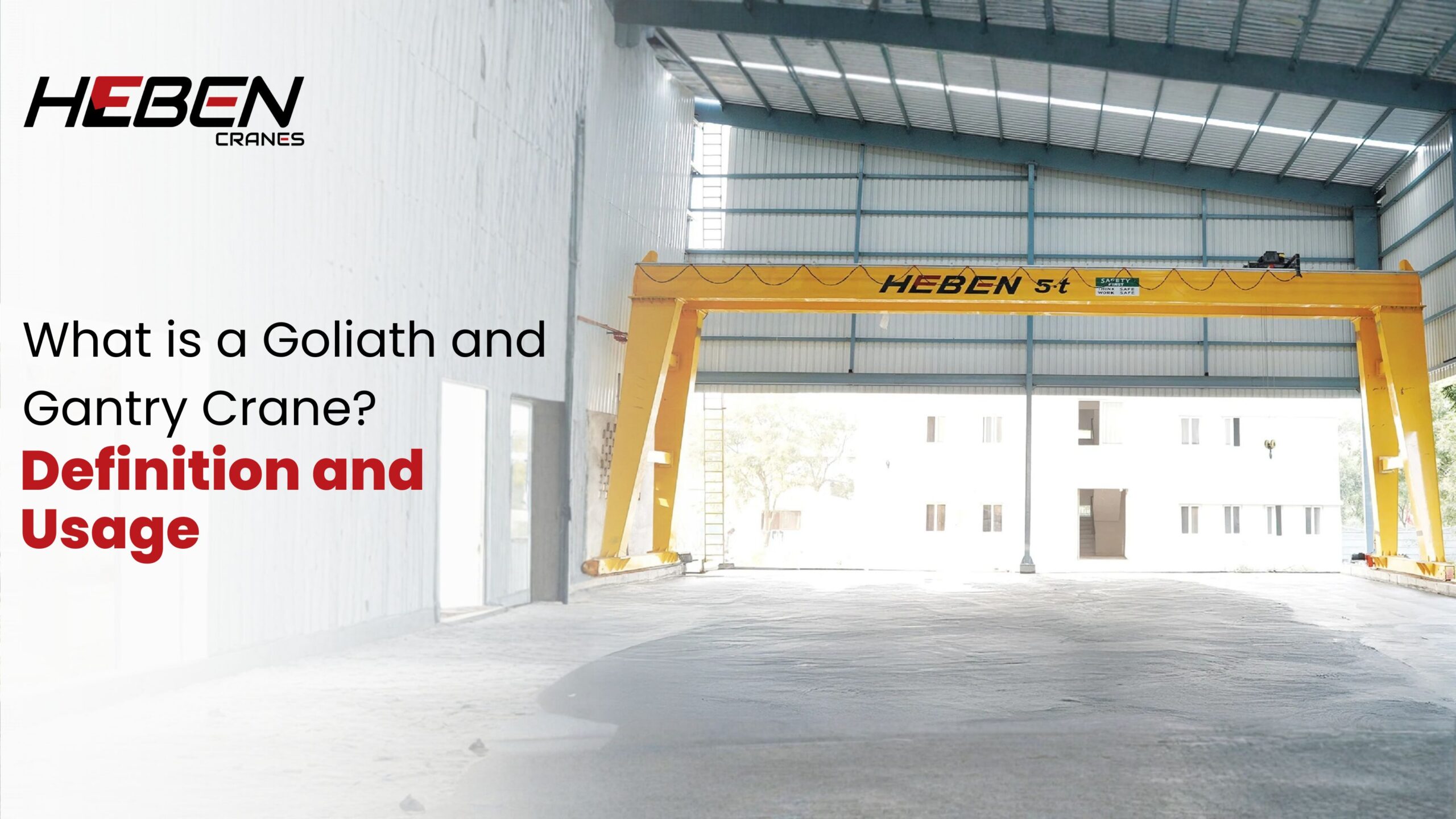
A gantry crane is an overhead lifting system that carries its own support structure. Two freestanding legs support a horizontal bridge beam. The hoist and trolley travel along the beam, and the entire assembly moves on ground-level rails or wheels.
The defining feature is structural independence. Gantry cranes don’t attach to building roofs or walls. They operate where building-mounted overhead cranes cannot—outdoors, in open yards, or inside facilities without adequate roof structure.
Capacities range widely. Small portable gantries handle 0.5-5 tons in workshops and maintenance areas. Large industrial models lift 50-100 tons across spans of 10-35 meters.
What is a Goliath Crane?
A Goliath crane is a heavy-duty, large-scale gantry crane designed for the most demanding outdoor applications. The term describes scale and capability, not a fundamentally different mechanism.
Goliath cranes run on fixed ground-level rails. Their legs are robust box-section or truss structures, engineered for spans reaching 50+ meters and capacities extending to 1,000 tons or more.
The scale creates operational realities that standard gantry cranes don’t face. Wind loading, foundation depth, rail gauge, and electrical infrastructure all require specialist engineering at Goliath scale.
Here is the counterintuitive reality: Goliath cranes often cost less per ton of capacity than smaller gantry cranes because of economies of scale in structure and drive systems.
Key Design Features
Both crane types share core structural logic but differ in execution:
Leg configurations:
- A-frame legs: standard for balanced, symmetrical loads
- Box-section legs: heavy-duty, used on Goliath designs for rigidity
- Adjustable-height legs: portable gantry variants for uneven terrain
Beam types:
- Single girder: standard for gantry cranes up to 20 tons
- Double girder: required for Goliath cranes and heavy-duty gantry above 20 tons
- Truss girder: lightweight option for lower capacities and longer spans
Travel systems:
- Rail-mounted: fixed path, high capacity, precise positioning
- Rubber-tired: mobile, suited to yards and sites without fixed rails
- Portal design: fixed foundations for permanent heavy installations
Types and Classifications
Full Gantry Cranes
Both legs travel on parallel rails or wheels. Complete structural independence from any building.
Semi-Gantry Cranes
One side runs on a building runway beam. The other travels on a ground rail. Suits facilities with partial overhead support.
Portable Gantry Cranes
Wheeled or caster-mounted units for 0.5-5 ton applications. Repositionable without infrastructure. Suited to maintenance bays, fabrication shops, and temporary sites.
Rail-Mounted Goliath Cranes
Permanent ground-rail installations handling 50 tons upward. Standard in shipyards, steel mills, and container terminals.
Technical Specifications
Capacity ranges differ substantially between types:
- Portable gantry: 0.5-5 tons
- Industrial gantry: 5-100 tons
- Goliath cranes: 50-1,000+ tons
Span lengths follow the same pattern. Portable units span 3-8 meters. Industrial gantry systems cover 10-35 meters. Goliath cranes reach 50+ meters in shipyard and port configurations.
Lifting heights range from 3 meters on workshop portables to 30+ meters on heavy Goliath installations. Travel speeds typically run 5-30 meters per minute for gantry cranes, with Goliath cranes operating at controlled lower speeds due to mass.
Applications and Industry Usage
Gantry cranes serve a broad application range:
- Construction sites: steel erection, precast concrete placement
- Warehouses: loading dock operations, storage retrieval
- Manufacturing: equipment maintenance, component assembly
- Power plants: turbine installation and maintenance
Goliath cranes concentrate in high-capacity permanent installations:
- Shipyards: hull assembly, outfitting, launching operations
- Steel mills: slab handling, coil movement across large yards
- Container terminals: inter-yard transfer and stack operations
- Rail yards: heavy rolling stock maintenance and assembly
The 50-ton threshold is a practical dividing line. Below it, standard gantry design handles most requirements. Above it, Goliath engineering becomes structurally and economically rational.
Advantages and Limitations
Advantages of both types:
- No building structure required
- Wide coverage area without fixed overhead infrastructure
- Scalable from light workshop use to heavy industrial deployment
- Suitable for indoor and outdoor environments
Limitations to plan for:
- Ground preparation for rails adds cost and time
- Wind loading in outdoor installations requires anchoring systems
- Longer spans reduce effective capacity due to structural deflection
- Goliath cranes require specialist foundation engineering and electrical infrastructure
Selection Guide
Four factors determine the right choice:
- Load requirement: Under 20 tons—standard gantry. Above 50 tons—Goliath design. Between 20-50 tons, span and duty cycle decide.
- Mobility need: Frequent repositioning favors portable or wheeled gantry. Fixed heavy-duty operations favor rail-mounted Goliath.
- Span coverage: Under 25 meters, standard gantry handles it. Beyond 30 meters, Goliath structural engineering becomes necessary.
- Environment: Indoor workshops suit portable and semi-gantry designs. Outdoor yards and ports suit rail-mounted Goliath configurations.
FAQs
Are all Goliath cranes gantry cranes?
Yes. Goliath is a classification of gantry crane, not a separate crane family. The term describes high-capacity, large-span, heavy-duty gantry systems used in demanding outdoor and industrial environments.
What foundation does a Goliath crane need?
Rail-mounted Goliath cranes require reinforced concrete rail beams embedded to depths of 1-3 meters depending on soil conditions and load. Foundation engineering is a significant portion of total project cost.
Can gantry cranes operate in wind?
Operating limits typically run 20-28 km/h. Non-operating storm anchoring systems resist winds up to 150 km/h. Exposed outdoor installations need wind monitoring systems and automatic rail clamps.
What’s the typical service life for these cranes?
Standard industrial gantry cranes deliver 15-20 years with proper maintenance. Goliath cranes, built to heavier duty standards with more robust components, commonly reach 25-35 year service lives.
Can I convert a standard gantry to a Goliath configuration later?
Not practically. The leg structures, rail systems, foundations, and drive systems differ substantially. Capacity upgrades beyond the original design envelope require full replacement.
Conclusion
Gantry cranes provide freestanding overhead lifting from 0.5 to 100 tons across indoor and outdoor applications. Goliath cranes are the heavy-duty subset of that family—rail-mounted, large-span systems built for 50-1,000+ ton capacities in shipyards, steel mills, and port operations. The choice depends on load, span, mobility requirements, and site conditions.
Contact us to specify a gantry or Goliath crane configuration matched to your capacity, span, and site requirements.
Heben Cranes manufactures gantry and Goliath crane systems from 0.5 tons to heavy industrial capacities, covering portable workshop units, full rail-mounted gantry designs, semi-gantry configurations, and large-span Goliath systems for demanding outdoor applications. Our engineering team conducts complete site assessments covering ground conditions, rail foundation design, span requirements, wind loading analysis, and electrical infrastructure planning. We manage the full project cycle from structural engineering through fabrication, installation, commissioning, and operator training. Every system comes with complete documentation, safety certifications, and maintenance planning for its full service life. Visit hebencranes.com to discuss your gantry or Goliath crane requirements and receive an engineered solution matched to your load, span, and site conditions.